

Key Takeaway: The DRV8825 and TMC2209 are the two most popular stepper motor drivers for CNC and 3D printer applications. While the DRV8825 offers higher voltage tolerance and lower cost, the TMC2209 delivers silent operation, higher microstepping, and advanced features like StallGuard and CoolStep that justify the premium price.
Table of Contents
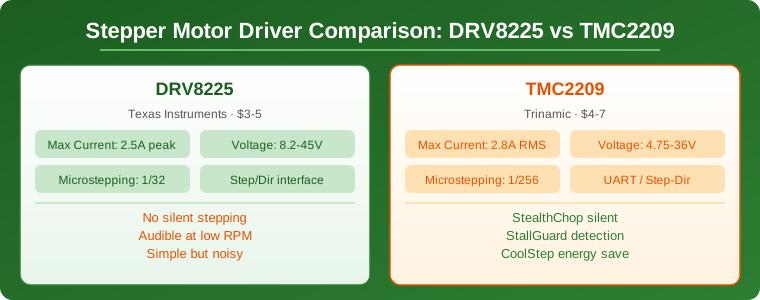
1. DRV8825 — The Budget Powerhouse
The DRV8825 from Texas Instruments is a popular stepper motor driver that has been the go-to choice for budget CNC and 3D printer builds for years. It drives bipolar stepper motors with up to 2.5 A peak current per coil (1.75 A RMS) and operates from 8.2 V to 45 V. The driver uses a simple step/direction interface — a pulse on the STEP pin advances the motor by one microstep, and the DIR pin determines rotation direction.
The DRV8825 supports microstepping up to 1/32 step, which means it can divide each full motor step (typically 1.8°) into 32 microsteps, giving an effective resolution of 0.056° per step. Microstepping is configured through two mode pins (M0, M1, M2) that select between full-step, 1/2, 1/4, 1/8, 1/16, and 1/32 stepping modes.
The internal architecture uses a fixed-off-time PWM current control scheme that regulates motor current by chopping the drive voltage. While effective, this produces audible noise — particularly at low RPM where the PWM switching frequency falls into the audible range (20 Hz to 20 kHz). The DRV8825 also lacks any form of silent stepping technology, so motor whine is expected.
Key specifications: 2.5 A maximum current, 8.2-45 V operating voltage, RDS(on) of 0.25 Ω (low-side) and 0.35 Ω (high-side), built-in over-temperature and over-current protection, and a compact 25-pin HTSSOP package that fits the common StepStick footprint.
2. TMC2209 — The Silent Performer
The TMC2209 from Trinamic (now part of Analog Devices) represents the current generation of stepper motor driver technology. It delivers up to 2.8 A RMS current per coil and operates from 4.75 V to 36 V. The defining feature is StealthChop2, Trinamic’s proprietary noise-elimination technology that makes stepper motors run silently even at low speeds.
StealthChop2 uses a spread-spectrum PWM technique that distributes switching energy across a wider frequency band. Instead of switching at a fixed frequency (which produces audible tonality), the TMC2209 varies the PWM frequency dynamically, spreading the acoustic energy so it falls below the threshold of human hearing. The result is genuinely silent motor operation at all but the highest speeds.
The TMC2209 supports 1/256 microstepping — eight times finer than the DRV8825’s maximum of 1/32. This ultra-fine microstepping is interpolated internally from a 1/16 step input, meaning you can send standard 1/16 step pulses and the driver seamlessly smooths the motion to 256-microstep resolution without changing your controller setup.
Beyond silence, the TMC2209 includes StallGuard2 — a sensorless stall detection feature that measures the motor’s back-EMF to detect mechanical stall or load changes without requiring an endstop switch. This is invaluable for homing and for detecting tool breakage in CNC applications. CoolStep automatically reduces motor current by up to 75% when the motor is under light load, reducing power consumption and heat generation.
The TMC2209 communicates via either traditional step/direction or a single-wire UART interface for configuration. Through UART, you can adjust motor current, microstep mode, StealthChop settings, and read back StallGuard values in real-time.
3. Head-to-Head: DRV8825 vs TMC2209
| Feature | DRV8825 | TMC2209 |
|---|---|---|
| Max Current | 2.5 A peak | 2.8 A RMS |
| Voltage Range | 8.2V – 45V | 4.75V – 36V |
| Max Microstepping | 1/32 | 1/256 |
| Silent Operation | No | Yes (StealthChop2) |
| Stall Detection | No | Yes (StallGuard2) |
| Current Reduction | No | Yes (CoolStep) |
| Interface | Step/Dir only | Step/Dir + UART |
| Cost (per unit) | $3 – $5 | $4 – $7 |
| Footprint | StepStick (same) | StepStick (same) |
| Heat Generation | High (requires heatsink) | Low (CoolStep helps) |
4. Microstepping: Why It Matters
Microstepping divides each full motor step into smaller increments, producing smoother motion and reducing vibration at low speeds. A typical NEMA 17 stepper motor has 200 full steps per revolution (1.8° per step). At 1/32 microstepping, this becomes 6,400 steps per revolution. At 1/256 microstepping, it becomes 51,200 steps per revolution.
Higher microstepping delivers smoother motion at slow speeds, which is critical for CNC machines during contouring operations and for 3D printers during fine detail printing. The trade-off is that at very high microstepping levels, positional accuracy no longer improves because motor friction and detent torque prevent the rotor from settling at each microstep position.
For most CNC applications, 1/16 or 1/32 microstepping is adequate. The TMC2209’s 1/256 stepping is most beneficial for applications requiring exceptionally smooth motion — like pick-and-place machines, precision stages, and medical devices.
5. Which Driver Should You Choose?
Choose DRV8825 if: You need 24-36V motor operation (the TMC2209 maxes at 36V, DRV8825 goes to 45V), you are on a tight budget and building multiple drivers, noise is not a concern (you are running in a garage or industrial environment), you only need basic step/direction control, or your CNC machine uses NEMA 23 or larger motors requiring higher voltage.
The DRV8825 remains the best value for money in budget builds. It powers thousands of OpenPnP pick-and-place machines, 3018 CNC routers, and RepRap 3D printers. The simple configuration (set microstep pins with jumpers, adjust current with a potentiometer) means no software setup is required.
Choose TMC2209 if: You need silent operation (home workshop, shared space), you want sensorless homing via StallGuard2, you need low heat generation for enclosed builds, you want the smoothest possible motion for fine detail work, or you are building a machine where every micron of precision matters.
The TMC2209 is the standard choice for high-end 3D printers (Prusa, Voron, RatRig) and increasingly for precision CNC machines. The UART configuration adds complexity but gives you real-time control over driver parameters that the DRV8825 cannot match.
Frequently Asked Questions
Are DRV8825 and TMC2209 pin-compatible?
Yes. Both use the standard StepStick footprint (A4988-compatible pinout), so you can swap them without rewiring. The TMC2209 has an additional TX pin for UART communication that the DRV8825 lacks, but this is optional for basic operation.
Does higher microstepping reduce torque?
Yes, at very high microstep resolutions, the torque per microstep drops because only a fraction of the coil pairs are energized. The TMC2209’s StealthChop2 technology compensates for this by optimizing the current waveform, but you will still see reduced holding torque at 1/256 compared to full step mode.
Do I need heatsinks for these drivers?
The DRV8825 absolutely requires a heatsink and active cooling (fan) when running above 1 A. The TMC2209 runs significantly cooler thanks to its lower RDS(on) and CoolStep current reduction, but a heatsink is still recommended for continuous operation above 1.5 A.
Can I use TMC2209 with 24V systems?
Yes. The TMC2209 operates from 4.75V to 36V, making it compatible with 12V, 24V, and most 36V power supplies. It is not recommended for 48V systems — use the TMC5160 or TMC2130 for higher voltage applications.
Which driver is better for a 3D printer?
The TMC2209 is the clear winner for 3D printers because of StealthChop2’s silent operation. The audible noise from DRV8825 drivers is a common complaint in quiet home environments. Most modern 3D printer designs (including Prusa MK4, Voron 2.4, and Bambu Lab machines) use TMC drivers.
Related Reading
- CNC Control Software Comparison: GRBL vs Mach3 vs LinuxCNC
- CNC Spindle vs Router: Choosing the Right Cutting Head
- Fusion 360 CAM Guide
Sources
- Texas Instruments — DRV8825 Datasheet
- Trinamic — TMC2209 Datasheet and Application Notes
- Klipper Firmware — TMC Driver Configuration
- RepRap Wiki — Stepper Motor Driver Comparison
Disclosure: This post contains affiliate links to products on Amazon and AliExpress. We may earn a commission if you purchase through these links.


