Edge AI in Industrial Automation: Real-Time Intelligence at the Factory Floor
Key Takeaway
Edge AI brings machine learning inference directly to factory floor devices, enabling real-time quality inspection, predictive maintenance, and autonomous decision-making without cloud latency — and with India’s manufacturing sector investing heavily in Industry 4.0, edge AI deployments are expected to grow 40% annually through 2028.
Figure 1: The five-layer Edge AI architecture stack for industrial automation
Table of Contents
1. What Is Edge AI?
Edge AI refers to running machine learning inference algorithms directly on local computing devices at or near the point of data generation, rather than sending data to centralized cloud servers for processing. In industrial automation, this means deploying AI models on factory floor devices — edge gateways, industrial PCs, or even directly on PLCs — to enable real-time decision-making with latency measured in milliseconds rather than seconds.
The concept addresses a fundamental limitation of cloud-based AI: network latency. In manufacturing environments where a defective product on a high-speed production line must be identified and rejected within 50 milliseconds, the round-trip time to a cloud server (typically 100-500ms) is simply too slow. Edge AI eliminates this bottleneck by processing data locally.
2. Why Edge, Not Cloud?
Cloud AI offers virtually unlimited compute resources and easy model updates, but industrial applications have constraints that make cloud-only architectures impractical:
Latency Requirements: Real-time quality inspection on a production line running at 100 parts per minute requires defect detection within 600ms. Edge processing delivers results in 5-50ms, while cloud processing adds 100-500ms of network latency.
Bandwidth Constraints: A single high-resolution inspection camera generates 100+ Mbps of data. A factory with 50 cameras would require 5 Gbps of continuous upload bandwidth — expensive and unreliable in many Indian industrial locations.
Data Privacy: Manufacturing process data, product designs, and quality metrics are competitive secrets. Keeping this data on-premises reduces the risk of intellectual property leakage.
Reliability: Network outages are common in Indian industrial areas. Edge AI continues operating even when cloud connectivity is lost, maintaining production quality and safety.
3. Edge AI Hardware Options
The choice of edge AI hardware depends on the complexity of the AI models, the number of inference tasks, and environmental conditions. Here are the primary options available in the Indian market:
NVIDIA Jetson Family
The NVIDIA Jetson series (Orin Nano, Orin NX, AGX Orin) provides the highest AI performance per watt for edge deployments. The Jetson Orin Nano delivers 40 TOPS of AI performance at just 15W, making it suitable for multi-camera inspection systems. Pricing in India ranges from INR 40,000 to INR 3,50,000 depending on the model.
Intel Edge Solutions
Intel’s edge portfolio includes the NUC (Next Unit of Computing) series with integrated GPU acceleration, and the Movidius Vision Processing Unit (VPU) for low-power vision applications. These solutions integrate well with existing Intel-based industrial systems and offer mature software ecosystems.
Raspberry Pi and Alternatives
For simpler AI tasks (anomaly detection, basic classification), Raspberry Pi 5 with Google Coral TPU accelerator provides a cost-effective solution at under INR 15,000. However, its limited processing power restricts it to lightweight models.
Industrial PCs
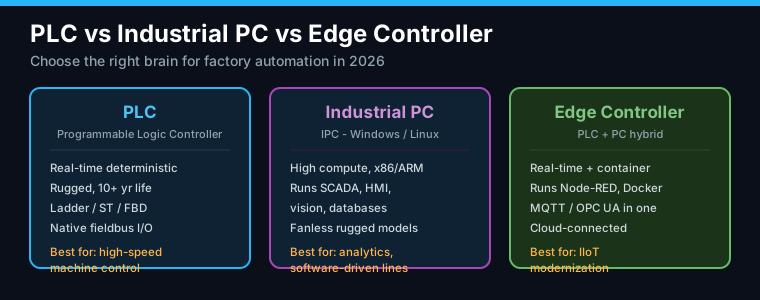
Companies like Advantech, Siemens (SIMATIC IPC), and Beckhoff offer ruggedized industrial PCs with integrated AI accelerators. These are designed for harsh factory environments with wide temperature ranges, vibration resistance, and extended product lifecycles.
4. Industrial Use Cases
Edge AI is transforming several key areas of industrial automation:
Visual Quality Inspection
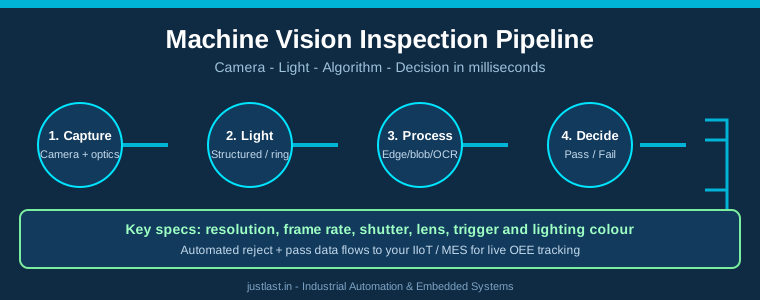
Computer vision models running on edge devices can inspect products at line speed, identifying defects, dimensional variations, and surface anomalies that human inspectors might miss. In Indian automotive manufacturing, edge AI vision systems are achieving 99.5% defect detection rates while operating at production line speeds.
Predictive Maintenance
Edge AI models analyzing vibration, temperature, and acoustic data from motors, pumps, and bearings can predict equipment failures 24-72 hours in advance. This allows maintenance to be scheduled during planned downtime, avoiding costly unplanned shutdowns that can cost Indian manufacturers INR 5-50 lakhs per incident.
Process Optimization
Real-time optimization of process parameters (temperature, pressure, flow rates) using reinforcement learning models running on edge devices. These systems continuously adjust process variables to maximize quality and throughput while minimizing energy consumption.
Safety Monitoring
Edge AI-powered safety systems can detect unsafe behaviors (missing PPE, unauthorized zone entry, improper machine operation) and trigger immediate alerts or shutdowns. Unlike cloud-based systems, edge processing ensures sub-100ms response times critical for safety applications.
5. Deployment Architecture
A typical edge AI deployment in an Indian factory follows a hierarchical architecture:
Layer 1 – Data Acquisition: Sensors, cameras, and PLCs generate raw data at the field level. This data is collected by edge gateways using industrial protocols (OPC UA, MQTT, Modbus TCP).
Layer 2 – Pre-processing: Edge gateways perform data cleaning, normalization, and feature extraction. This reduces the data volume by 80-90% before it reaches the AI inference engine.
Layer 3 – AI Inference: Optimized ML models (quantized to INT8 or FP16 for edge deployment) run inference on the pre-processed data. Models are typically trained in the cloud and deployed to edge devices using containers (Docker, Kubernetes at the Edge).
Layer 4 – Action: Inference results trigger actions through PLC commands, alarm systems, or process adjustments. The action layer integrates with existing SCADA and DCS systems.
Layer 5 – Cloud Sync: Edge devices periodically sync performance metrics, model accuracy data, and aggregated analytics to the cloud for fleet management and model retraining.
6. India Adoption Landscape
India’s manufacturing sector is rapidly adopting edge AI, driven by several factors:
Government Initiatives: The Production Linked Incentive (PLI) scheme for electronics manufacturing and the Smart Advanced Manufacturing and Research Hub (SAMARTH) Udyog Bharat 4.0 initiative are accelerating Industry 4.0 adoption.
Cost Advantages: Indian manufacturers can deploy edge AI solutions at 30-40% lower cost than equivalent Western installations, thanks to lower labor costs for integration and local hardware manufacturing.
Skill Development: Institutions like IITs, NITs, and industry bodies like CII are offering specialized training programs in industrial AI, creating a pipeline of skilled engineers.
Success Stories: Major Indian manufacturers including Tata Motors, Mahindra, and Bharat Forge have deployed edge AI systems for quality inspection and predictive maintenance, reporting 20-40% reductions in defect rates and 15-25% improvements in equipment uptime.
7. Challenges and Limitations
Despite its advantages, edge AI adoption faces several challenges in Indian manufacturing:
Infrastructure: Many Indian factories lack the reliable power supply, network connectivity, and environmental controls needed for edge computing equipment. Power fluctuations and dust can damage sensitive electronics.
Integration Complexity: Connecting edge AI systems with legacy PLCs, SCADA systems, and industrial networks requires specialized expertise that is scarce in the Indian market.
Model Maintenance: Edge AI models need regular retraining as production conditions change. Without proper MLOps practices, model accuracy can degrade over time, leading to false positives or missed defects.
ROI Uncertainty: While the technology is proven, many Indian SMEs struggle to quantify the return on investment for edge AI deployments, making it difficult to justify the upfront capital expenditure.
8. ROI and Business Case
A typical edge AI deployment for visual quality inspection in an Indian automotive parts manufacturer involves:
| Cost Component | Typical Range (INR) |
|---|---|
| Edge hardware (2 cameras + gateway) | 3,00,000 – 8,00,000 |
| Software and ML model development | 2,00,000 – 5,00,000 |
| Integration and commissioning | 1,50,000 – 3,00,000 |
| Annual maintenance | 50,000 – 1,50,000 |
| Total First Year | 7,00,000 – 17,50,000 |
Expected benefits include 20-40% reduction in defect-related rework costs, 15-25% improvement in equipment uptime, and 10-20% reduction in quality-related customer complaints. For a mid-sized Indian manufacturer with annual revenue of INR 50-100 crore, these improvements can translate to INR 15-40 lakhs in annual savings, delivering ROI within 12-18 months.
9. Related Reading
- AI-Driven Predictive Maintenance Cuts CNC Downtime by 35%
- STM32 + ESP32 Industrial IoT Gateway
- Renesas RZ/G3L and RZ/G3SE: 64-bit MPUs for Industrial HMI
10. Sources
- NVIDIA Industrial Automation Solutions
- McKinsey: Harnessing the Power of Edge AI
- CII: Technology and Innovation in Indian Manufacturing
Key Takeaways
- Edge AI processes ML inference locally on factory floor devices, eliminating cloud latency for real-time applications
- Key use cases include visual quality inspection, predictive maintenance, process optimization, and safety monitoring
- NVIDIA Jetson, Intel edge solutions, and Raspberry Pi with Coral TPU are the primary hardware options in India
- Indian manufacturers can deploy edge AI at 30-40% lower cost than Western equivalents
- ROI typically achieved within 12-18 months through reduced defects, improved uptime, and lower quality costs
- Challenges include infrastructure limitations, integration complexity, and model maintenance requirements