Key Takeaway: In 2026, the ESP32 is the right choice for roughly 7 out of 10 new IoT projects because it adds Bluetooth, a dual-core processor, far more RAM and GPIO for just $1.50 more than the ESP8266. Choose the ESP8266 only when you need absolute lowest cost in bulk, run simple Wi-Fi-only sensors, or maintain existing ESP8266 firmware.
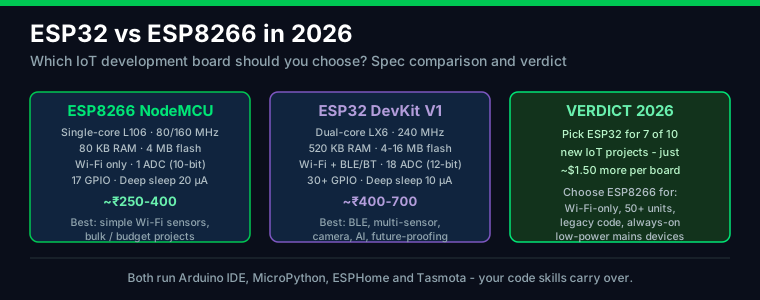
Table of Contents
1. Overview
If you have searched for an inexpensive way to add Wi-Fi to a DIY electronics project, you have almost certainly met the two boards at the centre of this comparison. Both are made by Espressif Systems, both cost less than a good meal, and both are used in millions of smart home devices around the world. The ESP8266, launched in 2014, started the affordable Wi-Fi microcontroller revolution. The ESP32, released in 2016, is its more powerful successor. Choosing between them is one of the most common decisions a maker, student, or engineer faces, and the answer has shifted noticeably by 2026.
This ESP32 vs ESP8266 guide breaks down every meaningful difference — processor, memory, connectivity, GPIO, power, and price — and gives you a clear decision framework so you do not over-spend on a board you do not need, or under-buy for a project that will outgrow its hardware.
2. Full Spec Comparison: ESP32 vs ESP8266
Here is the specification table that matters, based on the popular dev boards most people buy: the NodeMCU (ESP8266) and the ESP32 DevKit V1.
| Feature | ESP8266 (NodeMCU) | ESP32 (DevKit V1) |
|---|---|---|
| Processor | Single-core Tensilica L106 | Dual-core Xtensa LX6 |
| Clock speed | 80 / 160 MHz | Up to 240 MHz |
| SRAM | 80 KB | 520 KB |
| Flash | 4 MB typical | 4–16 MB |
| Wi-Fi | 802.11 b/g/n (2.4 GHz) | 802.11 b/g/n (2.4 GHz) |
| Bluetooth | None | Bluetooth 4.2 Classic + BLE |
| GPIO pins | ~17 usable | ~30–36 usable |
| Analog inputs | 1 × 10-bit ADC | 18 × 12-bit ADC |
| DAC output | None | 2 × 8-bit |
| Hardware crypto | No | AES, SHA, RSA, ECC |
| Deep sleep | ~20 µA | ~10 µA |
| Dev board price | ~₹250–400 | ~₹400–700 |
The headline numbers tell the story. The ESP32 is roughly three times faster, has six times the RAM, includes Bluetooth, and offers many more I/O pins. It also has hardware encryption, which makes secure HTTPS connections dramatically faster — a real concern for production devices. The only areas where the ESP8266 wins outright are sticker price and active power draw.
Processor and memory
For anything beyond the simplest sensor reading, the ESP32’s dual-core 240 MHz processor and 520 KB of RAM change what is possible. An ESP8266 with its 80 KB of RAM chokes when you try to run a modern web server, decode images, or buffer audio. The ESP32 handles these tasks without breaking a sweat and can even run small machine-learning models on variants like the ESP32-S3. If your project needs to “do multiple things at once” — read sensors, serve a dashboard, and talk to the cloud — the ESP32’s second core is a genuine advantage.
Bluetooth makes the ESP32 the only option for many projects
The ESP8266 has no Bluetooth at all. If you want to pair a smart device with a phone, connect BLE sensors, run a beacon, or use the popular “provision via Bluetooth, then switch to Wi-Fi” setup pattern, the ESP32 is not just better — it is the only choice in this price tier. The same applies to ESP-NOW mesh networking and Bluetooth audio projects.
3. Power Consumption and Battery Life
This is where the conventional wisdom gets interesting. During active Wi-Fi transmission, the ESP8266 draws less current (roughly 70–170 mA) than the ESP32 (roughly 160–260 mA). So for an always-on, mains-powered device, the ESP8266 is more efficient. But in deep sleep, the tables turn: the ESP32 drops to about 10 µA versus the ESP8266’s 20 µA, and its ultra-low-power (ULP) coprocessor can wake itself to take sensor readings.
For a battery-powered sensor that wakes once every few minutes to send a reading, real-world testing shows the ESP32’s deep-sleep advantage wins out over a typical week. The exception is a sensor that wakes very frequently, where the ESP8266’s faster wake-and-connect cycle (~150 ms versus ~300 ms) keeps total per-cycle energy lower. As a rule of thumb: coin-cell and long-life battery projects usually favour the ESP32; simple always-on Wi-Fi devices slightly favour the ESP8266.
4. Buying Guide: Which Board for Your Project?
Choose the ESP8266 if…
- Your project only needs Wi-Fi — a relay switch, a simple temperature logger, a basic web server.
- You are building 50 or more units and every rupee matters. In bulk, the ESP8266 chip costs about 60% of the ESP32.
- You are maintaining existing ESP8266 firmware or hardware and a rewrite is not worth the effort.
- You want the smallest possible module for a wall-switch form factor — the ESP-01 is tiny.
Choose the ESP32 if…
- You need Bluetooth or BLE for phone control, beacons, or sensors.
- You are reading more than one analog sensor — the ESP8266 has a single 10-bit ADC.
- You want headroom to add features later without a hardware redesign.
- You are building a battery-powered sensor where deep sleep matters.
- You care about secure HTTPS, OTA updates, or shipping a commercial product.
Both boards work with the Arduino IDE, MicroPython, ESPHome, and Tasmota, so your code skills and most of your libraries carry over. The newer ESP32-S3 and ESP32-C3 variants add native USB and faster Wi-Fi, making the ESP32 family even more future-proof. If you are also weighing an ESP32 against a Raspberry Pi for home automation, read our full comparison here.
5. Frequently Asked Questions
Is ESP32 better than ESP8266?
For most projects, yes. The ESP32 has a faster dual-core processor, 520 KB of RAM, Bluetooth, more GPIO, and better deep sleep, all for a small price premium. The ESP8266 remains better only for the lowest-cost simple Wi-Fi projects and bulk production.
Is the ESP32 faster than the ESP8266?
Yes. The ESP32 runs at up to 240 MHz on two cores, while the ESP8266 runs at 80–160 MHz on one core. This makes the ESP32 roughly 3–4 times faster for compute-heavy tasks.
Can I use ESP8266 code on an ESP32?
Mostly yes. Both use the Arduino API, so most sketches port with minor changes — mainly pin numbers and a few library differences. ESPHome and Tasmota configurations work on both.
Does the ESP8266 have Bluetooth?
No. The ESP8266 is Wi-Fi only. If you need Bluetooth Classic or BLE, you must use the ESP32 (or an ESP32-S3/C3 variant).
Which board is better for battery-powered IoT sensors?
For sensors that wake infrequently, the ESP32 wins on deep-sleep efficiency (~10 µA). For sensors that wake very often, the ESP8266 can last slightly longer per cycle. Check out our ESPHome smart sensor network guide for a full build example.
Related Reading
- ESP32 Smart Home Automation Guide 2026
- ESP32 vs Raspberry Pi for Smart Home
- Build Your Own ESP32 WiFi Smart Switch
Sources
- Espressif — ESP32 Product Page
- Espressif — ESP8266 Product Page
- Random Nerd Tutorials — ESP32 vs ESP8266
- RobotDyn — ESP32 vs ESP8266 in 2026
Disclosure: This post contains affiliate links. As an Amazon Associate I earn from qualifying purchases.