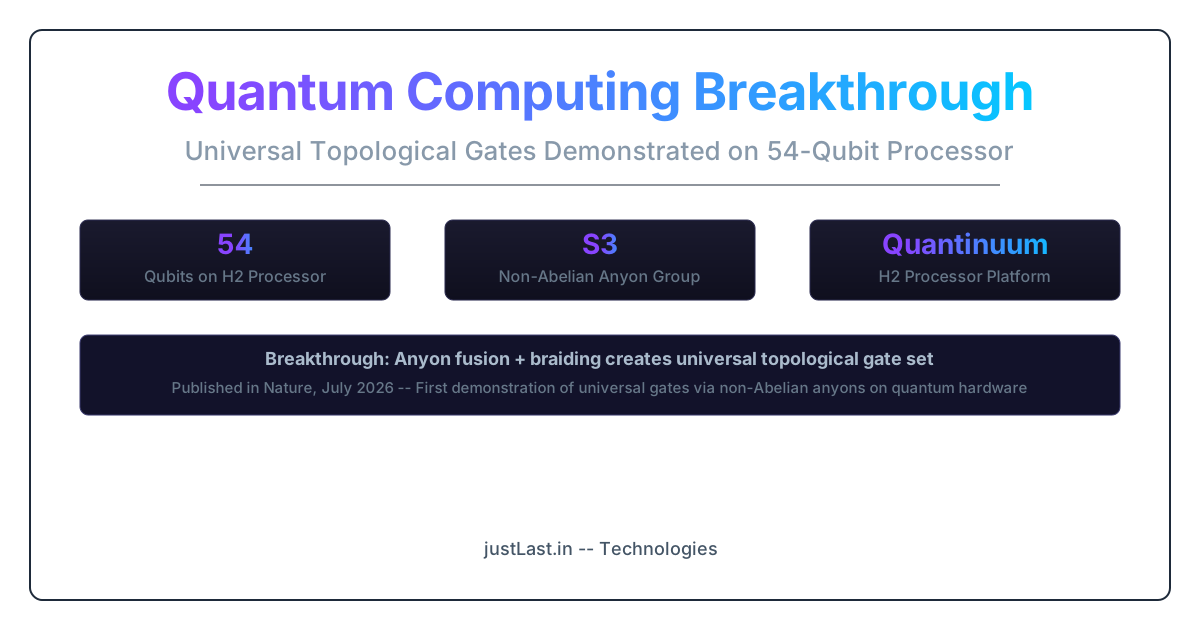
Key Takeaway: In July 2026, Quantinuum researchers demonstrated universal topological quantum gates on a 54-qubit H2 processor by braiding and fusing non-Abelian anyons from the S3 group — a breakthrough published in Nature that proves topological quantum computing can achieve universality without requiring exotic hardware.
Quantum Computing Breakthrough — July 2026
Universal topological gates via anyon braiding and fusion on Quantinuum H2
54 Qubits
H2 trapped-ion processor
S3 Group
Non-Abelian topological order
Nature
Published July 15, 2026
Braiding alone is NOT universal
Non-Abelian anyons need fusion for completeness
Fusion as computational primitive
Combining braid + fusion = universal gate set
Topological Magic State
Prepared and read out on the H2 system
Scalable Preparation
S3 topological state is scalably preparable
Impact: Topological qubits could eliminate error correction overhead in future quantum computers
Source: Nature (2026) — Universal gates from braiding and fusing anyons on quantum hardware
Error-protected computing
Inherent fault tolerance
Universal gate set
All quantum operations possible
Scalable architecture
Path to practical quantum computers
📖 Table of Contents
The Quantum Computing Landscape in 2026
Quantum computing has reached a pivotal inflection point in 2026. While classical computers continue to advance, the fundamental limits of silicon transistors are driving sustained investment into alternative computing paradigms. Among these, topological quantum computing has long promised a unique advantage: inherent error protection encoded in the mathematics of particle physics itself.
Unlike conventional quantum computers that require extensive error correction codes to manage decoherence, topological qubits store information in the global properties of quantum states — properties that are resistant to local noise. The challenge has been that the simplest topological codes do not support a universal set of quantum gates, limiting their practical utility.
The breakthrough published in Nature on July 15, 2026, by the Quantinuum team, working with the S3 non-Abelian anyon group on their H2 processor, demonstrates for the first time that combining anyon braiding with fusion creates a universal topological gate set. This bridges the gap between theoretical elegance and practical quantum computation.
Understanding Non-Abelian Anyons
Anyons are quasiparticles that exist in two-dimensional systems, and they defy the conventional classification of particles into bosons and fermions. Non-Abelian anyons have the remarkable property that exchanging their positions applies a non-commuting transformation to the quantum state — meaning the order of exchanges matters, just as the order of operations matters in matrix multiplication.
The S3 group represents the smallest non-Abelian group, making it the simplest platform for demonstrating non-Abelian statistics. By preparing a 54-qubit ground state of the quantum double of S3 on the H2 processor, the researchers created a topological state rich enough to support anyonic excitations. This choice was deliberate: S3 is the simplest system that still captures the essential physics of non-Abelian topological order.
Braiding vs. Fusion: Why Both Matter
Previous approaches to topological quantum computing focused exclusively on braiding — moving anyons around each other to implement gates. However, for the simplest non-Abelian generalizations of the toric code, braiding alone cannot achieve universality. The Quantinuum team showed that using anyon fusion as a computational primitive, combined with braiding, renders these systems universal.
Fusion refers to the process of combining two anyons and observing the outcome. When used intentionally as a computational operation, fusion provides additional gates that braiding alone cannot produce. By combining braiding with fusion, the team realized a universal topological gate set that includes all operations needed for arbitrary quantum computation.
The H2 Processor and Scalable Preparation
Quantinuum’s H2 processor is a trapped-ion quantum computer with 54 qubits. The team used it to prepare the quantum double ground state of S3, demonstrating that this topologically ordered state is scalably preparable on existing hardware. This is a critical result — it shows that the S3 topological state does not require impractical resources or exotic conditions to create.
The demonstration included encoding logical information in the global fusion space of non-Abelian anyons, implementing a universal topological gate set through combined braiding and fusion, and reading out the results. The team also topologically prepared a magic state — a resource state that enables non-Clifford gates essential for universal quantum computation.
Impact on Quantum Computing Roadmaps
This result has implications for every quantum computing company and research group. The ability to implement universal gates through topology rather than error correction could dramatically simplify the hardware requirements for fault-tolerant quantum computers. Instead of needing thousands of physical qubits per logical qubit for error correction, topological qubits could offer inherent protection with far less overhead.
Companies like IBM, Google, Microsoft, and IonQ are all pursuing different approaches to quantum computing. The Quantinuum result suggests that topological approaches deserve renewed attention, particularly for applications requiring long-lived quantum states, such as quantum simulation, cryptography, and optimization.
What This Means for Industry
For industries exploring quantum computing — pharmaceuticals, materials science, finance, and logistics — this breakthrough means that practical quantum computers may arrive sooner than projected. When topological qubits can be manufactured and controlled at scale, they will require significantly less error correction infrastructure, reducing the cost and complexity of quantum data centers.
From a hardware perspective, the demonstration that 54 qubits on a trapped-ion platform can support non-Abelian topological order is itself remarkable. It suggests that the path to scalable quantum computing may not require entirely new hardware platforms — existing trapped-ion and superconducting qubit systems may be adaptable to topological computation.
Challenges Ahead
Despite the breakthrough, significant challenges remain before topological quantum computers become practical. The S3 demonstration proves universality but does not yet achieve the gate fidelities required for complex algorithms. Scaling from 54 qubits to the thousands needed for practical problems presents engineering challenges in qubit control, readout, and connectivity.
Additionally, integrating fusion-based gates into existing quantum error correction frameworks requires new theoretical work. The current demonstration used the quantum double of S3, but other topological phases may offer better performance characteristics. Research into alternative non-Abelian anyon models and their experimental realizations is likely to accelerate following this result.
Frequently Asked Questions
What is topological quantum computing?
Topological quantum computing uses the properties of quasi-particles called anyons to encode and process quantum information. The information is stored in global properties of the quantum state that are inherently protected from local noise and decoherence.
What is the difference between braiding and fusion?
Braiding exchanges the positions of anyons, applying transformations to the quantum state. Fusion combines two anyons and measures the outcome. Braiding alone cannot create a universal gate set in the simplest topological codes, but combining braiding with fusion achieves universality.
Why is the S3 group significant?
S3 is the smallest non-Abelian group, making it the simplest system that still exhibits non-Abelian statistics. Demonstrating universal gates on this platform proves the concept is feasible without requiring exotic physics or impractical hardware.
How many qubits did the Quantinuum demonstration use?
The demonstration used 54 qubits on Quantinuum’s H2 trapped-ion processor to prepare the S3 quantum double ground state.
When will topological quantum computers be commercially available?
While this breakthrough is significant, commercial availability is likely 5-10 years away. The demonstration proves feasibility but scaling to useful problem sizes requires further engineering advances.
Does this mean error correction is unnecessary?
Not entirely. Topological qubits reduce but do not eliminate the need for error correction. The advantage is that far fewer physical qubits are needed per logical qubit compared to conventional approaches.
Related Reading
- Edge Computing in 2026: What IT Leaders Need to Know — Explore how distributed computing paradigms are reshaping IT infrastructure
- Understanding Modern Processor Architectures — A guide to the computing hardware powering today’s innovations
Sources
- Nature: Universal gates from braiding and fusing anyons on quantum hardware (2026)
- Quantinuum H2 Processor Technical Specifications
- arXiv: Non-Clifford gates between stabilizer codes via non-Abelian topological order (2026)
- IBM Quantum Computing Roadmap
- Google Quantum AI Lab