Key Takeaway: The edge computing market has surged past $232 billion in 2026, driven by the explosive growth of IoT devices and the need for sub-10-millisecond latency in real-time applications. While cloud computing remains essential for large-scale data analytics and machine learning training, edge computing now processes 75% of enterprise-generated data at the network edge. The winning architecture for most organizations is not edge OR cloud, but a hybrid approach that intelligently distributes workloads based on latency requirements, data volume, privacy constraints, and computational intensity.
Edge vs Cloud Computing: The 2026 Landscape
Market growth, latency comparison, and workload distribution
$232B
Edge Market Size 2026
75%
Data at Edge by 2026
10-50ms
Edge Latency vs Cloud
Best for Edge
Real-time control (sub-10ms), data privacy,
bandwidth-constrained IoT, offline operation
Best for Cloud
Big data analytics, ML model training,
global scale, cost-effective storage
Key Edge Enablers
5G networks, ARM/NVIDIA edge processors,
Kubernetes at edge, federated learning
Hybrid Architecture
Edge for real-time processing + filtering,
Cloud for training, storage, and scale
Key Insight: 90% of industrial IoT deployments use a hybrid edge-cloud model in 2026
Sources: Gartner, IDC, McKinsey 2026 Edge Computing Report — justLast.in | Technologies
Table of Contents
- 1. Understanding the Edge vs Cloud Divide
- 2. The Market Landscape in 2026
- 3. Latency: The Decisive Factor
- 4. Bandwidth and Cost Considerations
- 5. Privacy and Regulatory Compliance
- 6. Hybrid Edge-Cloud Architecture: Best Practices
- 7. The Role of 5G in Edge Computing
- 8. Frequently Asked Questions
- 9. Related Reading
- 10. Sources
Understanding the Edge vs Cloud Divide
The conversation around edge computing versus cloud computing has matured significantly by 2026. What was once framed as a binary choice has evolved into a nuanced understanding that each architecture excels in different domains. Cloud computing provides virtually unlimited compute resources, massive storage capacity, and centralized management. Edge computing brings computation closer to data sources, dramatically reducing latency and bandwidth requirements while enabling real-time decision-making.
To understand why both are essential, it helps to look at what each does best. Cloud platforms like AWS, Azure, and Google Cloud remain unmatched for large-scale data storage, complex analytics, machine learning model training, and applications that benefit from global distribution. Edge computing, by contrast, excels in scenarios where milliseconds matter, where bandwidth is limited or expensive, where data privacy regulations restrict cloud transmission, or where offline operation is required.
The fundamental driver behind edge computing’s rise is data volume. Global data generation reached 175 zettabytes in 2025, and Gartner projected that 75% of enterprise-generated data would be created and processed outside traditional centralized data centers. This shift makes it economically and practically impossible to send all data to the cloud for processing. Instead, the most efficient approach is to process data at the edge, send only relevant insights to the cloud, and maintain a two-way synchronization that keeps both layers aligned.
The Market Landscape in 2026
The edge computing market has grown to $232 billion in 2026, driven by several converging trends. The proliferation of IoT devices has reached over 50 billion connected endpoints globally, each generating streams of data that need processing. 5G networks have matured to provide the high-bandwidth, low-latency connectivity that makes edge computing practical for applications like autonomous vehicles, industrial automation, and augmented reality.
Major cloud providers have responded by extending their platforms to the edge. AWS Outposts, Azure Stack Edge, and Google Distributed Cloud allow organizations to run cloud services on local hardware, creating a consistent operational model across edge and cloud environments. This hybrid approach has become the dominant deployment pattern, with 90% of industrial IoT implementations using some combination of edge and cloud resources.
The investment landscape reflects this shift. Venture capital funding for edge computing startups exceeded $12 billion in 2025, and acquisitions by major technology companies have accelerated. NVIDIA’s edge computing platform, built around its Jetson family of processors, has become the de facto standard for AI inference at the edge, powering everything from smart cameras to industrial robots. Similarly, ARM-based processors from Ampere and AWS’s Graviton family have made power-efficient edge computing accessible at scale.
Latency: The Decisive Factor
Latency remains the most compelling argument for edge computing. Cloud round-trip times typically range from 50 to 200 milliseconds, depending on the distance to the data center, network congestion, and the complexity of the processing required. For many applications, this latency is perfectly acceptable. A web page load, email delivery, or database query can tolerate 100ms+ delays without noticeable impact.
However, a growing class of applications simply cannot function with cloud-level latency. Autonomous vehicles require sub-10-millisecond response times for obstacle detection and collision avoidance. Industrial control systems need deterministic response times measured in microseconds for tasks like motor synchronization and safety shutdown. Augmented reality applications demand motion-to-photon latency under 20 milliseconds to prevent motion sickness. These applications require edge-local processing where the round trip is measured in meters rather than kilometers.
Edge computing delivers 10-50 millisecond latency for most applications, with specialized edge deployments achieving sub-millisecond performance for time-critical workloads. This is achieved by placing compute resources at the network edge, often at the base of 5G towers, in local data centers, or directly on the device itself.
Bandwidth and Cost Considerations
Bandwidth costs are another powerful driver for edge adoption. Transmitting data from IoT devices to the cloud incurs significant network costs, particularly for high-resolution video, continuous sensor streams, and other data-intensive applications. A single industrial camera generating 4K video at 30 frames per second produces approximately 1.5 terabytes of data per day. Sending all of that to the cloud would be prohibitively expensive.
Edge computing solves this by processing data locally and transmitting only the results. Instead of sending raw video, an edge processor can analyze frames locally, detect events or anomalies, and send a few kilobytes of metadata per event to the cloud. This can reduce bandwidth costs by 90-99% for data-intensive applications, making previously uneconomical IoT deployments viable.
Privacy and Regulatory Compliance
Data sovereignty regulations have become increasingly stringent worldwide. The European Union’s GDPR framework, India’s Digital Personal Data Protection Act, China’s Personal Information Protection Law, and similar regulations in dozens of countries impose strict requirements on how personal data is collected, processed, stored, and transmitted across borders.
Edge computing offers a natural compliance architecture. By processing sensitive data locally and sending only anonymized or aggregated insights to the cloud, organizations can maintain compliance with data localization requirements while still benefiting from cloud-based analytics and machine learning. This is particularly important in sectors like healthcare, finance, and government, where data privacy regulations are most restrictive.
Hybrid Edge-Cloud Architecture: Best Practices
The most successful organizations in 2026 have moved beyond the edge-versus-cloud debate to implement intelligent hybrid architectures. In this model, each workload is analyzed on four dimensions: latency requirements, data volume, privacy sensitivity, and computational intensity. The workload is then placed on the appropriate tier, with seamless communication between tiers.
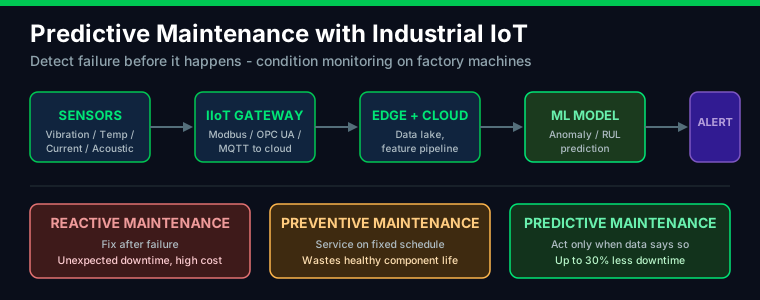
Real-time control loops and safety-critical functions run exclusively at the edge, where response times are guaranteed. Data preprocessing, filtering, and initial analysis also happen at the edge, reducing the volume of data that needs to be transmitted. The cloud handles model training, using data from multiple edge deployments to improve AI models, which are then deployed back to the edge for inference. Long-term storage, historical analysis, and global-scale applications remain cloud-native.
Frameworks like AWS IoT Greengrass, Azure IoT Edge, and Google’s Edge TPU provide the infrastructure for this hybrid model. These platforms manage the complexities of device management, over-the-air updates, data synchronization, and security across potentially thousands of edge nodes, making hybrid deployment practical at scale.
The Role of 5G in Edge Computing
5G networks have become a critical enabler for edge computing in 2026. The combination of 5G’s low latency (as low as 1 millisecond in ideal conditions), high bandwidth (up to 10 Gbps), and network slicing capabilities creates an environment where edge computing can deliver on its promise of real-time, reliable processing.
Multi-access Edge Computing (MEC), standardized by ETSI, integrates computing resources directly into the 5G network infrastructure. This allows applications to run at the base station level, providing single-digit millisecond latency without requiring on-premises hardware. Mobile operators worldwide have deployed MEC platforms in major urban centers, enabling edge computing as a service for applications ranging from autonomous vehicle coordination to live event streaming.
Private 5G networks have also gained traction in industrial settings. Manufacturers are deploying private 5G networks that combine ultra-reliable low-latency communications with on-premises edge computing, creating a complete infrastructure for Industry 4.0 applications. These private networks provide deterministic performance that Wi-Fi cannot match, with the security and control of a private infrastructure.
Frequently Asked Questions
What is the main difference between edge computing and cloud computing?
The main difference is location. Cloud computing processes data in centralized data centers that may be hundreds or thousands of kilometers away. Edge computing processes data at or near the source, reducing latency, bandwidth usage, and dependence on network connectivity.
Is edge computing replacing cloud computing?
No. Edge computing complements cloud computing rather than replacing it. The most effective architectures use both, with edge handling real-time processing and cloud managing large-scale analytics, storage, and model training.
What industries benefit most from edge computing?
Manufacturing (real-time control and predictive maintenance), autonomous vehicles (sub-10ms safety responses), healthcare (patient data privacy), retail (in-store analytics), energy (grid management), and telecommunications (5G network optimization) see the greatest benefits.
How secure is edge computing compared to cloud?
Edge computing can be more secure for sensitive data because it reduces data transmission over networks. However, edge devices are physically more accessible than cloud data centers, requiring hardware-based security measures like trusted platform modules, secure enclaves, and encrypted storage.
What hardware is needed for edge computing?
Edge computing hardware ranges from Raspberry Pi-class devices for simple sensor processing to NVIDIA Jetson modules for AI inference, Intel Xeon-based edge servers for industrial applications, and dedicated MEC infrastructure in 5G networks.
How does edge computing handle offline scenarios?
Edge computing excels in offline scenarios because processing happens locally. Edge devices continue operating during network outages, queuing synchronization data for when connectivity is restored. This makes edge architectures inherently more resilient than cloud-only designs.
Related Reading
- Digital Twins in Manufacturing 2026: How Virtual Replicas Are Revolutionizing Industrial Operations
- RISC-V in 2026: How Open-Source Processor Architecture Is Disrupting ARM
- More Technology Articles on justLast.in
Sources
- Gartner – Edge Computing Market Analysis 2026
- McKinsey – What Is Edge Computing?
- IDC – Edge Computing Forecasts and Analysis
- Wikipedia – Edge Computing Overview
- ETSI – Multi-Access Edge Computing Standards
Building an edge computing deployment? Development boards and edge processors are available on Mouser and source from DigiKey with reference designs and application notes.