Key Takeaway: The Klein MM700 at $75 is the best multimeter for 95% of homeowners and DIYers, offering higher CAT IV safety ratings, a temperature probe, and comparable accuracy to the Fluke 117 at one-third the price.
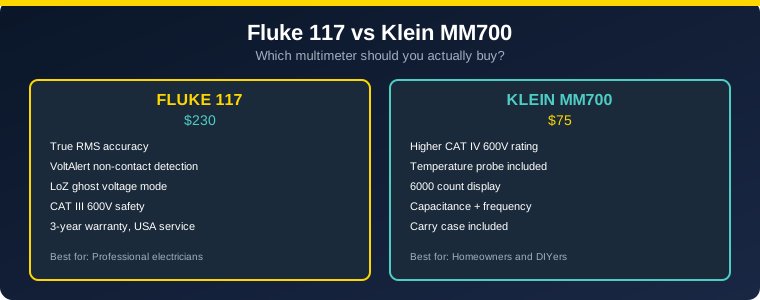
Table of Contents
1. Why This Comparison Matters
The Fluke 117 and Klein MM700 are the two most popular digital multimeters in their respective price ranges. One is the industry standard trusted by professional electricians worldwide. The other is a feature-packed value proposition that surprised everyone with its performance. Choosing between them comes down to what you actually need — and what you are willing to pay.
This is not just about price. The safety rating difference may surprise you, and the feature comparison reveals some unexpected advantages for the budget option. Let us break it all down.
2. Spec-by-Spec Comparison
| Feature | Fluke 117 | Klein MM700 |
|---|---|---|
| Price | $230 | $75 |
| True RMS | Yes | No (avg responding) |
| Safety Rating | CAT III 600V | CAT IV 600V / CAT III 1000V |
| NCV Detection | Yes (VoltAlert) | Yes |
| Temperature | No | Yes (probe included) |
| Display | 6000 count | 6000 count |
| Auto-ranging | Yes | Yes |
| Capacitance | Yes | Yes |
| Warranty | 3 years | 2 years |
| LoZ Mode | Yes (Auto-V/LoZ) | No |
| Carry Case | Sold separately | Included |
3. Fluke 117 — The Professional Standard
The Fluke 117 is one of the most trusted multimeters in the electrical trade. Its True RMS measurement, Auto-V/LoZ function, and VoltAlert non-contact voltage detection make it the go-to choice for professional electricians working on commercial and residential systems.
Where the Fluke wins:
- True RMS accuracy — essential for non-sinusoidal waveforms from VFDs, dimmers, and switching power supplies
- Auto-V/LoZ — low impedance mode eliminates ghost voltage readings caused by adjacent energized conductors
- VoltAlert — non-contact voltage detection for quick safety checks without test leads
- 3-year warranty with USA-based service and repair
- Resale value — used Fluke 117s sell for $120+ after a decade
The Fluke 117 is the right choice if you use your multimeter professionally, work with VFD equipment, or need the fastest possible response time for daily troubleshooting.
4. Klein MM700 — The Value Champion
The Klein MM700 delivers features that rival meters costing three times as much. With CAT IV 600V safety rating, included temperature probe, capacitance testing, and a rugged rubber-overmolded body that survives 2-meter drops, it is the best multimeter for homeowners and serious DIYers.
Where the Klein wins:
- Higher safety rating — CAT IV 600V exceeds the Fluke 117’s CAT III 600V
- Temperature measurement — included thermocouple probe for HVAC and motor work
- Better value — same accuracy on residential voltage and continuity tests at $75 vs $230
- Carry case included — the Fluke charges extra for this
- Drop-tested to 2 meters — rubber armor survives job site abuse
For homeowner electrical work, the Klein MM700 actually exceeds the Fluke 117 on safety rating — a surprising result at one-third the price.
5. Safety Ratings Explained
CAT (Category) ratings tell you the maximum transient voltage a meter can safely handle. This is the most important specification for anyone working on mains voltage.
- CAT II — portable appliances, small electronics
- CAT III — distribution panels, fixed installations, industrial equipment
- CAT IV — service entrance, utility connections, outdoor equipment (highest energy)
The Klein MM700’s CAT IV 600V rating means it is safe at the service entrance — the highest energy location in a building. The Fluke 117’s CAT III 600V is safe at the panel but not at the service entrance. For most homeowner and residential electrician work, both are perfectly safe. But the Klein’s higher rating is a genuine advantage.
Warning: Unbranded $15-$25 multimeters from Amazon claim CAT III ratings without UL certification. Without independent verification, the rating is just a marketing number. Use these for low-voltage DC work only — never on 120V/240V residential AC.
6. The Verdict
Buy the Fluke 117 if:
- You are a professional electrician using the meter daily
- You work with VFD equipment requiring True RMS accuracy
- You need the LoZ ghost voltage detection feature
- You value the 3-year warranty and USA service
Buy the Klein MM700 if:
- You are a homeowner, DIYer, or hobbyist
- You want the highest safety rating at the lowest price
- You need temperature measurement for HVAC work
- You want a complete kit (case + probes + thermocouple) out of the box
The bottom line: For 95% of homeowners and DIYers, the Klein MM700 at $75 is the better buy. You get higher safety ratings, more features, and comparable accuracy for residential work. Save the Fluke 117 for professionals who need True RMS and LoZ for commercial/industrial troubleshooting.
7. Frequently Asked Questions
Do I need True RMS for home use?
Not for basic electrical work. True RMS matters for non-sinusoidal AC waveforms — variable-speed mini-splits with VFDs, dimmer switches, and switching power supplies. If your home has modern inverter-based HVAC, consider upgrading to a True RMS meter.
Is the Klein MM700 accurate enough for professional use?
For residential electricians and maintenance technicians, yes. The Klein MM700 delivers the same accuracy as the Fluke 117 on voltage and continuity tests. The Fluke’s advantages — True RMS, LoZ, faster response time — matter more in commercial and industrial environments with complex electrical systems.
How long do these multimeters last?
Both are built to last. Fluke multimeters are known for 10+ years of daily professional use. Klein multimeters typically last 5-8 years with regular use. The Klein’s 2-year warranty is shorter than Fluke’s 3-year, but both exceed their warranty periods in normal conditions.
Can I use these for automotive work?
Yes, both handle 12V DC automotive work easily. For advanced automotive diagnostics (sensor testing, CAN bus), you may want a meter with millivolt resolution and frequency measurement. Both the Fluke 117 and Klein MM700 include frequency measurement.
Related Reading
- Oscilloscope Buying Guide: What to Look For
- Wire Size Chart: Complete Guide for DIY Electrical
- Multimeter Basics: How to Use a Multimeter
Sources
- BuildingTalks — Klein vs Fluke Multimeters: What a Homeowner Actually Needs
- This Old House — Best Multimeters 2026
- AzadTechHub — Fluke 117 vs Klein MM720
Disclosure: This post contains affiliate links. As an Amazon Associate I earn from qualifying purchases.