Key Takeaway: The right industrial IoT gateway depends on environment and workload — a general-purpose Pi is fine for a bench prototype, but a hardened STM32 controller or DIN-rail industrial PC wins on the factory floor where heat, vibration and uptime matter.
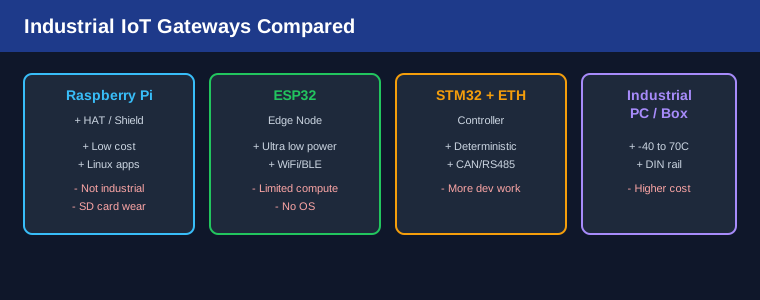
Table of Contents
1. What a Gateway Actually Does
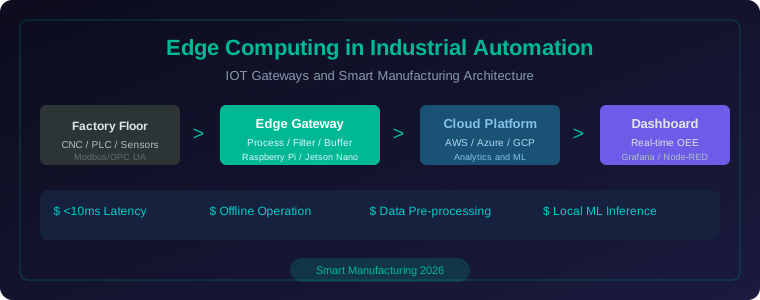
An industrial IoT gateway sits between field devices (sensors, drives, PLCs) and the cloud or plant network. It aggregates data, translates protocols (Modbus, CAN, MQTT), filters and buffers, and provides a secure uplink. The “best” gateway is the one that survives your environment while doing the protocol work you need.
2. Raspberry Pi + HAT
The Pi is the fastest path from idea to prototype. Add an RS-485 HAT, a CAN HAT or a relay board and you have a Linux box that speaks to almost anything. Strengths: cheap, huge software ecosystem, Python and Node-RED ready. Weaknesses: an SD card wears out under constant writes, the SoC is not rated for industrial temperature, and there is no galvanic isolation by default. Great for a lab demonstrator, risky for a two-year deployment on a machine.
3. ESP32 Edge Node
The ESP32 is a low-cost wireless node rather than a full gateway. It shines at the edge: sampling sensors and pushing over Wi-Fi or BLE with minuscule power draw. It is perfect for battery or energy-harvested endpoints. Limits: no operating system, limited RAM, and you would not run a protocol-bridging stack on it alone. Pair it with an STM32 (as we did in our STM32 + ESP32 gateway build) for a complete node.
4. STM32 + Ethernet Controller
For deterministic control, an STM32 with an Ethernet PHY (or external MAC/PHY) makes a compact, rugged gateway. It speaks CAN, RS-485 and SPI to the field, runs a lightweight TCP/IP or MQTT stack, and never needs an SD card. Development effort is higher than the Pi, but you get a device that boots in milliseconds, runs for years, and tolerates electrical noise. This is the sweet spot for most single-machine gateways.
5. Industrial PC / Box Gateway
A fanless industrial box PC with DIN-rail mount, -40 to 70 °C rating, and wide-range DC input is the enterprise answer. It runs Linux or Windows, multiple protocol stacks, and containerized apps. You pay for the ruggedization and certification, but you get redundancy, remote management and a support contract. Choose this when the gateway is mission-critical and a failure stops a line.
6. How to Choose
Ask three questions: How harsh is the environment? How much protocol translation is needed? What is the cost of downtime? Bench and clean-room use → Pi. Leaf sensor node → ESP32. One machine, moderate protocols, long life → STM32. Critical line, multi-protocol, managed → industrial PC. For the bigger picture on where gateways fit, see our edge computing in manufacturing overview.
Frequently Asked Questions
Can a Raspberry Pi be used in production?
For non-critical, climate-controlled deployments with redundant storage (SSD over SD) it can work, but most plants prefer hardened alternatives for reliability.
Is an ESP32 enough on its own?
For an endpoint that samples and sends, yes. For bridging PLCs and buffering, no — pair it with an STM32 or a larger controller.
Why not just connect sensors straight to the cloud?
Bandwidth, latency and protocol mismatch. A gateway filters, buffers and translates so the cloud sees clean, efficient data and the line keeps running offline.
Related Reading
- STM32 + ESP32 Industrial IoT Gateway Build
- Edge Computing in Manufacturing
- Modbus TCP vs EtherNet/IP
Sources
Disclosure: This post contains affiliate links. If you buy through them, justLast.in may earn a commission at no extra cost to you.