CNC Machining Mastery: Optimizing Toolpaths, Reducing Waste, and Maximizing Shop Floor Efficiency
Key Takeaway
CNC machining efficiency hinges on strategic toolpath optimization, selective adaptive clearing adoption, and systematic waste reduction — enabling Indian machine shops to cut machining costs by 25–40% while extending tool life and improving surface finish quality.
Figure 1: CNC Machining Efficiency Metrics — adaptive clearing, feed optimization, tool wear monitoring, waste reduction, and extended tool life
Table of Contents
- 1. Adaptive Clearing and Toolpath Optimization
- 2. Feed Rate Strategies for Material Removal
- 3. Real-Time Tool Wear Monitoring
- 4. Chip and Scrap Waste Reduction
- 5. Coolant Delivery and Management
- 6. Workholding and Fixture Design
- 7. Preventive Maintenance Scheduling
- 8. ROI and Payback Calculations for Indian Shops
1. Adaptive Clearing and Toolpath Optimization
CNC machining has traditionally relied on conventional clearing strategies — radial, linear, or circular — that maintain constant engagement angle between the tool and workpiece. This constant engagement leads to predictable wear patterns, excessive heat generation, and inefficient material removal rates. Adaptive clearing strategies dynamically adjust feed rate and tool engagement angle based on real-time chip thickness and cutting conditions, resulting in more uniform tool loading and extended tool life.
The core principle behind adaptive clearing is maintaining a consistent chip load throughout the toolpath. By varying the feed rate in real time, the tool maintains optimal cutting conditions regardless of geometry complexity. For Indian machine shops operating on narrower margins, this translates directly to reduced per-part production costs and improved competitiveness.
Key benefits of adaptive clearing include:
- 25–40% reduction in cycle time compared to conventional trochoidal paths on complex 3D contours
- 30–50% extension in tool life due to more uniform wear distribution across the cutting edge
- Improved surface finish with reduced scallop height and consistent tool engagement
- Lower cutting forces that reduce machine vibration and improve dimensional accuracy
Practical implementation requires CAM software with adaptive clearing post-processors — Fusion 360, Mastercam, and Siemens NX all offer adaptive clearing modules that can be configured for specific material and machine combinations. The key is selecting the right roughing strategy for the workpiece material and geometry.
2. Feed Rate Strategies for Material Removal
Feed rate is one of the most critical parameters in CNC machining, directly influencing material removal rate, surface quality, and tool life. The feed rate determines how quickly the tool advances through the material, and optimizing it for specific operations can yield significant efficiency gains.
For roughing operations, higher feed rates combined with reduced depth of cut enable faster material removal while keeping each flute within its design parameters. The feed per tooth (Fz) should be calculated based on tool diameter, material hardness, and machine rigidity. A common starting point for steel machining is Fz = 0.1–0.3 mm/tooth, adjusted upward for softer materials and downward for harder alloys.
For finishing operations, lighter finishing passes with optimized feed rates improve surface finish while minimizing built-up edge (BUE) formation. The key is balancing feed rate against cutting speed (SFM/M/min) to achieve the target surface roughness without excessive tool wear.
Modern CAM systems offer adaptive feed control that automatically adjusts feed rate based on real-time load monitoring, further optimizing the machining process. This is particularly valuable for variable-pitch tools and non-uniform toolpath geometries.
3. Real-Time Tool Wear Monitoring
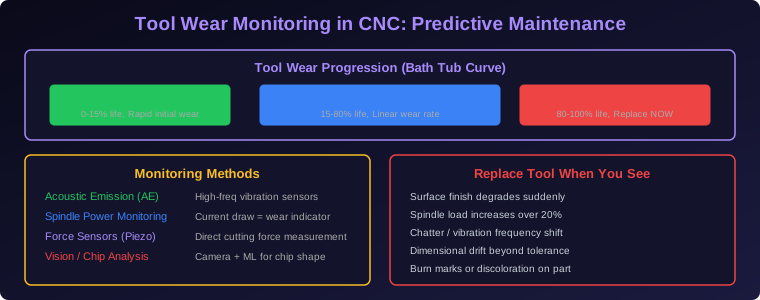
Tool wear is an inevitable aspect of CNC machining, but proactive monitoring can transform it from a hidden cost center into a manageable variable. Traditional approach — replacing tools on a fixed schedule or after reported breakage — results in unnecessary tool replacement costs and unplanned downtime from catastrophic failure.
Real-time tool wear monitoring systems use force sensors, acoustic emission, or cutting current monitoring to detect wear signatures before visible failure occurs. The most accessible approach for Indian shops is monitoring spindle load and cutting current, which correlates strongly with tool wear rate.
Key indicators of increasing tool wear:
- Gradual increase in cutting current (typically 3–5% per 100 components)
- Rising spindle power consumption without feed rate changes
- Slight increase in surface roughness over successive parts
- Dimensional drift exceeding tolerance windows
Implementation roadmap:
- Baseline establishment: Monitor and record cutting current for 50 consecutive parts under stable conditions
- Wear threshold setting: Define acceptable deviation (typically 5–7% from baseline) that triggers inspection
- Predictive replacement: Schedule tool changes at predicted wear point, not at failure
- Documentation: Track wear patterns by material, tool geometry, and operating parameters for continuous improvement
For Indian shops, even basic spindle load monitoring can extend tool life by 20–30% and reduce unplanned downtime by 40–50%.
4. Chip and Scrap Waste Reduction
Chip and scrap waste in CNC machining represents both a cost and an environmental concern. Metal chips from turning, milling, and drilling operations occupy storage space, require disposal, and represent lost material value. Effective chip management reduces these burdens while often improving machining conditions.
Chip formation characteristics vary significantly by material:
- Steel: Continuous chips with built-up edge at low speeds; segmented chips at optimal speeds
- Aluminum: Long, stringy chips that can wrap around the tool and workpiece
- Cast iron: Fragile chips that break easily but generate fine dust
- Exotics (titanium, Inconel): Chips that may weld to the tool flank
Effective chip reduction strategies include:
- High-efficiency milling (HEM) with reduced chip load per flute
- Coolant-through tooling to flush chips from the cutting zone
- Chip breakers and variable flute spacing in tool design
- Chip conveyors and magnetic separation for automated removal
- Nesting optimization to minimize material usage from stock
For Indian machine shops, chip briquetting and selling scrap aluminum/steel can generate additional revenue streams of Rs 10,000–50,000 per month depending on operation scale and material type.
5. Coolant Delivery and Management
Coolant delivery is often overlooked as a productivity lever in CNC machining. Effective coolant management serves multiple functions: heat dissipation, chip flushing, corrosion prevention, and tool life extension. The right coolant strategy for the right material can improve tool life by 20–40% and surface finish quality significantly.
Coolant types and their applications:
- Emulsions (oil-water mixtures): General-purpose, good for steel and iron, moderate corrosion protection
- Synthetic fluids: Cleaner than emulsions, good for aluminum and non-ferrous metals
- Pure oil: High lubricity for titanium and difficult-to-machine materials
- MQL (Minimum Quantity Lubrication): Oil mist delivery, minimal environmental impact, good for finishing operations
Delivery methods and their effectiveness:
- Flood coolant: Traditional coverage, high volume, good for roughing
- Through-tool coolant: Direct delivery to cutting edge, excellent for deep cavities and small tools
- High-pressure coolant (HPC): 50–100 bar, superior chip flushing, reduces built-up edge
- MQL: 0.5–5 ml/h oil mist, minimal cleanup, suitable for finishing and non-ferrous
Best practices for Indian shop floors:
- Maintain coolant concentration at manufacturer-specified levels (typically 6–8% for emulsions)
- Monitor pH and bacterial growth weekly; replace coolant every 2–3 weeks or per manufacturer recommendation
- Filter and recycle coolant to reduce operating costs by 30–50%
- Use appropriate coolant for material — emulsion for steel/iron, synthetic for aluminum, MQL for finishing
6. Workholding and Fixture Design
Workholding efficiency directly impacts CNC machining cycle time and part accuracy. Poor workholding setup time can account for 20–30% of total production time, especially in job shop environments with frequent job changes. Optimized fixture design reduces setup time, improves part consistency, and enables unattended machining.
Key principles of effective workholding:
- Modular fixture systems — interchangeable components reduce custom fixture design time
- Multiple-part clamping — fixtures that hold 2–4 parts simultaneously multiply effective machine utilization
- Pallet systems — allow one setup while another part is being machined, effectively doubling available machining time
- Locating features — design parts with built-in datum features for quick, repeatable setup
- Avoiding over-clamping — excessive clamping force can deform thin-walled parts and introduce residual stress
For Indian machine shops, standardized T-slot plates and vise-fixtures provide quick changeover capability without significant capital investment. A typical modular fixture system can reduce setup time from 45 minutes to under 10 minutes, enabling same-day job changes.
7. Preventive Maintenance Scheduling
Preventive maintenance is the foundation of consistent CNC machining performance and longevity. A well-maintained machine delivers predictable accuracy, reduced scrap rates, and lower repair costs compared to reactive maintenance approaches. For Indian shops operating multiple shifts, a structured maintenance schedule is essential.
Daily maintenance checklist:
- Clean chip guards and way wipers to prevent abrasive particle ingress
- Check and top off coolant levels and concentration
- Inspect tool holders for wear, corrosion, or damage
- Verify coolant pressure and flow rate
- Log any unusual vibrations, noises, or temperature readings
Weekly maintenance tasks:
- Lubricate way surfaces and ball screws per manufacturer specification
- Check and adjust belt tension on spindle and axis drives
- Inspect and clean tool magazine or carousel
- Verify axis calibration and backlash compensation values
- Clean coolant filters and replace if restricted
Monthly maintenance items:
- Full way wiper inspection and replacement if damaged
- Spindle bearing inspection and temperature monitoring
- Calibration verification using test bars and dial indicators
- Hydraulic pressure check and filter replacement
- Electrical cabinet inspection and contact tightening
For Indian shops, documenting maintenance history and tracking mean time between failures (MTBF) by machine enables data-driven maintenance intervals rather than arbitrary schedules. Machines with documented preventive maintenance programs typically achieve 40–60% longer service life and 30–50% lower repair costs over a 5-year period.
8. ROI and Payback Calculations for Indian Shops
Investing in CNC optimization technologies requires clear financial justification. For Indian machine shops, the ROI calculation should account for direct cost savings, indirect productivity gains, and competitive positioning benefits.
Typical investment categories and expected returns:
- Adaptive CAM post-processor upgrade: Rs 50,000–2,00,000 | Annual savings: Rs 2–8 lakhs | Payback: 3–8 months
- Real-time tool monitoring system: Rs 1–5 lakhs | Annual savings: Rs 3–12 lakhs | Payback: 4–12 months
- High-pressure coolant system: Rs 2–10 lakhs | Annual savings: Rs 2–15 lakhs | Payback: 6–18 months
- Modular fixture system: Rs 1–5 lakhs | Annual savings: Rs 1–6 lakhs (setup time reduction) | Payback: 6–18 months
- 5-axis upgrade (3+2 or full 5-axis): Rs 25–80 lakhs | Annual revenue increase: Rs 20–100 lakhs | Payback: 12–30 months
Sample ROI calculation for a 3-unit Indian machine shop:
- Investment: Rs 3 lakhs in adaptive clearing software and training
- Annual cycle time reduction: 30% on 500 parts/month
- Labor savings: Rs 500/part x 500 parts x 12 months = Rs 3.0 lakhs
- Tool life extension: 35% reduction in tooling costs from Rs 2.0 lakhs/year to Rs 1.3 lakhs/year
- Total annual savings: Rs 4.3 lakhs
- Payback period: Rs 3.0 lakhs / Rs 4.3 lakhs per year = 8.4 months
For most Indian machine shops, the key is starting with lower-cost interventions (CAM upgrades, monitoring, fixture improvements) before committing to major capital investments like 5-axis machines. The cumulative effect of multiple small improvements often outperforms single large investments.
9. Related Reading
- 5-Axis CNC Machining in 2026: Why Indian Manufacturers Are Moving Beyond 3-Axis
- AI Tool Wear Detection in 2026: How CNC Shops Are Cutting Scrap Before the Tool Fails
- Tool Wear Monitoring for CNC Machining
10. Sources
- Society of Manufacturing Engineers — CNC Machining Resources
- ISO 14649 — Machine Tool and Tooling Standards
- Autodesk Fusion 360 — Adaptive Clearing Documentation
- Mastercam — High Efficiency Machining Guides
- Bureau of Energy Efficiency India — Industrial Efficiency Programs
Key Takeaways
- Adaptive clearing and optimized toolpaths can reduce CNC cycle times by 25–40% and extend tool life by 30–50%
- Real-time tool wear monitoring via spindle load observation can prevent unplanned downtime and reduce tooling costs by 20–30%
- Effective chip management and scrap recovery generate additional revenue of Rs 10,000–50,000/month for Indian shops
- Coolant management is a high-leverage lever — proper selection and maintenance can improve tool life by 20–40%
- Modular fixture systems reduce setup time from 45 min to under 10 min, enabling same-day job changes
- Cumulative ROI from multiple small improvements often exceeds single large investments — typical payback 6–18 months