How CNC & Machining Are Evolving with Digital Transformation in 2026
Key Takeaway
CNC and machining are undergoing a radical digital transformation in 2026, driven by edge AI, digital twins, and Industry 5.0. Smart machines now self-optimize, predict failures, and adapt to changing requirements in real-time.
Figure 1: CNC Machine Evolution from Legacy to AI-Smart Manufacturing
Table of Contents
- 1. The Digital CNC Revolution
- 2. Edge AI on the Factory Floor
- 3. Digital Twins for Machining Optimization
- 4. Industry 5.0 Human-Machine Collaboration
- 5. Sustainable Machining Practices
- 6. Additive-Subtractive Hybrid Manufacturing
- 7. Workforce Development and Skills Gap
- 8. Global Supply Chain Implications
1. The Digital CNC Revolution
Traditional CNC machines have long been the backbone of manufacturing, but 2026 marks a decisive shift. Legacy G-code programming is being augmented—and in some cases replaced—by adaptive toolpaths generated by AI algorithms that learn from each operation.
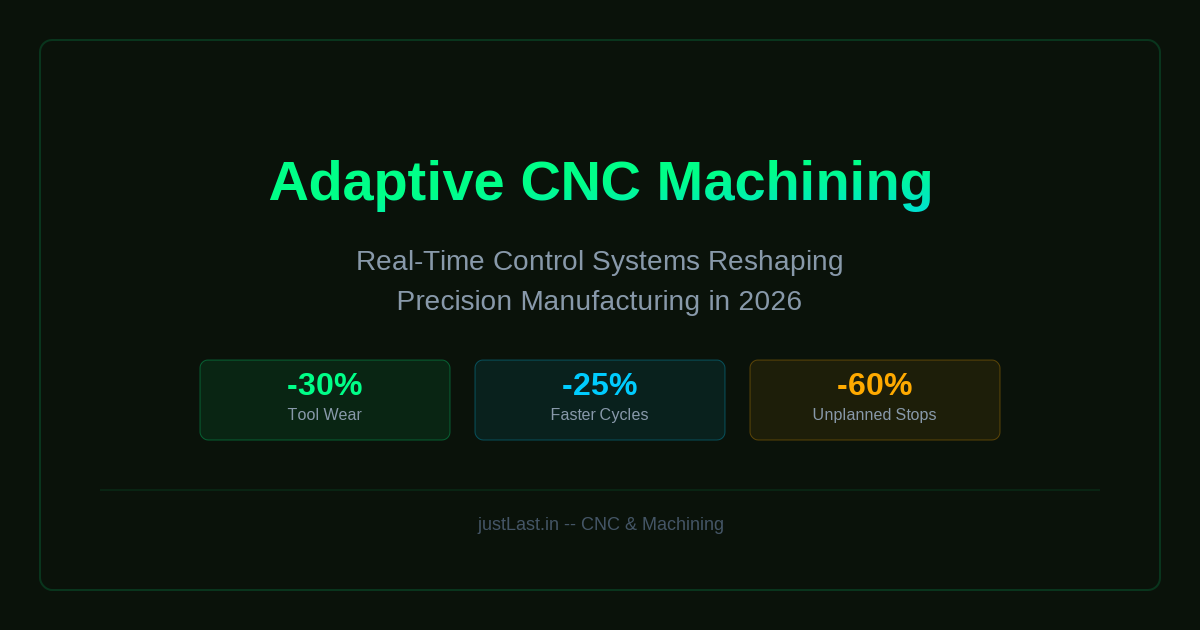
Modern CNC controllers now integrate real-time sensor data from spindle load, vibration, and temperature monitors. Machine learning models analyze this data to predict tool wear before it becomes critical, adjusting cutting parameters on the fly to maintain optimal surface finish and extend tool life by 20-30%. This predictive capability alone represents a fundamental shift from reactive maintenance to proactive optimization.
2. Edge AI on the Factory Floor
Edge computing brings AI inference directly to the machine controller, eliminating the latency and bandwidth concerns of cloud-dependent approaches. TinyML models running on embedded chips can detect anomalies in vibration patterns, classify surface defects in real-time, and even optimize feed rates based on material properties detected during machining.
For example, an edge AI system can distinguish between normal cutting chatter and dangerous tool-path deviations within milliseconds, triggering automatic slowdowns or operator alerts before costly damage occurs. This capability is particularly valuable for unattended night and weekend shifts.
3. Digital Twins for Machining Optimization
A digital twin creates a virtual replica of a physical CNC machine, including its kinematics, tooling, and material interactions. By simulating machining operations before execution, manufacturers can verify tool collisions, optimize tool-changing sequences, and validate surface finish predictions—all without risking expensive workpiece material or machine time.
During actual production, the digital twin compares real-time sensor data against simulated expectations, flagging deviations that indicate tool degradation, programming errors, or fixture issues. This closed-loop feedback cycle enables continuous improvement across production runs.
4. Industry 5.0 Human-Machine Collaboration
Unlike Industry 4.0’s focus on automation alone, Industry 5.0 emphasizes the complementary strengths of humans and machines. CNC operators are evolving into advanced manufacturing technicians who oversee smart machine fleets, intervene when AI systems encounter unfamiliar scenarios, and contribute creative problem-solving for novel workpieces.
Collaborative robots (cobots) now handle material loading/unloading while human operators focus on setup optimization, quality verification, and complex programming tasks. This human-machine partnership improves both productivity and job satisfaction.
5. Sustainable Machining Practices
Digital transformation also enables environmental gains. Adaptive machining reduces energy consumption by 15-25% by optimizing spindle speed and feed rate based on real-time conditions. Predictive tool changeover minimizes waste from defective parts. And digital twins enable “what-if” analysis of different machining strategies to identify the most resource-efficient approach for each workpiece.
Coolant recycling systems integrated with machine monitoring further reduce fluid consumption and hazardous waste, aligning CNC operations with broader sustainability goals.
6. Additive-Subtractive Hybrid Manufacturing
The convergence of 3D printing and CNC machining is creating hybrid machines that can build near-net-shape components additively and then finish them with high-precision subtractive operations in a single setup. This capability reduces lead time, eliminates intermediate inspections, and enables geometries that are impossible with pure additive or subtractive processes.
Industries from aerospace to medical devices are adopting hybrid manufacturing for components requiring both complex internal structures and tight dimensional tolerances.
7. Workforce Development and Skills Gap
The transition to smart CNC machining demands new skills. Training programs now cover not only traditional machining theory but also data analytics, basic AI/ML concepts, digital twin creation, and cobot programming. Community colleges and technical schools are partnering with industry to develop curricula that address the practical skills needed on modern factory floors.
Meanwhile, experienced machinists are upskilling through on-the-job training with smart machines, ensuring that institutional knowledge translates to the digital era.
8. Global Supply Chain Implications
Smart CNC capabilities are reshaping global manufacturing footprints. Regions that once relied on low-cost labor for basic machining are investing in automation to maintain competitiveness. Meanwhile, countries with advanced manufacturing ecosystems are leveraging digital CNC to offer mass-customization services—producing small batches of personalized components at near-mass-production prices.
This shift has implications for reshoring decisions, as the cost advantage of offshoring diminishes when domestic smart factories can produce quickly and efficiently.
Related Reading
- AI & Edge Computing in Manufacturing 2026
- Digital Twins for Industrial Machinery 2026
- Collaborative Robots in Manufacturing 2026
Sources
- IndustryWeek, “State of Manufacturing 2026: Digital Transformation Report,” Q1 2026.
- Deloitte, “Smart Factory Index 2026,” June 2026.
- IMT Journal, “Edge AI in Manufacturing: Use Cases and Impact,” May 2026.
- SME, “CNC Technology Trends 2026,” April 2026.
- McKinsey & Company, “The Future of Production,” February 2026.
- National Institute of Standards and Technology (NIST), “Advanced Manufacturing Technology Roadmap,” 2026.
- Oxford Academic, “Hybrid Manufacturing: Additive-Subtractive Integration,” 2026.
Key Takeaways
- Edge AI enables real-time tool wear prediction and adaptive machining parameters, extending tool life by 20-30%.
- Digital twins provide virtual simulation and closed-loop feedback for continuous optimization.
- Industry 5.0 emphasizes human-machine collaboration, improving both productivity and job satisfaction.
- Hybrid additive-subtractive manufacturing combines the strengths of both approaches for complex geometries.
- Sustainable machining practices reduce energy consumption by 15-25% and hazardous waste.
- Workforce development must address both traditional skills and new digital competencies.
- Smart CNC is reshaping global supply chains and reshoring decisions.
- Predictive maintenance and real-time quality monitoring reduce scrap rates and rework.