Key Takeaway: Edge computing has transitioned from experimental technology to a core architectural pillar for Industry 4.0 in 2026. By processing data locally on factory floors instead of sending it to the cloud, manufacturers are achieving sub-50ms decision loops, reducing unplanned downtime by up to 60%, and cutting WAN bandwidth costs by 40% while keeping sensitive production data on-premises.
Table of Contents
Why Edge Computing Matters in Manufacturing
Modern manufacturing processes generate terabytes of data per day from sensors, PLCs, vision systems, and robotic controllers. Sending all this data to the cloud introduces unacceptable latency for closed-loop control. Edge computing processes data locally, within the factory network, enabling real-time analytics and AI inference that would be impossible with cloud-dependent architectures.
The shift from cloud-centric to edge-centric thinking is driven by several converging factors. Deterministic networking standards like Time-Sensitive Networking (TSN) now guarantee sub-millisecond response times for control loops. AI inference at the edge means defect detection and predictive maintenance happen in real time. A 2026 study of an FMCG manufacturer deploying edge-based analytics demonstrated 58% less unplanned downtime, yield improvement from 81% to 93%, and a projected first-year ROI of 3.8x.
2026 Edge Computing Reference Architecture
The modern edge computing stack follows a layered architecture: IIoT sensors and PLCs feed data through edge gateways using OPC UA, MQTT, and Modbus TCP. Industrial PCs or ruggedized edge servers run containerized AI models for real-time inference. Local time-series databases store historical data while syncing only metadata to the cloud, reducing WAN costs by up to 40%.
Real-World Deployments
Audi’s Edge Cloud 4 Production
Audi deployed EC4P at the Bollinger Hofe plant since July 2023, virtualizing legacy IPCs and HMI devices onto centralized server clusters. Upgrade times dropped from 20 minutes per device to minutes across hundreds of stations. Audi deployed the world’s first TUV-certified virtual failsafe PLC, proving safety workloads can run entirely in software.
NTT DATA and Hyster-Yale Physical AI
NTT DATA and Hyster-Yale announced physical AI in manufacturing assembly that integrates vision sensors and edge AI to validate assembly steps in real time, cutting deployment timelines from months to weeks.
AWS Autonomous Production Line
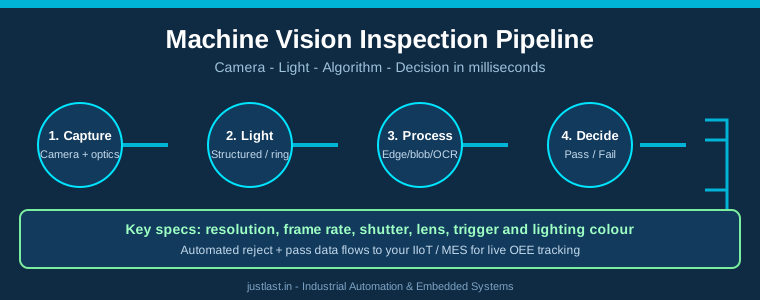
At Hannover Messe 2026, AWS and SoftServe demonstrated a fully autonomous production line using ROS2, Amazon Bedrock AgentCore, and NVIDIA Jetson Thor for AI inference. Quality inspection ran in under 5 seconds with zero training data required.
Hardware Choices
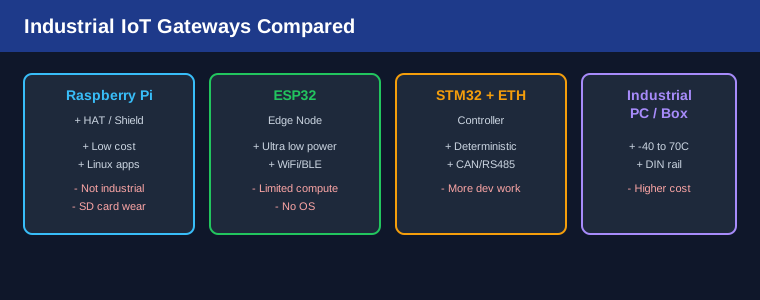
Fanless industrial PCs with Intel Xeon or AMD EPYC ($5,000-$15,000) handle heavy AI workloads. NVIDIA Jetson AGX Orin devices provide high-throughput inference at 15-75W. FPGAs from Xilinx or Intel enable ultra-low-latency deterministic processing.
ROI and Business Case
ROI from edge computing is typically realized within 6 to 12 months. A four-line deployment costs approximately $420,000 with a projected first-year net benefit of $1.6M, driven by downtime avoidance ($720K), yield improvement ($510K), and defect reduction ($280K).
Frequently Asked Questions
How does edge computing differ from cloud computing for manufacturing?
Edge computing processes data locally with 1-5ms inference times, compared to 200ms-several seconds for cloud. Edge analytics operates fully during network outages.
Can edge computing work with existing SCADA and MES systems?
Yes. Edge platforms complement existing systems via OPC-UA and SQL database connections without requiring new sensor installations.
What AI models run at the edge?
Optimized neural networks using TensorRT or ONNX Runtime run on GPU/NPU accelerators for defect detection, predictive maintenance with LSTM models, and quality control classification.
Sources
- Edge Computing in Manufacturing: 2026 State of the Art
- Audi EC4P Transformation
- NTT DATA and Hyster-Yale Physical AI
- AWS Autonomous Factory