Key Takeaway: Choosing between a CNC spindle and a trim router for your machine involves balancing precision, noise, cost, and longevity. Spindles offer superior accuracy and quiet operation for production, while routers deliver adequate performance at a fraction of the cost for hobby builds.
Table of Contents
1. What Is a CNC Spindle?
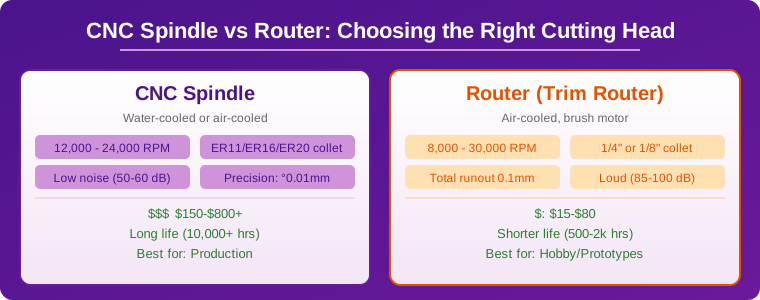
A CNC spindle is a precision motor designed specifically for computer-controlled machining. Unlike a handheld router, a spindle uses a three-phase induction motor or a brushless DC motor paired with a VFD (Variable Frequency Drive) that controls both speed and torque electronically. The VFD converts single-phase AC to three-phase variable-frequency output, allowing the spindle to maintain constant torque across its speed range.
Spindles use ER collet chucks (ER11, ER16, ER20 being the most common) which provide concentric runout of 0.01 mm or less — significantly better than the 0.1 mm typical of router collets. This precision directly translates to better surface finish, tighter tolerances, and longer tool life. The collet system also allows tool changes in seconds without needing wrenches on many models.
CNC spindles come in air-cooled and water-cooled variants. Air-cooled spindles are simpler and cheaper but louder (around 60-70 dB). Water-cooled spindles run near-silent (50-60 dB) and can sustain continuous operation without overheating, making them the preferred choice for production environments.
2. What Is a Trim Router in CNC?
A trim router (or laminate trimmer) is a compact handheld power tool adapted for CNC use. Common models include the Makita RT0701C, Bosch GKF1250, Dewalt DWP611, and generic Chinese 500W-1500W routers. These tools use universal brushed motors that run directly on 120V/240V AC at a fixed speed (or 2-6 speed settings on variable-speed models).
Routers use 1/4-inch or 1/8-inch collets (some accept 6mm in metric versions). The collet runout on a typical trim router is 0.05-0.15 mm, which is acceptable for wood and plastic but problematic for precision aluminum work or small-diameter end mills.
The main advantage of a trim router is cost — a quality unit costs $50-100 compared to $200-800 for a spindle plus VFD. For prototype work, one-off parts, and hobby machining, a router provides perfectly adequate results. Many Shapeoko, Workbee, and LowRider builds use routers as their default spindle.
The downside is noise (85-100 dB — hearing protection mandatory), shorter brush life (500-2000 hours before brush replacement), and less torque at low RPM. Routers are designed for woodworking at high RPM (20,000-30,000) and struggle with metals that require lower speeds with higher torque.
3. Spindle vs Router: Side-by-Side Comparison
| Parameter | CNC Spindle | Trim Router |
|---|---|---|
| Price Range | $150 – $800+ | $15 – $80 |
| RPM Range | 12,000 – 24,000 | 8,000 – 30,000 |
| Noise Level | 50-60 dB (water-cooled) | 85-100 dB |
| Runout (Precision) | ±0.01 mm | ±0.05-0.15 mm |
| Collet Type | ER11/ER16/ER20 | 1/4″ or 1/8″ |
| Lifespan | 10,000+ hours | 500-2,000 hours |
| Cooling | Air or water | Air (fan) |
| Torque at Low RPM | Excellent (VFD control) | Poor |
4. When to Upgrade to a CNC Spindle
You should consider upgrading from a router to a spindle when you need to do any of the following: run production jobs lasting more than 2 hours continuously, machine aluminum or steel (requires low RPM high torque), achieve surface finish better than Ra 1.6 μm, work in a shared workshop space where noise matters, or use small end mills (under 1/8-inch) where runout breaks tools.
The upgrade cost is significant. A 1.5 kW water-cooled spindle kit (spindle + VFD + water pump + hoses) costs around $200-350 from Chinese suppliers, while reputable brands like HSD, Colombo, or Perske cost $800-3000+. The VFD alone requires proper CAM post-processor configuration for M3/M4/M5 spindle control codes.
5. Budget Recommendations
Budget (under $100): Stick with a Makita RT0701C or Bosch Colt trim router. These are reliable, parts are widely available, and they deliver good results for wood, plywood, MDF, and plastics. Accept the noise and shorter lifespan.
Mid-Range ($150-$400): A Chinese 1.5 kW water-cooled spindle with VFD. This is the most popular setup for hobbyists who want spindle performance without the brand premium. The Huanyang VFDs are adequate but require careful parameter configuration.
Pro ($500+): A branded spindle from HSD, Colombo, or an automated quick-change spindle. These come with proper documentation, CE/UL certification, and reliable spindle load monitoring for tool breakage detection.
Frequently Asked Questions
Can I use a trim router for aluminum machining?
Yes, but with limitations. You need to take very light cuts (0.2-0.5 mm depth), use appropriate feeds and speeds, and apply cutting lubricant. The router’s high runout and limited low-RPM torque make heavy cuts impractical. Small engraving cuts work well; production runs require a spindle.
Do I need a VFD for a CNC spindle?
Yes. A VFD (Variable Frequency Drive) is required to power and control any three-phase CNC spindle from single-phase mains power. The VFD converts AC to DC and back to three-phase AC at the desired frequency, which determines spindle RPM. Without a VFD, the spindle will not run.
Can I wire a router directly to my CNC controller?
Most routers can be switched via a relay or solid-state relay connected to your CNC controller’s spindle output. For routers with variable speed, you control speed manually — the CNC controller only turns the router on and off. Some advanced setups use PWM-to-voltage converters for speed control.
How do I know when a CNC spindle needs replacement?
Signs include excessive noise (grinding, whining), visible runout when measured with a dial indicator, overheating despite proper cooling, or electrical faults. Spindle bearings typically last 3,000-10,000 hours depending on load and maintenance. Replacing bearings is often possible and cheaper than a full spindle replacement.
Which is quieter, air-cooled or water-cooled spindle?
Water-cooled spindles are significantly quieter because they lack the cooling fan that generates most of an air-cooled spindle’s noise. A water-cooled spindle operates at 50-60 dB (conversation-level), while air-cooled spindles run at 60-75 dB. Routers run at 85-100 dB, requiring hearing protection.
Related Reading
- CNC Control Software Comparison: GRBL vs Mach3 vs LinuxCNC
- Fusion 360 CAM Guide: Complete CNC Toolpath Creation Workflow
- Predictive Maintenance in CNC Machining
Sources
- Makita RT0701C Compact Router Specifications
- Bosch Colt Router Specifications
- HSD Spindle Specifications and Selection Guide
- AH R&D: CNC Spindle vs Router — Detailed Breakdown
Disclosure: This post contains affiliate links to products recommended based on our testing. We may earn a commission if you purchase through these links.