Key Takeaway: The ESP32-S31 is Espressif’s most powerful microcontroller yet — a dual-core 320 MHz RISC-V chip with Wi-Fi 6, Bluetooth 5.4, Zigbee/Thread, Gigabit Ethernet and Matter support, now in mass production as of July 2026.
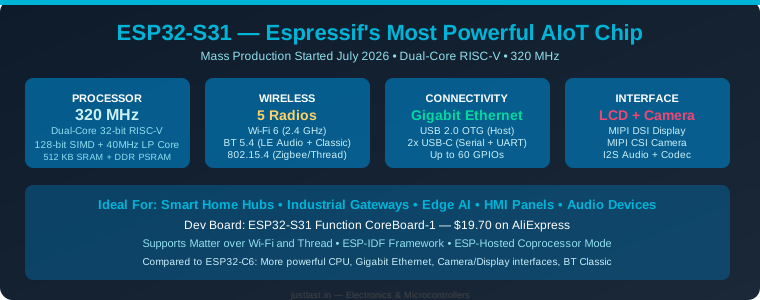
Table of Contents
1. What Is the ESP32-S31?
Espressif Systems announced that the ESP32-S31 entered mass production in July 2026, making it the most feature-rich wireless microcontroller the company has ever produced. Designed for next-generation AIoT applications, the ESP32-S31 combines five wireless radios, a powerful dual-core RISC-V processor, Gigabit Ethernet, and camera/display interfaces on a single chip.
For embedded systems engineers, industrial IoT gateway builders and Matter/Thread enthusiasts, the ESP32-S31 represents a significant step up from the popular ESP32-C6 and ESP32-S3. It bridges the gap between low-cost Wi-Fi MCUs and more expensive application processors, offering enough compute power for edge AI, HMI panels and smart home hubs while retaining the low power consumption and affordability expected from the ESP32 family.
2. Key Specifications and Features
Processor
The ESP32-S31 features a dual-core 32-bit RISC-V CPU running at up to 320 MHz, with one core supporting a 128-bit data path and SIMD instruction set for accelerated computing. A 40 MHz low-power coprocessor handles background tasks while the main cores sleep. The chip includes 512 KB of on-chip SRAM and supports high-speed 250 MHz DDR PSRAM expansion for memory-intensive applications.
Memory and GPIO
With up to 60 GPIO pins, the ESP32-S31 offers significantly more I/O than the ESP32-C6 (30 GPIOs) or the ESP32-S3 (45 GPIOs). This makes it suitable for complex industrial applications requiring multiple sensor interfaces, display connections and communication buses simultaneously.
Display and Camera Interfaces
The ESP32-S31 integrates MIPI DSI (display) and MIPI CSI (camera) interfaces — a first for ESP32-class chips. This enables building compact HMI panels, smart displays and vision-enabled IoT devices without requiring a separate application processor. Combined with the I2S audio interface and onboard codec support, the chip can handle multimedia applications that previously required multiple components.
3. Five Radios on One Chip
The ESP32-S31’s standout feature is its wireless connectivity suite. Five radios on a single chip eliminates the need for separate modules or external components:
- Wi-Fi 6 (2.4 GHz) — 802.11ax with OFDMA and BSS Coloring for efficient operation in congested environments
- Bluetooth 5.4 — including LE Audio and Classic BR/EDR for legacy device compatibility
- IEEE 802.15.4 — Zigbee and Thread support for Matter smart home connectivity
- Gigabit Ethernet MAC — wired networking at 10/100/1000 Mbps for industrial reliability
- Matter over Wi-Fi and Thread — native support for the interoperability standard
The combination of Wi-Fi 6, Bluetooth 5.4 and 802.15.4 means a single ESP32-S31 can serve as a Matter bridge between Thread sensors and Wi-Fi infrastructure, or as a smart home hub that communicates with devices across multiple protocols.
4. Development Boards: CoreBoard and Korvo
ESP32-S31 Function CoreBoard-1 ($19.70)
The CoreBoard is the practical workhorse for evaluation and prototyping. Based on the ESP32-S31-WROOM-3 module, it features Gigabit Ethernet via RJ45, USB 2.0 OTG (Type-A host port with 500 mA supply), two USB-C ports (Serial/JTAG and UART), an onboard audio codec (ES8311), Class-D amplifier (NS4150B) for driving a 3W speaker, and an addressable RGB LED. It is available on AliExpress for $19.70.
ESP32-S31-Korvo-1 ($58.41)
The Korvo board targets multimedia and voice applications. It features a dual-microphone array for speech recognition, near/far-field wake-up, two speaker connectors, a 4.3-inch LCD display, a 3MP camera module, and a microSD card slot. This board is designed for building connected audio/video and HMI devices. Available on AliExpress for $58.41.
5. ESP32-S31 vs ESP32-C6 vs ESP32-S3
Choosing the right ESP32 chip depends on your application requirements:
| Feature | ESP32-S31 | ESP32-C6 | ESP32-S3 |
|---|---|---|---|
| CPU | Dual-core RISC-V 320 MHz | Single-core RISC-V 160 MHz | Dual-core Xtensa 240 MHz |
| Wi-Fi | Wi-Fi 6 | Wi-Fi 6 | Wi-Fi 4 |
| Bluetooth | 5.4 (LE Audio + Classic) | 5.0 (LE only) | 5.0 (LE only) |
| 802.15.4 | Yes | Yes | No |
| Ethernet | Gigabit | No | No |
| GPIO | 60 | 30 | 45 |
| Camera/Display | MIPI CSI + DSI | No | Parallel camera only |
| Best For | Gateways, HMI, hubs | Low-cost Thread sensors | Wi-Fi-only AI projects |
The ESP32-C6 remains the best choice for low-cost, low-power Thread sensors where you only need Wi-Fi 6 and 802.15.4. The ESP32-S3 is better for AI projects that need PSRAM and camera support but do not need Thread or Ethernet. The ESP32-S31 sits above both, offering the full connectivity suite plus wired networking and multimedia interfaces.
6. Ideal Use Cases
Smart Home Hubs and Bridges
The ESP32-S31 can serve as a Matter bridge connecting Thread sensors to Wi-Fi infrastructure, or as a full smart home hub with local automation. Gigabit Ethernet provides reliable wired backbone connectivity while Wi-Fi 6 and Thread handle wireless device communication.
Industrial IoT Gateways
For industrial IoT applications, the combination of Gigabit Ethernet, multiple wireless radios and up to 60 GPIOs makes the ESP32-S31 suitable as a compact edge gateway. The dual-core 320 MHz processor with SIMD support can handle local data processing, protocol translation and cloud connectivity simultaneously.
HMI Panels and Smart Displays
MIPI DSI display and MIPI CSI camera support enable building compact human-machine interfaces. Combined with I2S audio and the ESP-IDF framework, developers can create touch-screen control panels, security monitors and interactive kiosks.
Connected Audio Devices
Bluetooth LE Audio support, onboard audio codec interfaces and the Korvo board’s dual-microphone array make the ESP32-S31 suitable for smart speakers, voice assistants and connected audio systems.
7. Getting Started with ESP-IDF
The ESP32-S31 is supported by Espressif’s ESP-IDF development framework. Since the chip is relatively new, some features may require the master branch of ESP-IDF rather than stable releases. The development workflow follows standard ESP32 patterns:
- Install ESP-IDF — clone the repository and run the install script for your platform (Windows, Linux or macOS)
- Select the target — set the build target to esp32s31
- Use the master branch — since the chip is new, the master branch has the most complete support
- Start with examples — Espressif provides example projects for Wi-Fi, Bluetooth, Thread and Matter
- Configure via menuconfig — enable the peripherals and wireless features you need
The chip also supports ESP-Hosted mode, where it functions as a connectivity coprocessor for a host MCU, and ESP-AT for AT command-based configuration. Documentation is available at the ESP32-S31 Developer Portal.
8. Frequently Asked Questions
How much does the ESP32-S31 cost?
The Function CoreBoard-1 development board is available for $19.70 on AliExpress. The Korvo multimedia board costs $58.41. Individual chip pricing for volume orders is available through Espressif’s sales team.
Is the ESP32-S31 backwards compatible with ESP32 code?
The ESP32-S31 uses RISC-V cores rather than the Xtensa cores found in the original ESP32 and ESP32-S3. Code written for those chips will need modification, but Espressif’s ESP-IDF framework provides a common API layer. Code written for the ESP32-C6 (also RISC-V) will be more directly portable.
Does the ESP32-S31 support Matter?
Yes. The ESP32-S31 supports Matter over both Wi-Fi and Thread. Espressif provides ESP-Matter integration in the development framework.
What is the difference between ESP32-S31 and ESP32-P4?
The ESP32-P4 is a higher-end application processor with HDMI output and more RAM, but it lacks wireless connectivity. The ESP32-S31 adds Wi-Fi, Bluetooth and 802.15.4 to a capable processor, making it a more integrated solution for connected applications.
Can I use the ESP32-S31 for industrial applications?
Yes. Gigabit Ethernet, wide GPIO count, Thread/Matter support and the dual-core processor make it suitable for industrial IoT gateways, HMI panels and control systems. For applications requiring certified functional safety, pair with an external safety controller.
Related Reading
- ESP32-C6 in 2026: Wi-Fi 6 + Zigbee/Thread and Matter on One RISC-V Chip
- Industrial IoT Gateways Compared: Raspberry Pi, ESP32, STM32 and Industrial PCs
- STM32 + ESP32 Industrial IoT Gateway Build Guide
Sources
- Espressif Systems — ESP32-S31 Now in Mass Production (July 2026)
- CNX Software — ESP32-S31 Development Boards Unveiled
- Elektor Magazine — ESP32-S31 Function CoreBoard-1
Disclosure: This post contains affiliate links. If you purchase through these links, we may earn a commission at no additional cost to you.