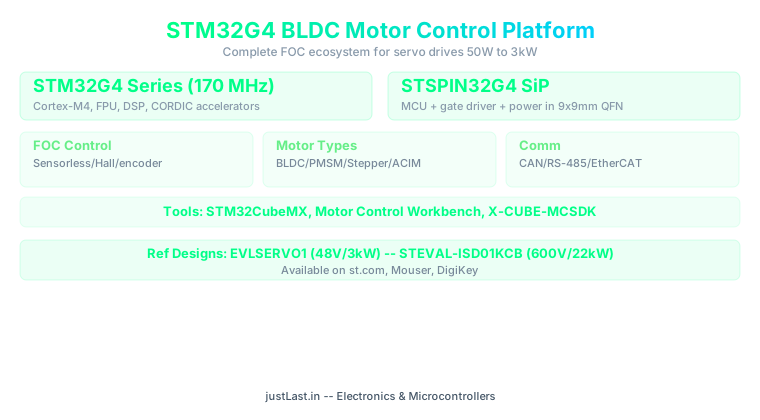
Key Takeaway: The STM32G4 series with its 170 MHz Cortex-M4 core, hardware accelerators, and advanced motor control timers has become the go-to microcontroller platform for building industrial-grade BLDC servo drives. Combined with ST’s STSPIN32G4 system-in-package and the free X-CUBE-MCSDK motor control SDK, developers can implement field-oriented control (FOC) for applications from 50W to 3kW.
If you are looking for STM32 motor control BLDC 2026 solutions, this guide covers the complete ecosystem.
Table of Contents
Why STM32G4 for Motor Control
The STM32G4 series is STMicroelectronics’ most optimized microcontroller family for motor control. With an Arm Cortex-M4 core at 170 MHz, FPU, DSP instructions, and CORDIC/FMAC hardware accelerators, it executes FOC algorithms in 8-12 microseconds.
The STM32 Motor Control Ecosystem
X-CUBE-MCSDK (free PMSM FOC firmware library, Motor Control Workbench GUI), STM32CubeMX, and STM32 Motor Pilot for real-time monitoring.
Hardware Platforms
Low Power (10W-200W): P-NUCLEO-IHM03. Mid Power (200W-3kW): EVLSERVO1 with STSPIN32G4. High Power (3kW-22kW): STEVAL-ISD01KCB with SIL 2 safety.
Implementing FOC on STM32G4
FOC transforms three-phase motor currents into a rotating d-q reference frame. Each 16-25 kHz cycle executes: ADC sampling, Clarke/Park transforms, PI controllers, SVM PWM generation.
Sensorless vs Sensored Control
Sensorless FOC (Luenberger/HSO observers) for pumps and fans. Sensored FOC (Hall/encoder) for full zero-speed torque in servo applications.
PCB Design Guidelines
Use 4-6 layer stackup, keep high-current paths short, place DC bus capacitors close to MOSFETs, use Kelvin connections for sense resistors.
FAQ
What is the difference between FOC and 6-step control?
FOC provides smooth torque with low noise. 6-step is simpler for basic applications.
Can I use STM32G4 for sensorless servo control?
Yes but without zero-speed torque. Use encoder for servo applications.
Is X-CUBE-MCSDK free?
Yes, download from st.com.