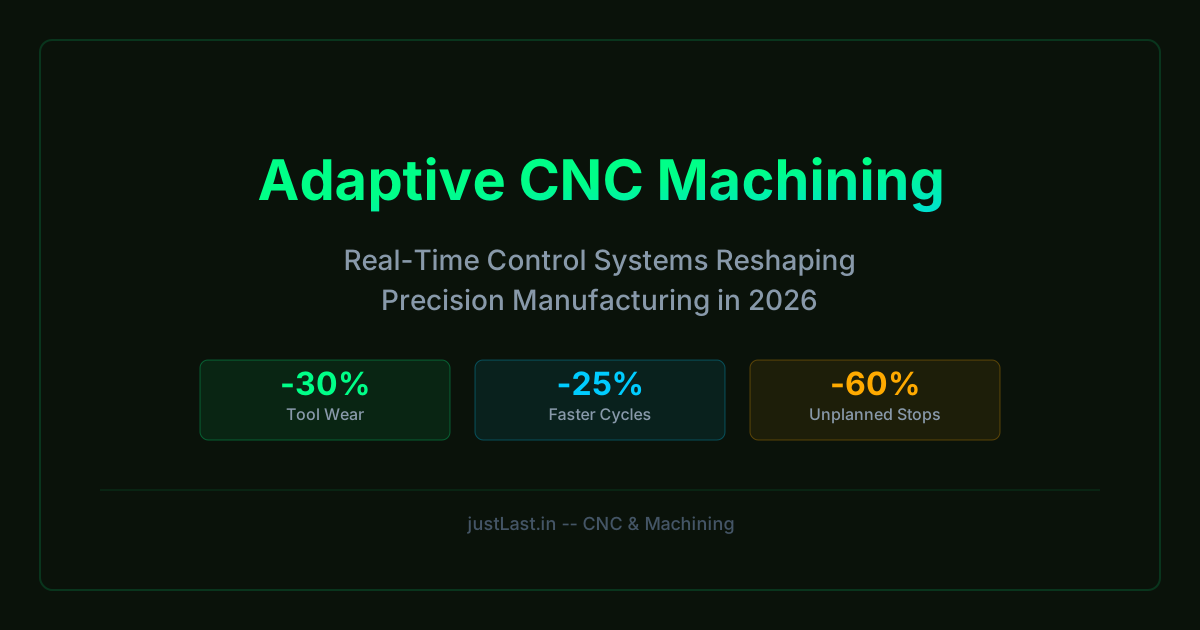
Key Takeaway: A structured CNC preventive maintenance schedule — daily, weekly, monthly, and quarterly — can prevent 80% of unplanned downtime and extend machine life by 5–10 years, saving manufacturers thousands in emergency repairs.
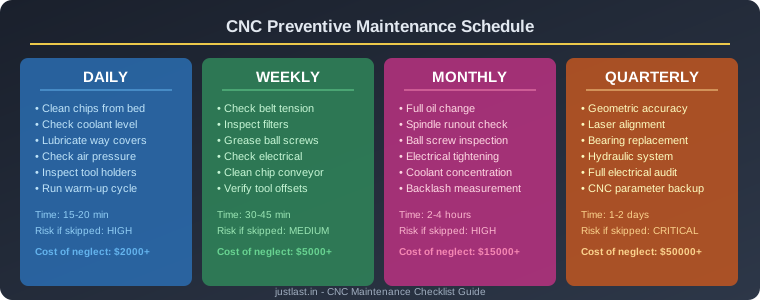
Table of Contents
1. Why Preventive Maintenance Matters
CNC machines are precision instruments costing $50,000 to $500,000+. Without regular maintenance, even the best machines degrade. Ball screws lose accuracy, spindle bearings develop play, way covers crack, and coolant systems corrode. The result: scrapped parts, extended downtime, and expensive emergency repairs.
Industry data shows that CNC machines receive only 2–4 hours of preventive maintenance per month on average, yet the cost of unplanned downtime ranges from $500 to $5,000 per hour depending on the machine and production environment. A $200/month investment in preventive maintenance can prevent $50,000+ in annual downtime losses.
The three pillars of CNC machine health:
- Cleanliness: Chips, coolant residue, and dust cause 60% of premature wear failures
- Lubrication: Proper lubrication reduces friction wear by 80% and extends bearing life 3–5x
- Calibration: Regular geometric checks catch accuracy drift before it produces scrap parts
2. Daily Maintenance Checklist (15–20 minutes)
Daily maintenance is the foundation of CNC machine health. These tasks should be performed at the start or end of every shift, before the machine is left idle overnight.
Daily tasks:
- Clean chips from the machine bed, table, and chip tray — Use a brush (never compressed air on precision surfaces). Chips trapped under the workpiece cause dimensional errors.
- Check coolant level and concentration — Top up as needed. Use a refractometer to verify concentration (typically 6–10% for water-soluble coolants). Low concentration causes bacterial growth and corrosion.
- Lubricate way covers and sliding surfaces — Apply way oil to exposed guideways. Check that way covers move freely without binding or scraping.
- Check air pressure (pneumatic systems) — Most CNC machines require 5.5–6.5 bar (80–95 PSI). Low pressure causes tool changer failures and chuck clamping issues.
- Inspect tool holders for damage — Check tapers for nicks, burrs, or coolant residue. A damaged tool holder causes runout that ruins surface finish.
- Run a 10-minute warm-up cycle — Move all axes through full range, cycle the spindle at 50% max RPM. This distributes lubricant and identifies any unusual sounds or vibrations.
Time estimate: 15–20 minutes. Risk if skipped: High — cumulative damage accelerates bearing and way wear.
3. Weekly Maintenance Checklist (30–45 minutes)
Weekly tasks address components that degrade more slowly but require periodic inspection and adjustment.
Weekly tasks:
- Check drive belt tension — Press the belt midway between pulleys. Deflection should be 10–15mm. Loose belts cause spindle speed inconsistency; overtight belts destroy bearings.
- Inspect and clean air filters — Remove, blow out with compressed air, and reinstall. Clogged filters reduce cooling efficiency and can cause electrical overheating.
- Grease ball screws — Apply lithium-based grease to ball screw nuts via grease fitting. Use 1–2 pumps of a quality ball screw grease (e.g., Mobilgrease XHP 222). Over-greasing attracts chips.
- Check electrical connections — Visually inspect terminal blocks for loose wires, signs of arcing, or heat discoloration. Tighten any loose connections.
- Clean chip conveyor — Remove accumulated chips from the conveyor belt and sump. Clogged conveyors cause coolant overflow and chip re-circulation.
- Verify tool offsets — Run a tool length check on a known reference. If offsets drift more than 0.02mm, investigate the tool changer or presetter.
Time estimate: 30–45 minutes. Risk if skipped: Medium — issues develop gradually over 2–4 weeks.
4. Monthly Maintenance Checklist (2–4 hours)
Monthly maintenance requires more thorough inspection and often involves disassembly of covers and access panels.
Monthly tasks:
- Full oil change — Drain and replace spindle oil and hydraulic oil. Use manufacturer-specified grades. Old oil loses viscosity and protection.
- Spindle runout check — Use a dial indicator to measure spindle runout at the taper. Maximum acceptable runout: 0.005mm (5 microns). Higher values indicate bearing wear.
- Ball screw inspection — Check for axial play by pushing/pulling the table. Any detectable play means the ball screw preload has degraded — schedule replacement.
- Electrical tightening — Systematically check all terminal connections with a torque screwdriver. Vibration loosens connections over time.
- Coolant concentration and pH testing — Use test strips. Ideal pH: 8.5–9.5. Below 8.0 indicates bacterial growth; above 10.0 causes skin irritation and metal staining.
- Backlash measurement — Use a dial indicator to measure backlash on each axis. Acceptable: less than 0.01mm for precision work. Excessive backlash indicates ball screw or bearing wear.
Time estimate: 2–4 hours. Risk if skipped: High — accuracy degradation becomes measurable within 1–2 months.
5. Quarterly Maintenance Checklist (1–2 days)
Quarterly maintenance is the most comprehensive and may require scheduled downtime. These tasks often require specialized tools and technician expertise.
Quarterly tasks:
- Geometric accuracy verification — Use a precision square, level, and dial indicator to check all axes for straightness, squareness, and parallelism. Compare to manufacturer specifications.
- Laser alignment check — For high-precision work, use a laser interferometer to measure positioning accuracy and repeatability across the full travel of each axis.
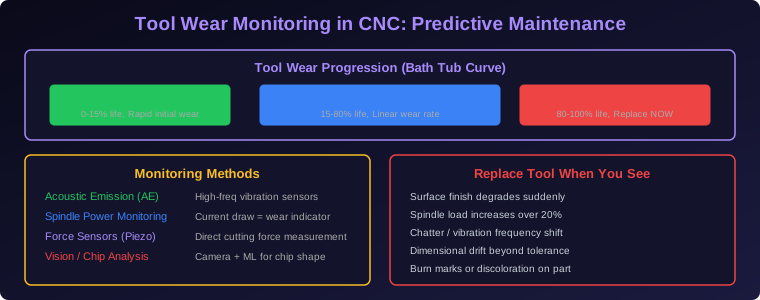
- Bearing inspection and replacement — Spindle bearings have a finite life (typically 5,000–10,000 hours). Monitor vibration levels and schedule replacement before failure.
- Hydraulic system inspection — Check hydraulic fluid level, filter condition, pressure settings, and hose integrity. Look for leaks at fittings and cylinders.
- Full electrical audit — Inspect all fuses, contactors, relays, and circuit boards. Check for burnt components, swollen capacitors, and corroded contacts.
- CNC parameter backup — Export all machine parameters, tool offset tables, and program files to USB or network storage. This recovery data is invaluable if the CNC controller fails.
Time estimate: 1–2 days. Risk if skipped: Critical — geometric errors compound over time and may require expensive reconditioning.
6. Maintenance Log Templates
Documenting every maintenance action creates a machine health history that enables predictive maintenance. A simple log should include:
| Date | Machine | Task | Findings | Action Taken | Next Due |
|---|---|---|---|---|---|
| 2026-08-07 | VMC-01 | Daily clean | Coolant low | Topped up, pH 8.8 | 2026-08-08 |
| 2026-08-07 | VMC-02 | Weekly belt | Tension OK | None needed | 2026-08-14 |
For digital tracking, consider using a simple spreadsheet or a free tool like Google Sheets shared across the shop floor. The key is consistency — a log that is not maintained is useless.
Frequently Asked Questions
How often should I change CNC coolant?
Full coolant replacement depends on usage, but a general guideline is every 3–6 months for water-soluble coolants and 6–12 months for semi-synthetic or synthetic coolants. Monitor pH weekly — when it drops below 8.0, it is time for a change. Regular skimming and filtration extend coolant life significantly.
What is the most common cause of CNC machine failure?
Lack of cleanliness is the #1 cause of premature CNC failure. Chips trapped in way covers, coolant residue on precision surfaces, and dust entering electrical cabinets cause 60% of preventable breakdowns. Daily cleaning is the single most impactful maintenance activity.
Should I hire an external technician for quarterly maintenance?
For most shops, quarterly geometric checks and spindle inspections should be performed by a qualified CNC service technician. Internal staff can handle daily, weekly, and most monthly tasks. The $500–$1,000 quarterly service fee is negligible compared to the cost of undetected accuracy drift producing scrap parts.
How do I know when my spindle bearings need replacement?
Monitor spindle vibration levels with a portable vibration analyzer. New bearings: less than 0.5 mm/s RMS. Warning threshold: 2.5 mm/s. Critical: greater than 4.0 mm/s. Also listen for changes in spindle sound — a high-pitched whine or grinding noise indicates bearing wear. Most spindle bearings last 5,000–10,000 operating hours.
Related Reading
- CNC Machine Calibration: Step-by-Step Accuracy Setup
- CNC End Mills: Complete Guide to Types, Materials and Selection
- Feeds and Speeds for CNC: Complete Calculation Guide
- VFD Motor Speed Control: Complete Installation Guide
Sources
- Modern Machining — CNC Preventive Maintenance Best Practices
- Haas Automation — Machine Maintenance Schedules
- Okuma — CNC Machine Maintenance Guide
- Machine Design — CNC Machine Tool Maintenance
Disclosure: This post contains affiliate links. If you purchase through these links, we may earn a commission at no additional cost to you. This helps support our content creation.