
Key Takeaway: There is no single best CNC coolant system — flood coolant gives maximum heat removal and chip flushing, mist (MQL) keeps the shop clean at a fraction of the cost, and through-spindle coolant reaches deep features that external nozzles cannot. Choosing the right one is about matching the coolant method to your material, operation and spindle capability.
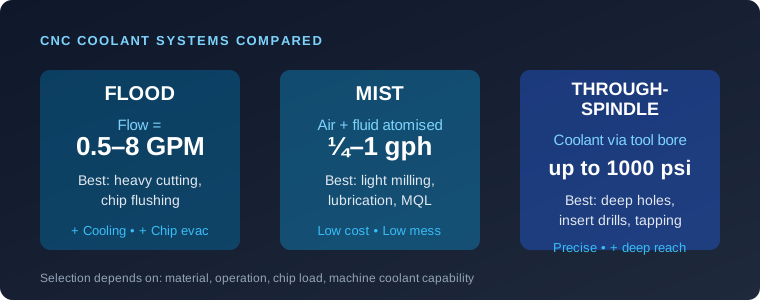
Table of Contents
- 1. Why Coolant Matters in CNC Machining
- 2. Flood Coolant
- 3. Mist and Minimum Quantity Lubrication (MQL)
- 4. Through-Spindle Coolant
- 5. How to Choose the Right CNC Coolant System
- 6. Coolant Maintenance Tips
- 7. FAQ
1. Why Coolant Matters in CNC Machining
Cutting generates heat, and heat is the enemy of both tool life and part accuracy. At high spindle speeds and chip loads, a steel workpiece can locally reach temperatures well above what the cutting edge can survive, burning the edge and work-hardening the part. CNC coolant systems exist to manage four jobs at once: carrying away heat, lubricating the cutting zone, flushing chips away from the tool, and preventing the workpiece from distorting as it warms up.
Studies on cutting fluids consistently show that effective cooling and lubrication can multiply tool life several times over compared with dry cutting, while also improving surface finish. But cooling is not the whole story. In some operations, particularly with carbide tooling and aluminum, aggressive cooling can cause thermal shock that shortens tool life — which is why the choice of system comes down to balancing cooling, lubricity and chip evacuation rather than simply blasting as much liquid as possible.
2. Flood Coolant
Flood coolant is the workhorse of the machine shop. A pump draws fluid from a coolant tank and delivers it through a nozzle or pipe directly at the cutting zone, and the fluid is collected, filtered and recirculated. Typical flow rates land anywhere from about 0.5 gallons per minute up to several gallons per minute depending on the machine and application.
The biggest strengths of flood coolant are heat removal and chip flushing. A high-volume stream carries heat away from the tool edge rapidly and pushes chips out of the cut so they do not recut or weld to the tool. This makes flood the default choice for most heavy roughing operations in steel, stainless and the majority of general machining.
There are trade-offs. Flood coolant is messy, it needs a filtration system, and it can create mist that settles on shop surfaces and raises housekeeping and health concerns. Managers of enclosed machining centers rarely worry about this, but operators of open machines and small shops need to plan for containment and cleaning. On top of that, applying flood coolant to a hot carbide tool in interrupted cutting can cause thermal cycling that increases the risk of chipping.
3. Mist and Minimum Quantity Lubrication (MQL)
Mist coolant delivers a fine spray — air mixed with a small amount of fluid — aimed at the cutting zone. True Minimum Quantity Lubrication goes further, delivering barely a few milliliters of lubricant per hour in a precise air-oil dose, enough to lubricate the tool edge without flooding the work. Many small-shop operators run a lightweight mist unit on a router or hobby mill and are surprised at how capable it is.
Mist and MQL excel where lubrication matters more than bulk cooling and where a wet floor is unacceptable. Light milling, drilling into aluminum, and many finishing passes run beautifully on mist. Because the fluid consumption is tiny, mist is far cheaper to run than flood, and the work stays dry enough that cleanup is quick and parts do not need degreasing before inspection.
The limitations are real. Mist removes far less heat than flood, so it is not the right answer for deep, heavy roughing in hard materials. It also presents an inhalation hazard if the fluid is not formulated as a low-impairment misting fluid, so good ventilation or an enclosed machine is wise. For budget builds it is often the most practical way to protect tooling without the cost and plumbing of a flood system.
4. Through-Spindle Coolant
Through-spindle coolant (TSC) routes coolant up through the spindle and out through the tool holder and the tool itself, so it exits at the cutting edge from inside. Pressures range from a modest few hundred pounds per square inch up to over 1000 psi on high-pressure systems. Because the coolant exits exactly where the cut happens, it reaches the tool tip from the inside rather than being deflected by the chips and airflow around the tool.
This makes through-spindle coolant the preferred option for deep hole drilling, where a conventional external nozzle cannot get fluid down a long, narrow hole. It is also widely used for insert drills and for tapping, where effective lubrication at the cutting edge dramatically improves thread quality and tool life. High-pressure versions are standard on modern multi-axis machining centers that need repeatable, reliable coolant delivery on complex operations.
The cost is the main barrier. Through-spindle coolant requires a spindle and tooling designed for it, plus a high-pressure pumping system, which makes it uneconomical for most hobby and light industrial machines. If your machine and tool holders do not support TSC, this option is effectively off the table regardless of how useful it would be.
5. How to Choose the Right CNC Coolant System
A practical way to decide is to start with the operation and material, then let the machine capability narrow the field. For heavy roughing in steel and stainless on an enclosed machine, flood coolant is the safe default because it handles both heat and chip evacuation. For light milling, drilling aluminum, or finishing work where a clean, dry shop matters, mist or MQL gives most of the benefit at a fraction of the operating cost.
Reach deep interior features like deep holes or pockets that an external nozzle cannot reliably reach, and through-spindle coolant becomes almost mandatory — but only if the spindle supports it. It is also worth remembering that no coolant system replaces a good cutting strategy; chip load, speeds and feeds set by the toolpath have just as much influence on tool life and finish. Machinists who treat coolant as part of a coordinated system — toolpath, speeds and feeds, and coolant together — get the best results.
6. Coolant Maintenance Tips
Whichever system you choose, coolant only works if it stays clean and at the correct concentration. Test concentration with a refractometer regularly and top up with fluid rather than plain water, because evaporation drives the mix toward too-rich or too-thick. Keep tramp oil skimmed or separated so it does not breed bacteria and smell. Barrels and screens need periodic cleaning to prevent nozzles clogging and pumps cavitating. In a small shop especially, five minutes of coolant care a week prevents most of the downtime attributed to plugged lines and ruined parts.
Frequently Asked Questions
Is flood coolant always better than mist coolant?
No. Flood is better at heat removal and chip flushing, but mist and MQL are cleaner, cheaper and often perfectly adequate for light milling and aluminum. The right choice depends on the operation, not on a universal ranking.
Can I convert my CNC machine from mist to flood coolant?
Usually yes, but you need a tank, pump, filtration and containment. Enclosed machines convert more easily than open machines, which need splash guards.
What is the best coolant for aluminum?
A low-foam, aluminum-specific water-soluble coolant is the safe default because it provides good lubrication and chip flushing without staining. Many shops run mist or flood with a soluble oil at the manufacturer-specified concentration.
Does through-spindle coolant work with any tool holder?
No. It requires tool holders and tools with an internal coolant passage from the spindle to the cutting edge, such as through-coolant drills.
How often should I check my coolant concentration?
At least weekly for regular production. Evaporation changes concentration over time, and a refractometer check takes under a minute.
Related Reading
- CNC Toolpath Strategies: Conventional vs Climb Milling
- Tool Wear Monitoring in CNC Machining
- VFD for CNC Spindle Motors
Sources
- Modern Machine Shop — The Role of Cutting Fluids in Machining
- SME — Cutting Tool and Lubrication Resources
- Carrollton Manufacturing — Coolant Types and Maintenance
Disclosure: This post contains affiliate links. If you buy through a link, we may earn a small commission at no extra cost to you. This helps keep justLast.in free for readers.