Key Takeaway: The average U.S. home using about 900 kWh a month typically needs 20–24 solar panels (an 8–10 kW system), but the exact number depends on your bill, your local sun hours, and your panel wattage — a simple formula gets you a precise answer.
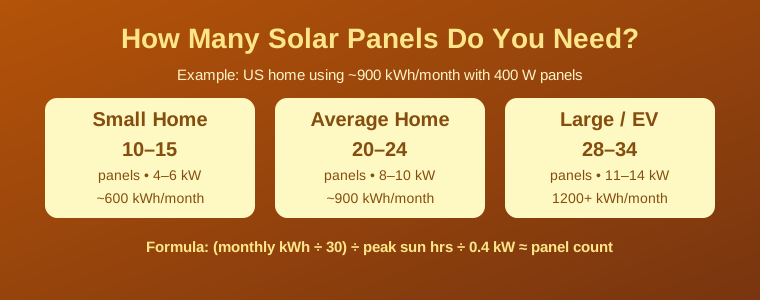
Table of Contents
1. Overview
If you are sizing a home solar system, “how many solar panels do I need” is the first question to answer — and the answer is not a one-size-fits-all number. It depends on your monthly electricity use, how much sun your roof gets, and the wattage of the panels you pick. Most 400 W panels in 2026 produce roughly 1.5–2 kWh per day in decent sun.
This guide walks you through a simple, repeatable calculation so you can estimate panels for your own home, then gives typical ranges so you know if a quote is in the right ballpark.
2. The Formula: How to Calculate Your Panel Count
Use this four-step formula. Grab your most recent electricity bill — it shows your monthly kWh usage, which is the most important number.
Step 1: Convert monthly use to daily use
Divide your monthly kWh by 30. Example: 900 kWh ÷ 30 = 30 kWh per day.
Step 2: Find your peak sun hours
This is the average daily hours of strong sunlight at your location. Most of the U.S. gets 4–5; sunbelt states get 5–6; cloudier regions get 3–4. Use the DOE’s solar resource reference for your area.
Step 3: Calculate the system size you need
System size (kW) = daily kWh ÷ peak sun hours. Example: 30 ÷ 4.5 = 6.7 kW.
Step 4: Divide by panel wattage
Panel count = system size ÷ panel rating. Example: 6700 W ÷ 400 W = 17 panels. Add a safety margin for cloudy months and inverter losses, so round up to 20.
You can skip the math entirely and run a free solar calculator on EnergySage to get regional estimates instantly.
3. Panel Count by Home Size
Here are typical ranges assuming 400 W panels and average U.S. sun of about 4.5 peak hours.
| Home & Usage | Monthly Use | Panel Count | System Size |
|---|---|---|---|
| Small home | ~600 kWh | 10–15 | 4–6 kW |
| Average home | ~900 kWh | 20–24 | 8–10 kW |
| Large home / EV charger | 1200+ kWh | 28–34 | 11–14 kW |
Your roof may hold fewer panels if it is shaded, faces the wrong direction, or has a complex pitch. If you plan to add an EV, add 2–4 panels to cover charging. Also check the federal solar tax credit — it can offset a big chunk of system cost.
Frequently Asked Questions
How many solar panels do I need for 1000 kWh per month?
At about 4.5 peak sun hours and 400 W panels, you need roughly 22–24 panels for a 1000 kWh/month home.
How many solar panels do I need for a 3-bedroom house?
A typical 3-bedroom home using 700–900 kWh/month usually needs 16–22 panels depending on your local sun and panel wattage.
Can solar panels power my house completely?
Yes, if you size the system to your full consumption and have enough roof space. Most homeowners cover 80–100% of usage. Net metering lets you bank extra daytime production for the evening.
What is the average cost to install solar panels?
After the 30% federal tax credit, an 8 kW system in 2026 typically costs around $15,000–$22,000 before incentives, and the payback period is roughly 6–9 years depending on your electricity rates. Read the DOE’s guide to going solar.
Related Reading
- Rooftop Solar Panel Installation: Complete 2026 Cost Guide
- Home Solar Battery Storage 2026: Powerwall 3 vs Enphase vs Franklin WH
- Best Portable Solar Generators 2026: Complete Buying Guide
Sources
- U.S. Department of Energy — Homeowner’s Guide to Going Solar
- EnergySage — Solar Calculator and Marketplace
Disclosure: This post contains affiliate links. As an Amazon Associate I earn from qualifying purchases.