
Key Takeaway: NXP’s MCX A5 is the first industrial MCU to integrate a 10BASE-T1S Ethernet digital PHY with topology discovery and post-quantum cryptography, enabling simplified, secure industrial edge networking.
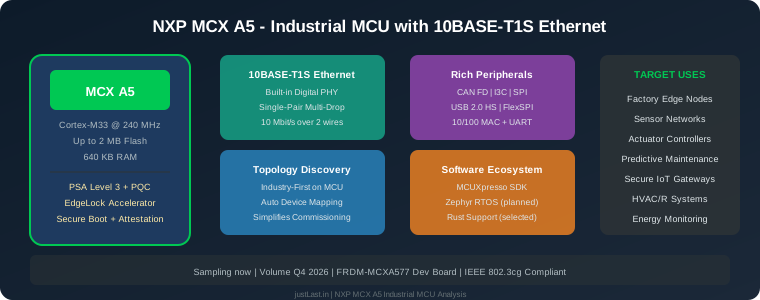
Table of Contents
- 1. NXP MCX A5 Overview: What Makes It Different
- 2. 10BASE-T1S Ethernet: Single-Pair Networking for Industrial IoT
- 3. Topology Discovery: The Industry-First Feature
- 4. Post-Quantum Security: PSA Level 3 and EdgeLock
- 5. Full Specifications and MCU Comparison
- 6. Target Applications: Factory Edge to HVAC
- 7. Software Ecosystem: MCUXpresso, Zephyr and Rust
- 8. Development Board and Getting Started
- 9. Frequently Asked Questions
1. NXP MCX A5 Overview: What Makes It Different
NXP MCX A5 is a newly announced family of microcontrollers (August 2026) that combines an Arm Cortex-M33 core running at up to 240 MHz with an integrated 10BASE-T1S Ethernet digital PHY, hardware topology discovery, and post-quantum cryptography support. The NXP MCX A5 represents a significant step toward simplifying industrial edge networking by bringing Ethernet connectivity directly onto the MCU die.
Industrial edge devices today remain disconnected or rely on legacy connections like RS-232 and RS-485, limiting access to the real-time operational data needed for effective automation. The NXP MCX A5 addresses this by enabling more sensors, actuators, and controllers to connect directly to IP networks while reducing component count, cost, and design complexity.
Charles Dachs, executive vice-president and general manager of secure connected edge at NXP Semiconductors, said: “Industrial edge AI cannot realize its full potential without access to real-time data, requiring developers to have expertise in networking, security, software and long product lifecycles. That’s why we’re investing across our portfolio in solutions like the NXP MCX A5 family.”
2. 10BASE-T1S Ethernet: Single-Pair Networking for Industrial IoT
The integrated 10BASE-T1S digital PHY is the headline feature of the NXP MCX A5. 10BASE-T1S (IEEE 802.3cg) provides 10 Mbit/s Ethernet over a single twisted pair of wires, supporting multi-drop operation where multiple nodes share the same bus — similar to how RS-485 works, but using the Ethernet protocol stack.
Key advantages of the NXP MCX A5’s 10BASE-T1S implementation:
- Built-in digital PHY: Reduces external components compared to solutions requiring a separate PHY chip. Developers still need an external 10BASE-T1S PMD transceiver (NXP positions its TJF1410 as a companion).
- Single-pair wiring: Two wires instead of four (Fast Ethernet) or eight (Gigabit). This dramatically reduces cabling costs in industrial installations where sensors and actuators are distributed across large areas.
- Multi-drop topology: Multiple devices connect to the same cable segment, eliminating the need for an Ethernet switch at each node. This is the fundamental cost advantage over traditional switched Ethernet.
- IP-native communication: Devices on the 10BASE-T1S network communicate using standard IP protocols, enabling seamless integration with IT infrastructure and cloud services.
For embedded developers, the NXP MCX A5’s 10BASE-T1S integration means a single MCU can handle both the application logic and the Ethernet networking stack, reducing BOM cost and board space in distributed industrial sensor nodes.
3. Topology Discovery: The Industry-First Feature on the NXP MCX A5
The NXP MCX A5 claims an industry-first: topology discovery on a wired MCU. In distributed systems with multi-drop Ethernet, knowing which devices are connected and where they are on the network is critical for commissioning, maintenance, and diagnostics.
Traditionally, network topology documentation in industrial installations is manually maintained — when a sensor is added, moved, or replaced, someone has to update the network map. The NXP MCX A5’s topology discovery feature automatically identifies and maps connected devices, eliminating this manual process.
This is particularly valuable in factory environments where the NXP MCX A5 might be deployed across hundreds of sensor nodes on a single 10BASE-T1S bus segment. Commissioning becomes plug-and-play: connect the device, power it on, and the network automatically discovers it.
4. Post-Quantum Security: PSA Level 3 and EdgeLock on the NXP MCX A5
The NXP MCX A5’s security architecture is designed for the long product lifecycles typical in industrial deployments. Key security features include:
- PSA Certified Level 3: The highest level of Platform Security Architecture certification, covering secure boot, attestation, and lifecycle management.
- Post-Quantum Cryptography (PQC): Support for quantum-resistant algorithms, preparing designs for evolving cybersecurity requirements. As the NXP MCX A5’s product page notes, an MCU entering production in 2026 may remain in operation for many years — secure boot and update mechanisms must support maintenance well after the hardware architecture is fixed.
- EdgeLock Accelerator: Hardware-accelerated cryptographic operations for secure boot, firmware updates, and attestation without burdening the main Cortex-M33 core.
- Secure boot with PQC hybrid mode: Supports both current and quantum-resistant algorithms during the transition period.
- Debug authentication: Controlled access to debug interfaces, preventing unauthorized code inspection in deployed devices.
The European Cyber Resilience Act adds another reason for manufacturers to consider lifecycle security early in product design. An MCU like the NXP MCX A5 cannot make a complete product compliant by itself, but hardware-backed boot, authentication, update, and attestation functions provide mechanisms on which OEMs can build their wider vulnerability management process.
5. NXP MCX A5 Full Specifications and MCU Comparison
The NXP MCX A5 family specifications:
- Core: Arm Cortex-M33 @ up to 240 MHz
- Flash: Up to 2 MB
- RAM: Up to 640 KB
- Ethernet: 10/100 MAC + integrated 10BASE-T1S digital PHY
- USB: High-speed USB 2.0
- CAN: CAN FD for industrial bus communication
- SPI/I2C/I3C: Full peripheral set including next-generation I3C
- Security: PSA Level 3, PQC support, EdgeLock, secure boot, attestation
- Interface count: UART, FlexSPI, FlexIO for extended peripheral mapping
- Temperature range: Industrial (-40°C to +105°C expected)
NXP MCX A5 vs NXP MCX C15/C16 (also announced August 2026)
NXP also launched the MCX C15 and MCX C16 — lower-cost Cortex-M23 MCUs at under 60 cents. The NXP MCX A5 is the premium option with Ethernet and advanced security, while the MCX C series targets cost-sensitive analog and motor control applications. Pin-to-pin compatibility between MCX A and MCX C families enables migration paths.
NXP MCX A5 vs WCH CH32V407
The WCH CH32V407 ($2.40, RISC-V, 200 MHz) also integrates Ethernet MAC + PHY but at a fraction of the cost. The NXP MCX A5 counters with industrial-grade security (PQC, PSA Level 3), topology discovery, ARM ecosystem maturity, and long-term industrial support — features the maker-focused CH32V407 lacks.
6. Target Applications: Factory Edge to HVAC with the NXP MCX A5
NXP positions the NXP MCX A5 for these industrial applications:
- Factory edge nodes: Connecting sensors and actuators to IP networks without requiring a dedicated Ethernet switch at every node. The 10BASE-T1S multi-drop capability reduces infrastructure cost.
- Predictive maintenance: Real-time vibration, temperature, and current sensors feeding data to edge analytics through the NXP MCX A5’s Ethernet interface.
- HVAC/R systems: CAREL, a major HVAC/R control intelligence developer, was featured in NXP’s launch announcement, calling the NXP MCX A5 “the forward-looking innovation we require, combining advanced Ethernet connectivity with next generation security technologies.”
- Secure IoT gateways: The NXP MCX A5’s PQC support and PSA Level 3 security make it suitable for gateway devices at the boundary between operational technology (OT) and information technology (IT) networks.
- Distributed energy monitoring: Connected meters and monitors in smart grid and microgrid applications using the NXP MCX A5’s IP-native connectivity.
- Building automation: BACnet/IP sensors and controllers using single-pair Ethernet for reduced wiring in commercial buildings.
7. Software Ecosystem: MCUXpresso, Zephyr and Rust for the NXP MCX A5
The NXP MCX A5 software ecosystem includes:
- MCUXpresso SDK: NXP’s primary development environment with full driver support, middleware, and security libraries for the NXP MCX A5.
- MCUXpresso IDE integration: Visual Studio Code support for modern development workflows.
- Zephyr RTOS: Planned support for the Zephyr real-time operating system, which has strong networking and industrial protocol support.
- Rust: Selected NXP MCX A5 devices are expected to support Rust for teams seeking memory-safe language alternatives alongside established C and C++ embedded development.
- Long-term support (LTS) releases: Critical for industrial applications where the NXP MCX A5 may remain deployed for 10+ years.
8. Development Board and Getting Started with the NXP MCX A5
The FRDM-MCXA577 development board provides:
- Arduino, mikroBUS, and PMOD expansion headers for rapid prototyping
- On-board 10BASE-T1S interface for testing Ethernet connectivity
- Full access to all NXP MCX A5 peripherals
- Integration with MCUXpresso and VS Code development environments
The NXP MCX A5 is sampling now, with volume availability expected in Q4 2026. For embedded developers, the combination of single-pair Ethernet, topology discovery, and post-quantum security on a single MCU makes the NXP MCX A5 worth evaluating for any new industrial edge design targeting IP-native connectivity.
Frequently Asked Questions About the NXP MCX A5
What makes the NXP MCX A5 different from other industrial MCUs?
The NXP MCX A5 is the first industrial MCU to integrate a 10BASE-T1S Ethernet digital PHY with hardware topology discovery and post-quantum cryptography. Most industrial MCUs require external PHY chips for Ethernet and lack built-in topology discovery, adding cost and complexity to distributed sensor networks.
When will the NXP MCX A5 be available?
The NXP MCX A5 is sampling now (August 2026), with volume availability expected in Q4 2026. The FRDM-MCXA577 development board is available for early evaluation.
How does 10BASE-T1S differ from standard Ethernet?
10BASE-T1S runs at 10 Mbit/s over a single twisted pair (2 wires) and supports multi-drop topology — multiple devices share the same cable segment. Standard Fast Ethernet requires 2 pairs (4 wires) and a switch at each node. 10BASE-T1S dramatically reduces cabling and infrastructure costs for distributed industrial sensor networks.
Does the NXP MCX A5 support Rust development?
Yes, selected NXP MCX A5 devices are expected to support Rust, providing a memory-safe language option alongside C and C++. This is part of NXP’s broader strategy to support modern development practices in industrial embedded applications.
What security certifications does the NXP MCX A5 have?
The NXP MCX A5 targets PSA Certified Level 3 — the highest level of ARM’s Platform Security Architecture. It also supports post-quantum cryptography (PQC) with a hybrid secure boot mode, the EdgeLock hardware security accelerator, secure firmware updates, attestation, and debug authentication.
Can the NXP MCX A5 replace RS-485 in existing industrial installations?
The NXP MCX A5’s 10BASE-T1S multi-drop topology is functionally similar to RS-485 but uses the Ethernet/IP protocol stack instead of proprietary serial protocols. Migration from RS-485 to 10BASE-T1S via the NXP MCX A5 enables IP-native communication without requiring a complete infrastructure overhaul — the single-pair cabling can often be reused.
Related Reading
- Industrial IoT Gateways Compared: Raspberry Pi, ESP32, STM32 and Industrial PCs
- Edge AI in Industrial IoT 2026: On-Device Intelligence in Factory Automation
- PLC Scan Time Explained: How Cycle Time Affects Real-Time Machine Control
- STM32 + ESP32 Industrial IoT Gateway: Build a Reliable Edge-to-Cloud Bridge
Sources
- Computer Weekly — NXP MCX A5 for Secure Industrial Connectivity (Aug 2026)
- IN Electronics — NXP Puts Secure Ethernet into MCX A5 (Aug 2026)
- CNX Software — NXP MCX C15/C16 Low-Cost Cortex-M23 MCUs (Aug 2026)
- CNX Software — WCH CH32V407/467 RISC-V MCU with Ethernet (Aug 2026)
Disclosure: This post contains affiliate links to products on Amazon and other retailers. If you purchase through these links, we may earn a small commission at no additional cost to you. We only recommend products we genuinely find useful for engineers, makers, and tech enthusiasts.