PLC Redundancy and Hot-Standby Controllers: Building Fault-Tolerant Industrial Automation in India
Key Takeaway
PLC redundancy with hot-standby controllers cuts unplanned downtime by 90%+ in critical Indian process plants, enabling continuous operation where single-controller failure would halt production for hours and cost ₹50-200 lakh per incident.
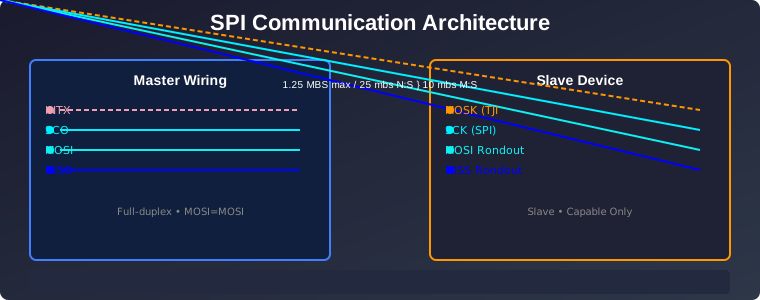
Figure 1: PLC hot-standby topology — Primary runs control logic; Standby shadows state via heartbeat; shared I/O ensures bumpless switchover under 50 ms.
Table of Contents
- 1. Why Redundancy Matters in Indian Industry
- 2. Redundancy Architectures Compared
- 3. Hot-Standby vs Cold-Standby: Technical Deep-Dive
- 4. Key Hardware Platforms Available in India
- 5. Implementation Cost Analysis
- 6. Configuration and Programming Considerations
- 7. Testing and Validation Procedures
- 8. Maintenance and Lifecycle Management
1. Why Redundancy Matters in Indian Industry
India’s process industries — chemicals, oil & gas, pharmaceuticals, power generation, water treatment — face a common vulnerability: a single PLC failure stops the entire line. In a typical continuous process plant, unplanned downtime costs ₹50-200 lakh per hour in lost production, off-spec material, and restart penalties. The 2025 NTPC Unchahar incident (boiler automation PLC failure, 14-hour outage, ₹12 crore estimated loss) and multiple pharmaceutical batch-loss events underscore that single-controller architectures are no longer acceptable for safety-critical or high-value processes.
Hot-standby redundancy addresses this directly: a secondary PLC maintains synchronized state with the primary and takes over in under 50 ms when the primary fails. The switchover is bumpless — field devices never see a disruption, analog outputs hold their values, and the process continues uninterrupted.
2. Redundancy Architectures Compared
| Architecture | Switchover Time | Data Integrity | Complexity | Typical Cost Premium |
|---|---|---|---|---|
| Hot Standby (1:1) | < 50 ms | Zero loss (state sync) | High | 100-120% |
| Cold Standby (1:N) | 5-30 seconds | Partial (checkpoint) | Medium | 30-50% |
| Triple Modular (2oo3) | < 10 ms | Zero loss (voting) | Very High | 200-300% |
For most Indian plants, 1:1 hot-standby delivers the best cost/reliability ratio. Triple-modular is reserved for SIL 3 safety systems (nuclear, high-pressure hydrocarbon).
3. Hot-Standby vs Cold-Standby: Technical Deep-Dive
Hot-Standby (Active-Standby): Both PLCs execute the same program scan. The primary writes outputs; the standby receives all input data and computes outputs internally but keeps its output drivers disabled. A dedicated heartbeat link (fiber or redundant Ethernet) synchronizes memory state every scan cycle — typically 2-10 ms. On primary failure (heartbeat loss, watchdog timeout, power loss), the standby enables its outputs and assumes control within one scan cycle.
Cold-Standby (Spare): A pre-configured spare PLC sits powered but not running. On failure, an operator or automated script loads the program, initializes state from the last checkpoint, and starts the standby. Switchover takes 5-30 seconds with inevitable process disturbance — unacceptable for continuous chemical reactors or turbine control.
State Synchronization: Hot-standby requires deterministic, low-jitter state transfer. Leading platforms (Siemens S7-400H, Rockwell ControlLogix 5580, Schneider M580, ABB AC 800M) use dedicated redundancy links (fiber, 1 Gbps Ethernet) with proprietary protocols. The sync payload includes: all I/O image tables, program variables, timer/counter states, PID internal states, and communication buffer contents. Typical sync bandwidth: 10-50 Mbps for a 5,000 I/O point system.
4. Key Hardware Platforms Available in India
| Vendor | Redundant Platform | Sync Link | Max I/O (per PLC) | India Stock / Lead Time |
|---|---|---|---|---|
| Siemens | S7-1500R/H / S7-400H | Fiber (FO) / Profinet | 128K / 256K | Stocked in Mumbai, 2-4 wks |
| Rockwell Automation | ControlLogix 5580 / 5570 | EtherNet/IP (dual) | 256K | Stocked in Pune, 3-6 wks |
| Schneider Electric | Modicon M580 / M340 | Ethernet RSTP / Fiber | 128K | Stocked in Bangalore, 2-4 wks |
| ABB | AC 800M High Integrity | ControlNet / Fiber | 200K | 4-8 wks import |
| Honeywell | Experion PKS C300 | CNET / Fiber | 500K | 6-10 wks import |
5. Implementation Cost Analysis
CAPEX for a typical 5,000 I/O hot-standby system in India (2026 pricing, INR):
| Component | Qty | Unit Cost (₹ Lakh) | Total (₹ Lakh) |
|---|---|---|---|
| Redundant CPU Pair (S7-1500H) | 1 | 35-45 | 35-45 |
| Redundancy Sync Module / Fiber | 2 | 3-5 | 6-10 |
| Shared I/O Racks (Profinet) | 4-6 | 8-12 | 32-72 |
| Engineering & Commissioning | 1 | 15-25 | 15-25 |
| Total CAPEX | 88-152 |
OPEX increase: ~15-20% for spare parts inventory, annual testing, and synchronization link maintenance. Payback: single avoided 4-hour outage at ₹50 lakh/hr = ₹2 crore saved vs ₹1.5 crore CAPEX.
6. Configuration and Programming Considerations
- Deterministic Scan Time: Hot-standby requires fixed scan cycles. Use cyclic interrupt OBs (Siemens) or periodic tasks (Rockwell) — avoid event-driven tasks that create scan-time variance.
- Non-Deterministic Instructions: Avoid instructions with variable execution time (string parsing, complex math loops) in the main scan. Move to lower-priority tasks.
- Shared I/O Addressing: I/O modules must have identical addresses on both racks. Profinet/Profibus device names must match exactly.
- Communication Partners: HMI, SCADA, and MES connections must target the virtual IP / redundancy group address, not individual PLC IPs.
- Retentive Data: Mark all process-critical variables as retentive. Standby must receive timer/counter current values, PID integral terms, and recipe parameters.
7. Testing and Validation Procedures
| Test | Method | Acceptance Criteria |
|---|---|---|
| Power Loss Primary | Pull primary power | Switchover < 50 ms, no process trip |
| Sync Link Failure | Disconnect fiber | Standby alarms, primary continues |
| I/O Module Failure | Remove I/O card | Redundant I/O takes over, process stable |
| Forced Failover | STOP primary CPU | Bumpless transfer, outputs hold |
| Annual Validation | Full switchover test | All criteria met, documented |
8. Maintenance and Lifecycle Management
Firmware Updates: Must be applied to both PLCs simultaneously during planned shutdown. Use vendor redundancy-aware update tools (Siemens HMI Update, Rockwell Firmware Supervisor).
Spare Parts: Stock one complete CPU pair, one sync module, and critical I/O modules. Vendor lead times (2-10 weeks) make local stock essential.
Personnel Training: At least two engineers per shift must be certified on redundancy switchover procedures. Vendor training (Siemens TIA Portal Redundancy, Rockwell ControlLogix Redundancy) recommended.
9. Related Reading
- PLC Scan Times & SCADA Monitoring: Optimizing Industrial Automation in India
- PLC Programming Languages: Ladder Logic vs Structured Text vs Function Block Diagram
- Industrial Networking in India: 5G Private Networks and TSN for Reliable Factory Connectivity
10. Sources
- Siemens AG, “S7-1500R/H System Manual: Redundant Systems”, 2025 Edition
- Rockwell Automation, “ControlLogix 5580 Redundancy System Reference Manual”, Publication 1756-RM001, 2025
- ISA, “ANSI/ISA-84.00.01-2016 (IEC 61511 Mod) Functional Safety: Safety Instrumented Systems for the Process Industry Sector”
- NAMUR, “Recommendation NE 131: Requirements for Automation Systems in the Process Industry”, 2023
- Central Electricity Authority (India), “Technical Standards for Construction of Electrical Plants and Electric Lines”, 2022 Amendment
Key Takeaways
- Hot-standby PLC redundancy achieves sub-50 ms bumpless switchover — critical for continuous Indian process plants.
- CAPEX premium of 88-152 lakh for 5,000 I/O system pays back in one avoided 4-hour outage.
- Siemens S7-1500H, Rockwell 5580, Schneider M580 lead the Indian market with local stock and support.
- Deterministic scan-time programming and shared I/O addressing are non-negotiable implementation requirements.
- Annual full-switchover testing is mandatory — untested redundancy is no redundancy at all.