PLC SCADA Systems Explained: Architecture and How They Work
Key Takeaway
PLC SCADA systems combine programmable logic controllers (PLCs) with supervisory control and data acquisition (SCADA) software to automate industrial machinery and processes across discrete and process manufacturing. A PLC handles real-time, deterministic control at the machine level, reading sensors and driving actuators in milliseconds, while SCADA provides centralized visualization, alarming, event logging, and historical data storage across an entire plant or multiple sites. Together they form the backbone of modern industrial automation, enabling factories to run faster, safer, and with less manual intervention.

Figure 1: PLC SCADA layered architecture from field devices to remote monitoring
Table of Contents
- 1. What is PLC SCADA
- 2. PLC vs SCADA: Key Differences
- 3. PLC Components and Hardware
- 4. SCADA Architecture and Functions
- 5. PLC Scan Cycle Explained
- 6. Industrial Communication Protocols
- 7. PLC Programming Languages
- 8. Alarms, Events, and Historian
- 9. Industrial Applications
- 10. Security and Maintenance
- 11. Future Trends in PLC SCADA
- 12. Key Takeaways
1. What is PLC SCADA
A PLC (Programmable Logic Controller) is a ruggedized industrial computer purpose-built to control machinery and processes in real time. Unlike a general-purpose PC, a PLC is designed to withstand harsh factory conditions—temperature extremes, vibration, dust, and electrical noise—while running deterministic control logic with response times in the millisecond range.
SCADA (Supervisory Control and Data Acquisition) is a software system that supervises distributed field equipment from one or more central operator stations. It collects data from many PLCs and RTUs (Remote Terminal Units) spread across a plant, presents live process values on graphical screens, logs history, manages alarms, and allows authorized operators to change setpoints or issue commands remotely.
In a PLC SCADA system, the PLC performs the hard real-time control at the machine or cell level, while SCADA operates at the plant or enterprise level, giving managers and engineers visibility into production performance, energy consumption, and equipment health across the whole operation.
2. PLC vs SCADA: Key Differences
Although PLC and SCADA are often mentioned together, they serve different roles. A PLC is a hardware controller that executes control logic locally and directly interfaces with field I/O. SCADA is primarily software that provides supervisory visibility and control over multiple controllers and sites.
| Aspect | PLC | SCADA |
|---|---|---|
| Primary role | Real-time machine control | Plant-wide supervision |
| Forms | Hardware controller | Software system |
| Direct I/O | Yes, connects to sensors/actuators | No, communicates via network |
| Response time | Milliseconds (deterministic) | Seconds to minutes (supervisory) |
| Location | Machine or panel level | Control room or cloud |
| Users | Machine operators, maintenance | Plant managers, engineers |
In practice, they complement each other: the PLC runs the fast control loops, and SCADA aggregates data from many PLCs for reporting, alarming, and high-level optimization.
3. PLC Components and Hardware
A typical PLC system consists of several hardware modules mounted in a rack or compact chassis:
- CPU (Central Processing Unit): The brain that stores and executes the user program, maintains the input/output image tables, and manages communication.
- Power Supply: Converts mains voltage (230 V AC in India) to the low-voltage DC required by PLC logic circuits, typically 24 V DC.
- Input Modules: Convert field signals (pushbuttons, sensors, limit switches, analog transducers) into digital values the CPU can read. Available in digital (24 V DC, 230 V AC) and analog (4-20 mA, 0-10 V) variants.
- Output Modules: Convert CPU commands into signals that drive contactors, solenoid valves, indicator lamps, and motor starters. Relay and transistor outputs are common.
- Communication Port: Ethernet, RS-485, or fieldbus port for connecting to SCADA, HMI panels, and programming PCs.
- Memory: Stores the user program, data tables, and retentive values that survive power loss.
Modern PLCs are compact, fanless, and DIN-rail mounted. They support hot-swappable I/O modules, redundant power supplies, and network redundancy for critical applications such as automotive assembly lines and continuous process plants.
4. SCADA Architecture and Functions
SCADA systems follow a layered architecture. At the bottom are field devices—sensors and actuators—connected to PLCs or RTUs. Above them is the communication layer, usually an industrial Ethernet network or fieldbus. At the top are SCADA servers, historian databases, engineering workstations, and operator HMIs.
Core SCADA functions include:
- Data acquisition: Polling tag values from PLCs at configurable intervals.
- Supervisory control: Sending setpoint changes, start/stop commands, and mode selections back to field controllers.
- Alarm management: Detecting out-of-limit conditions, prioritizing alarms, and notifying operators by screen, email, or SMS.
- Trend visualization: Displaying real-time and historical graphs of temperature, pressure, flow, and other variables.
- Reporting: Generating shift reports, production summaries, and energy consumption statements.
- User access control: Role-based permissions so only authorized personnel can change critical parameters.
Modern SCADA platforms support web-based thin clients, mobile access for shop-floor supervisors, and integration with enterprise systems such as ERP (Enterprise Resource Planning) and MES (Manufacturing Execution Systems).
5. PLC Scan Cycle Explained
A PLC operates in a continuous, repetitive scan cycle. Each cycle typically takes 1 to 100 milliseconds depending on program size, hardware performance, and communication load.
- Read inputs: The CPU samples the physical status of all input modules and updates the input image table in memory.
- Execute program: The CPU runs the user logic program using the input image, performing logic, math, timer, and counter operations, and writes results to the output image table.
- Write outputs: The CPU transfers values from the output image table to the physical output modules, energizing or de-energizing connected devices.
- Housekeeping: Communication handling, diagnostics, and watchdog refresh occur between or within cycles.
Scan time matters for high-speed control. A packaging line counting products at 600 per minute needs fast, deterministic response, while a tank-level control loop can tolerate a slower scan. For very fast motion control, dedicated servo drives or motion controllers are often used alongside the PLC rather than relying solely on the standard scan cycle.
6. Industrial Communication Protocols
PLC SCADA systems depend on industrial communication protocols to exchange data between controllers, HMIs, and supervisory software. The most widely used include:
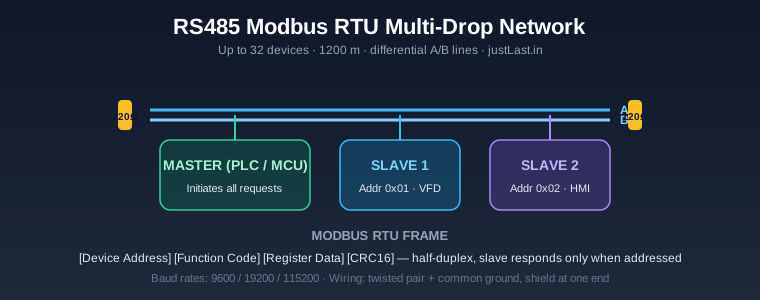
- Modbus TCP / RTU: Simple, open, and supported by nearly every PLC and SCADA vendor. Common in India for small and medium automation projects.
- EtherNet/IP: Dominant in discrete manufacturing and automotive, especially with Rockwell Automation hardware.
- PROFINET / PROFIBUS: Widely used with Siemens SIMATIC PLCs in process and discrete industries.
- OPC UA: The emerging standard for secure, interoperable, platform-independent data exchange between shop-floor devices and enterprise applications.
- CC-Link / DeviceNet: Fieldbus options common in Japanese and American machine installations.
Protocol choice affects wiring cost, scan speed, and integration effort. Modbus is inexpensive and easy to deploy, while OPC UA provides better security and semantic modeling for Industry 4.0 initiatives.
7. PLC Programming Languages
The IEC 61131-3 international standard defines five PLC programming languages, each suited to different applications:
- Ladder Logic (LD): Graphical language resembling electrical relay schematics. The most widely used language, favored by maintenance electricians for readability and ease of troubleshooting.
- Function Block Diagram (FBD): Functions and blocks connected by signal lines. Well suited to process control and continuous applications.
- Structured Text (ST): Text-based language similar to Pascal. Ideal for complex calculations, data handling, and algorithms.
- Instruction List (IL): Low-level mnemonics similar to assembly. Being phased out in favor of ST and LD.
- Sequential Function Chart (SFC): Graphical representation of process steps and transitions. Useful for batch processes and multi-stage sequences.
Most Indian machine builders and system integrators standardize on ladder logic because it matches the relay diagrams their maintenance teams already know, reducing training and troubleshooting time.
8. Alarms, Events, and Historian
SCADA alarm management alerts operators to abnormal conditions such as high motor temperature, low tank level, conveyor jam, drive fault, or communication loss. Alarms are prioritized by severity—critical, high, medium, low—and routed to HMI screens, annunciator panels, email, or SMS based on shift and escalation rules.
Event logging records operator actions, parameter changes, and system messages with timestamps, supporting audit trails and root-cause analysis. The historian database stores time-stamped process data for months or years. Engineers use historian trends to optimize production schedules, reduce energy consumption, perform root-cause analysis after incidents, and support predictive maintenance programs.
9. Industrial Applications
PLC SCADA systems are used across manufacturing, oil and gas, water treatment, power generation, food and beverage, pharmaceuticals, textiles, and mining. Typical applications include:
- Automotive assembly line control and robot cell coordination
- Batch processing in chemical and pharmaceutical plants
- Conveyor and sorting system automation
- Water and wastewater pump station control
- HVAC and compressed air system optimization
- Textile machine speed and tension control
- CNC machine tool integration and cell management
In India, PLC SCADA adoption is growing rapidly in automotive manufacturing, textile mills, food processing, and infrastructure projects. Industries modernize to improve product quality, reduce material and energy waste, meet export quality standards, and comply with increasingly strict energy efficiency norms.
10. Security and Maintenance
Industrial control systems are increasingly targeted by cyber threats, including ransomware and targeted attacks on critical infrastructure. PLC SCADA networks should be segmented from corporate IT networks using firewalls or demilitarized zones (DMZs), remote access should pass through secure gateways with multi-factor authentication, default passwords must be changed, and PLC firmware and SCADA software kept up to date.
Routine maintenance includes backing up PLC programs to a secure server, checking I/O module status and LED indicators, cleaning dust from panels and cooling fans, inspecting terminal connections for tightness, verifying backup power (UPS) health, and testing alarm and emergency-stop circuits. A well-maintained PLC SCADA system can operate reliably for 10 to 15 years, though obsolete hardware should be planned for replacement before failure.
11. Future Trends in PLC SCADA
PLC SCADA is evolving toward open, connected, and data-rich architectures. Edge computing allows analytics to run closer to machines, reducing latency and bandwidth. OPC UA and MQTT enable secure, publish-subscribe data flow to cloud platforms. PLCs increasingly embed web servers and support containerized applications. Cybersecurity is becoming a design requirement rather than an afterthought, with secure boot, signed firmware, and role-based access built into new controllers. For Indian manufacturers, these trends lower the cost of adopting smart-factory capabilities and improve competitiveness in global supply chains.
12. Key Takeaways
- PLC SCADA systems combine real-time machine control (PLC) with centralized plant-wide supervision (SCADA).
- The PLC runs a deterministic scan cycle: read inputs, execute logic, write outputs.
- SCADA provides operator visualization, alarming, data logging, reporting, and remote supervisory control.
- Common industrial protocols include Modbus, EtherNet/IP, PROFINET, PROFIBUS, and OPC UA.
- Ladder logic is the most widely used PLC programming language under IEC 61131-3.
- Network segmentation, strong authentication, and firmware updates are essential for PLC SCADA security.
- Predictive maintenance and energy optimization are key benefits of connecting SCADA data to analytics.