Key Takeaway: India’s UPI ecosystem crossed 22.71 billion monthly transactions in June 2026 with 400 million+ active users, as NPCI rolls out biometric authentication (600M+ transactions), explores agentic AI payments through a new Unified Agent Protocol, and the government debates bringing back MDR for large merchants to ensure the ecosystem’s financial sustainability.
The Unified Payments Interface (UPI) has completed a decade of transforming India’s digital payments landscape, and 2026 is proving to be its most transformative year yet. From biometric authentication crossing half a billion transactions to the imminent arrival of AI-powered agentic payments, UPI continues to redefine how India transacts.
📖 Table of Contents
- 1The Numbers That Define UPI in 2026
- 2Biometric Authentication: The PINless Revolution
- 3MDR 2.0: The Great Debate Returns
- 4Agentic AI Payments: NPCI’s Unified Agent Protocol
- 5Visa Payment Passkey: The End of the OTP Era
- 6New UPI Features Transforming Payments in 2026
- 7Security Concerns and Staying Safe
- 8The Road Ahead: UPI in 2027 and Beyond
- 9Frequently Asked Questions
- 10Related Reading
- 11Sources
The Numbers That Define UPI in 2026
UPI’s growth trajectory remains nothing short of extraordinary. In June 2026 alone, the platform processed 22.71 billion transactions worth Rs 28.92 lakh crore, according to NPCI data. This represents approximately 20% year-on-year growth in transaction value, demonstrating that the payments juggernaut shows no signs of slowing down.
What makes this particularly impressive is that 63.5% of all UPI transactions are now peer-to-merchant (P2M) payments. This ratio signals that UPI has fully transitioned from a person-to-person money transfer tool into the backbone of India’s retail payment infrastructure, accepted at everything from roadside chai stalls to luxury hotels.
The ecosystem now serves over 400 million monthly active users, making UPI the most widely used real-time payment system globally. From a mere 20 million annual transactions in FY2017, UPI has grown to over 242 billion transactions in FY2026 — a 12,000x increase in a decade.
Biometric Authentication: The PINless Revolution
Perhaps the most significant operational shift in 2026 has been the explosive adoption of biometric authentication for UPI payments. In June 2026, biometric UPI transactions crossed 611 million, according to NPCI. This authentication method allows users to authorize payments using their smartphone’s fingerprint sensor or facial recognition instead of entering a UPI PIN.
NPCI executive director Sohini Rajola noted that biometric authentication reduces dependence on UPI PINs by enabling payments through on-device biometrics, helping improve transaction speed and success rates. The feature supports both person-to-person (P2P) and person-to-merchant (P2M) transactions and is available for RuPay Credit Card on UPI, allowing PIN-free credit payments.
The adoption trajectory has been remarkable. Biometric transactions grew from approximately 280 million in January 2026 to 420 million in March, before crossing the 600-million milestone in June. Multiple banks and UPI applications already offer this feature, and industry observers expect near-universal adoption as more platforms roll out support.
For users, this means faster checkouts, fewer failed transactions due to incorrect PIN entries, and a seamless payment experience. For businesses, it translates to higher throughput at payment counters and reduced friction during peak hours.
MDR 2.0: The Great Debate Returns
After six years of zero merchant discount rate (MDR) on UPI transactions, the Indian government is actively considering bringing back transaction charges for large merchants, ET reported on July 15, 2026. The MDR — the fee merchants pay banks and payment companies for processing UPI and RuPay debit card transactions — has been zero since January 2020.
According to sources, the proposed threshold may be pegged at Rs 1-1.5 crore annual merchant turnover, with transaction-level thresholds of Rs 2,000. This would effectively spare small merchants and micro-transactions from any charges. Peer-to-peer transfers are also expected to remain free under the proposed MDR 2.0 framework.
The Parliamentary Standing Committee on Finance made a strong case for MDR revival in March 2026, stating that "establishing a viable revenue mechanism is critical to ensuring the UPI ecosystem achieves financial sustainability without perpetually straining the government exchequer."
In the FY27 budget, the government set aside Rs 2,000 crore to compensate banks for losses incurred from providing UPI and RuPay debit cards free of cost. However, industry bodies have argued that compensation payouts have shrunk year-on-year, leaving banks and fintech firms without a sustainable business model.
The Payments Council of India has through multiple representations requested the government to consider bringing back MDR. A fintech executive told ET that "the industry has been rallying with the government to bring back MDR to make the business viable as the volumes have zoomed over the past few years."
Agentic AI Payments: NPCI’s Unified Agent Protocol
Perhaps the most forward-looking development in India’s payments landscape is NPCI’s work on a Unified Agent Protocol (UAP) for AI-led payments. First reported by Business Standard on July 8, 2026, the protocol is designed to create a trusted, common, interoperable infrastructure through which AI agents can be registered, verified, and authorized to transact across the UPI ecosystem.
Think of it this way: instead of you opening a UPI app to pay your milkman every morning, your AI assistant could handle that recurring payment automatically. The Unified Agent Protocol would ensure the AI agent is properly authenticated, has defined spending limits, and operates within a framework of accountability.
NPCI’s role would remain limited to validating whether a payment request is genuine, similar to the current UPI system, without visibility into what is being purchased. This preserves UPI’s existing trust architecture while adding a new layer for machine-initiated transactions.
Low-value, repetitive purchases such as groceries, dairy products, and other daily essentials are expected to be the first use cases for agentic payments. This could create significant new opportunities for quick-commerce platforms and reshape how Indian households manage daily expenses.
India is not alone in this pursuit. Visa, Google, and OpenAI are all developing similar protocols for AI-enabled commerce. Visa’s Payment Passkey, launched in India on July 2, 2026, is already positioning passkeys as infrastructure for agent-led commerce, where users could authorize software agents to make purchases on their behalf.
Visa Payment Passkey: The End of the OTP Era
Speaking of Visa, the card network’s Payment Passkey service went live in India on July 2, 2026, with IDFC FIRST Bank as the launch partner. The service allows cardholders to approve online payments using their device’s biometric authentication rather than receiving and entering a one-time password.
Based on the FIDO global passkey framework, the system lets a customer complete a card payment using fingerprint, facial recognition, device PIN, password, or pattern. The authentication stays linked to the user’s device and eliminates the need to type a code received over SMS — a frequent pain point in Indian e-commerce where delayed OTP delivery and network issues cause transaction failures.
The passkey has already been integrated with major merchants including Myntra, Paytm, MakeMyTrip, Tata Starbucks, Reliance Digital, and EatSure, and is supported by payment partners Juspay, Razorpay, PayU, Pine Labs, and BillDesk.
New UPI Features Transforming Payments in 2026
UPI Credit Line
One of the most significant expansions in 2026 has been the introduction of UPI Credit Line, which allows pre-approved credit from banks to be directly accessible through UPI apps. Users can now make purchases using available credit without needing a physical credit card. This extends formal credit access to millions of Indians who were previously excluded from the traditional credit system.
UPI One World and NRI Access
UPI One World is a wallet-based service for foreign visitors that requires no Indian bank account — tourists can load the wallet at airports and use it for all UPI transactions during their stay. Similarly, NRIs with international phone numbers can now link their international bank accounts to UPI for transactions in India, eliminating the friction of maintaining a separate Indian bank account.
Conversational Payments
Integration with AI assistants now allows users to initiate payments through voice commands in Hindi and English. Simply saying "Pay Rs 500 to Ramesh for yesterday’s lunch" initiates a UPI transaction confirmation without opening an app.
Security Concerns and Staying Safe
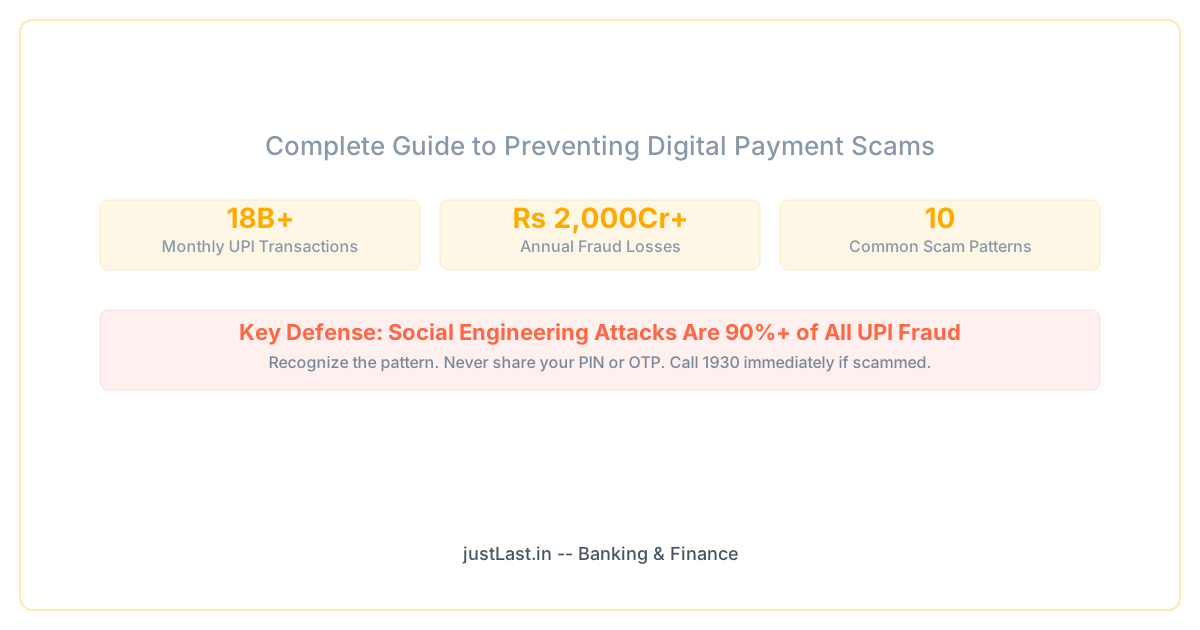
UPI’s rapid adoption has unfortunately been matched by the growth of fraud. The most common scam remains the "incoming money" fraud, where fraudsters claim to be sending money and ask victims to enter their UPI PIN to "receive" it. The golden rule: you never need to enter your UPI PIN to receive money.
Other red flags include unsolicited calls claiming to be from your bank asking for UPI details, fake UPI payment screenshots, and QR codes shared over WhatsApp claiming to offer refunds. Users are advised to set appropriate UPI transaction limits and never share their UPI PIN, OTP, or full card details with anyone, regardless of how official they appear.
The Road Ahead: UPI in 2027 and Beyond
The NPCI roadmap for the coming year includes several transformative initiatives. CBDC (Central Bank Digital Currency) integration with UPI will allow digital rupee transactions through the same interface. UPI for feature phones using *99# and voice-based IVR continues to expand for non-smartphone users. And deeper integration with the Open Credit Enablement Network (OCEN) promises real-time credit products triggered directly through UPI transactions.
RBI’s e-Kuber 3.0 initiative, announced as part of the FY27 agenda, will also impact UPI’s underlying infrastructure. The new core banking system targets real-time gross settlement speeds below 5 seconds and AI-assisted fraud detection, both of which will further strengthen UPI’s reliability and security.
UPI has already inspired similar real-time payment systems globally, and as India moves toward becoming a trillion economy, the platform’s evolution will be central to achieving that ambition. From biometric authentication eliminating PIN friction to AI agents handling routine payments autonomously, UPI in 2026 is not just keeping pace with global payments — it’s defining the future.
Frequently Asked Questions
What is the current volume of UPI transactions in 2026?
In June 2026, UPI processed 22.71 billion transactions worth Rs 28.92 lakh crore. The annual volume reached approximately 242 billion transactions in FY2026.
How do biometric UPI payments work?
Biometric UPI payments allow users to authorize transactions using their smartphone’s fingerprint sensor or facial recognition instead of entering a UPI PIN. Over 611 million such transactions were recorded in June 2026.
Will MDR on UPI transactions be reinstated?
The government is actively considering bringing back MDR for large merchants with annual turnover above Rs 1-1.5 crore. Small merchants, P2P transfers, and transactions below Rs 2,000 are expected to remain free.
What is NPCI’s Unified Agent Protocol?
UAP is a proposed framework by NPCI that would allow AI agents to be registered, verified, and authorized to make UPI payments on behalf of users. It’s designed for low-value repetitive purchases like groceries and daily essentials.
What is Visa Payment Passkey and how does it work in India?
Visa Payment Passkey is a FIDO-based authentication service that replaces OTP-based verification with device biometrics (fingerprint, face recognition, or device PIN). It launched in India on July 2, 2026, with IDFC FIRST Bank and several major merchants.
Related Reading
FortiBleed Explained: Cybersecurity Lessons for Digital Finance — Understanding security vulnerabilities in financial infrastructure.
GPT-5.6 Family Explained: How Sol, Terra and Luna Actually Work — The AI technology that could power next-generation payment agents.
Sources
- Economic Times — Biometric UPI transactions top 600 million
- Economic Times — MDR on UPI Payments may be Back for Large Business
- Business Standard — India may allow agentic AI-led UPI transactions
- Economic Times — Visa launches Payment Passkey in India
- Prime Scope News — UPI 2026: What’s New, What’s Coming