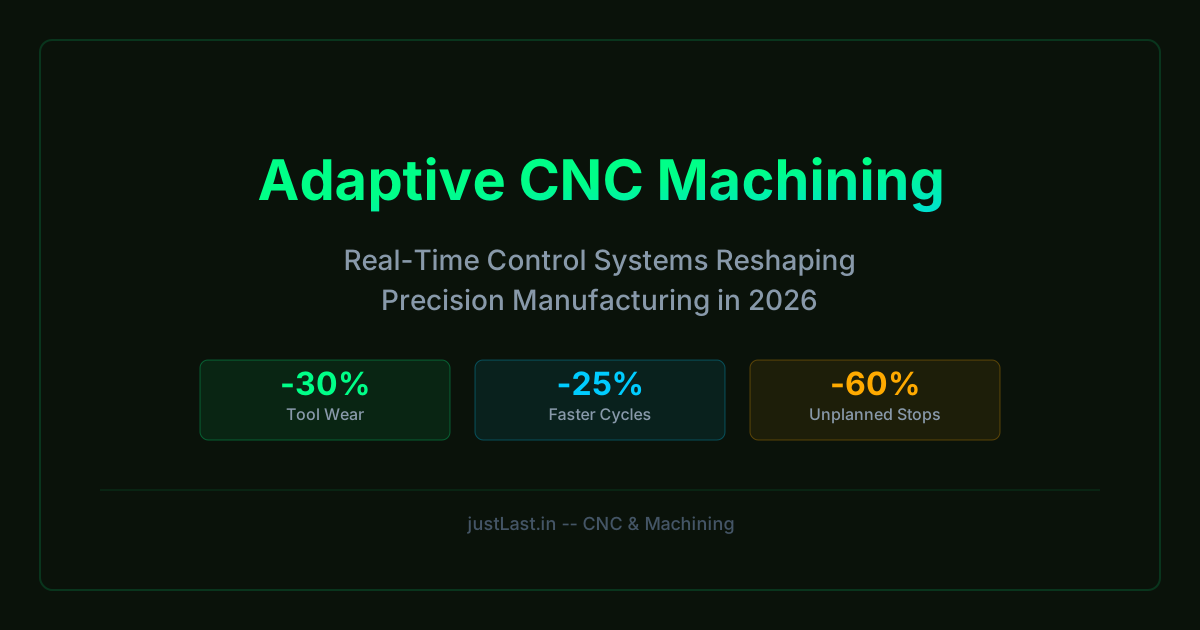
Key Takeaway: Adaptive machining is transforming CNC manufacturing in 2026 by using real-time sensor feedback to automatically adjust feeds, speeds, and toolpaths during cutting operations. This closed-loop approach reduces tool wear by up to 30%, improves surface quality, and minimizes production halts — making it essential for shops that want to stay competitive in precision manufacturing.
Adaptive CNC Machining in 2026
Real-Time Sensor Feedback and Closed-Loop Control in Precision Manufacturing
30%
Reduction in Tool Wear
25%
Faster Cycle Times
60%
Fewer Unplanned Stops
Sensor Feedback Loop
Vibration, load, and temperature sensors
monitor cutting conditions in real time
Digital Twin Integration
Virtual commissioning and clash detection
before the first chip is cut
Closed-Loop Control
AI adjusts feeds, speeds, and toolpaths
automatically based on live data
Sustainability Metrics
MQL, dry cutting, and coolant recycling
embedded in machining KPIs
Adaptive machining shifts operators from alarm-responding to data-validating roles
Source: Dassault Systemes DELMIA 2026 CNC Trends Report | Data based on industry implementations
📖 Table of Contents
Introduction: A New Era for CNC Machining
CNC machining has been the backbone of precision manufacturing for decades, but the pace of change in 2026 is unlike anything the industry has seen before. As global supply chains rebalance and customers demand tighter tolerances, shorter lead times, and lower costs, manufacturers are turning to adaptive machining solutions that bring real-time intelligence to the shop floor.
Adaptive machining refers to CNC systems that use live sensor data — vibration, spindle load, temperature, and acoustic emissions — to automatically adjust cutting parameters during operation. Instead of running a static G-code program from start to finish, adaptive systems respond to what is actually happening at the cutting edge, second by second.
How Adaptive Machining Works
Traditional CNC machining follows a fixed program. The tool moves along programmed paths at predetermined speeds and feeds, regardless of actual cutting conditions. If the material hardens, the tool wears, or vibration develops, the program continues blindly. This leads to scrap parts, broken tools, and wasted time.
Adaptive machining solves this by closing the loop between sensing and action. Here is how the key components work together:
Real-Time Sensor Arrays
Modern CNC machines equipped with adaptive control use multiple sensors to monitor cutting conditions. Spindle load sensors detect when the tool is working harder than expected. Vibration sensors (accelerometers) identify chatter before it damages the surface finish. Temperature sensors monitor thermal growth in the spindle and workpiece. Some advanced systems even use acoustic emission sensors to detect micro-fractures in real time.
Intelligent Control Algorithms
The sensor data feeds into control algorithms that adjust machining parameters on the fly. If sensor readings show increasing tool load, the system reduces feed rate to protect the tool. If vibration is detected, spindle speed is adjusted to move away from resonant frequencies. These adjustments happen in milliseconds — far faster than any human operator could respond.
Closed-Loop Toolpath Correction
The most advanced adaptive systems can modify toolpaths in real time. When a tool wears down, the system compensates by adjusting the tool center point to maintain dimensional accuracy. This closed-loop correction ensures that the last part of a production run matches the first, even as tools degrade.
Digital Twins: The Virtual Backbone
One of the most significant enablers of adaptive machining in 2026 is the digital twin. A digital twin is a living virtual model of the machining process that integrates design, process engineering, machining, and inspection into a continuously updated simulation.
The digital twin is no longer a buzzword. In 2026, it is a production backbone. Manufacturers use digital twins for:
- Virtual commissioning — testing programs and fixturing before cutting metal
- Clash detection — identifying collisions between tool, holder, and workpiece
- Kinematic validation — verifying that multi-axis moves are safe and efficient
- Process optimization — simulating different cutting strategies to find the best approach
- Operator training — mixed-reality tools that let new machinists practice on virtual machines
The true power of the digital twin lies in its feedback loop. Real machining data continuously refines simulation accuracy, making each production cycle smarter than the last. A shop that cuts a part today can use the data from that cut to improve how the next part runs.
The Role of AI in Adaptive Machining
AI has moved beyond academic pilots into daily machine control and planning. In 2026, AI-driven machining analyzes historical cutting data alongside real-time sensor readings to predict optimal parameters before the tool even touches the material.
Machine learning models trained on thousands of previous cuts can predict tool life with remarkable accuracy, allowing shops to change tools at exactly the right moment — neither too early (wasting tool life) nor too late (risking scrap). Predictive maintenance models analyze spindle vibration patterns to detect bearing wear weeks before failure.
For small and medium machine shops, this technology is becoming accessible through CAM software integrations that require no dedicated data science team. Modern CAM systems from leading vendors now include adaptive machining modules that learn from each job.
Practical Implementation Guide
For shops considering the transition to adaptive machining, here are the key steps:
- Start with sensor retrofits — Many existing machines can be upgraded with spindle load monitors and vibration sensors
- Choose the right CAM system — Modern CAM platforms with adaptive roughing and finishing strategies are essential
- Build your digital twin capability — Start with one critical process and expand
- Train your team — Operators need to shift from reacting to alarms to validating data patterns
- Measure and iterate — Track tool life, surface quality, and cycle times to quantify ROI
Key Benefits at a Glance
Shops that have implemented adaptive machining report: 25-40% reduction in cycle times for roughing operations, 30-50% longer tool life, 60% fewer unplanned production stops, and significant improvements in first-pass yield. Source vibration sensors and monitoring hardware from DigiKey for retrofit projects.
Frequently Asked Questions
What is adaptive CNC machining?
Adaptive CNC machining is a technology that uses real-time sensor feedback to automatically adjust cutting parameters — feeds, speeds, and toolpaths — during machining operations, optimizing performance and protecting tools.
How does adaptive machining improve tool life?
By continuously monitoring spindle load and vibration, the system reduces feed rates when it detects excessive stress, preventing tool overload and premature wear. This typically extends tool life by 30-50%.
Can existing CNC machines be upgraded for adaptive machining?
Yes. Many older machines can be retrofitted with sensors and connected to modern CAM systems that support adaptive control. The investment is often recovered within months through reduced tool costs and fewer scrapped parts.
What sensors are used in adaptive CNC machining?
Common sensors include spindle load monitors, accelerometers for vibration detection, thermocouples for temperature monitoring, and acoustic emission sensors for detecting micro-fractures and tool wear.
Is adaptive machining suitable for small machine shops?
Yes. Adaptive machining is increasingly accessible through affordable CAM software add-ons and sensor retrofits. Small shops benefit significantly from reduced scrap rates and longer tool life. Browse sensor solutions available on Mouser for retrofit projects.
How do digital twins relate to adaptive machining?
Digital twins provide the virtual environment where adaptive strategies are validated before production. They also receive real-time data from the machine to continuously improve simulation accuracy.
Related Reading
- CNC Machining Centers: A Complete Guide for Manufacturers
- Stepper Motor Control in Precision Motion Systems
Sources
- Dassault Systemes DELMIA, “2026 CNC Machining Trends: 5 Key Shifts Defining Precision Manufacturing” (2026)
- Machine Design, “From Printer to Spindle: How Aerospace Components Actually Get Made” (2026)
- International Journal of Advanced Manufacturing Technology, “Applications of Wire Arc Additive Manufacturing for Aerospace” (2023)