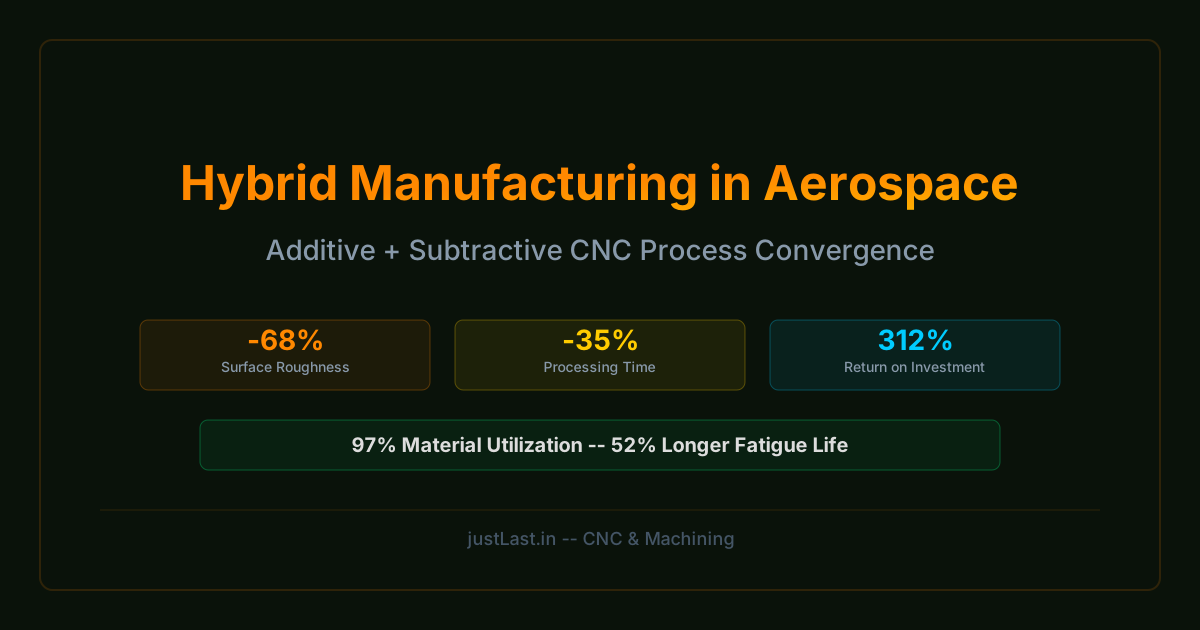
Key Takeaway: Hybrid manufacturing — combining additive processes like laser powder bed fusion with precision CNC finishing — is no longer experimental in aerospace. A 2026 benchmark study shows 68% reduction in surface roughness, 45% improvement in dimensional accuracy, and 312% ROI across three aerospace facilities. Shops that master hybrid workflows now will secure a decisive competitive advantage.
Hybrid Manufacturing in Aerospace
Additive and Subtractive Process Convergence — 2026 Benchmark Results
68%
Surface Roughness Reduction
45%
Better Dimensional Accuracy
312%
Return on Investment
Additive (LPBF)
Near-net shape fabrication
Internal channels and lattices
Complex geometry capability
Subtractive (CNC)
Tight tolerance finishing
Superior surface finish
Aerospace-grade accuracy
Combined Workflow: Print — HIP — CNC Machine
LPBF provides near-net shape, Hot Isostatic Pressing ensures material integrity, CNC delivers dimensional accuracy and surface control
97% material utilization — 35% reduction in total processing time
Source: Journal of Polymer & Composites 2026; Machine Design Aerospace Report 2026
📖 Table of Contents
The Convergence of Two Manufacturing Worlds
For years, additive manufacturing (3D printing) and subtractive manufacturing (CNC machining) were viewed as competing technologies. Proponents of additive argued that layer-by-layer fabrication would eventually eliminate the need for cutting metal away from solid blocks. Skeptics countered that additive could never match the precision, surface finish, and reliability of traditional machining.
In 2026, the debate is over. The conclusion is not that one technology replaces the other, but that they are far stronger together. Hybrid manufacturing — where a single production workflow combines additive deposition with CNC finishing — has moved from research labs into production floors, particularly in aerospace, where the stakes for precision and performance are highest.
What Hybrid Manufacturing Actually Means
Hybrid manufacturing takes two primary forms in 2026:
Sequential Hybrid Workflows
The most common approach today. A part is first additively manufactured to near-net shape using laser powder bed fusion (LPBF) or directed energy deposition (DED). It then undergoes hot isostatic pressing (HIP) to eliminate internal porosity and improve fatigue strength. Finally, the part is finish-machined on a CNC machine to achieve the tight tolerances and surface finishes required for flight-critical applications.
Integrated Hybrid Machine Tools
A single machine platform that combines both additive and subtractive capabilities without moving the workpiece between different machines. Products like the Mazak INTEGREX i-400 AM and DMG MORI Lasertec series include both laser deposition heads and milling spindles in the same workspace. These machines can switch between additive and subtractive operations within a single program, enabling internal channels, lattice structures, and conformal cooling paths that are impossible to cut conventionally.
The Aerospace Benchmark Study That Changes Everything
A comprehensive 2026 benchmarking study published in the Journal of Polymer and Composites evaluated hybrid manufacturing against conventional approaches using a critical aerospace component — the pickle fork derivative. The study compared multiple process routes including LPBF, wire-arc DED, powder-blown DED, additive friction stir deposition, and agility forging, all followed by CNC finishing.
The results are striking:
- 68% reduction in surface roughness — from 25.6 microns to 8.2 microns Ra
- 45% improvement in dimensional accuracy — achieving +/-0.05 mm tolerances
- 52% increase in fatigue life — critical for flight-safety components
- 35% reduction in total processing time — fewer setups and less material waste
- 97% material utilization — compared to 10-20% for conventional machining from solid billet
- 312% ROI — with break-even between 18 months and 5 years across three aerospace facilities
These numbers represent a tipping point. When hybrid manufacturing delivers both better performance and lower cost, the business case becomes undeniable.
Why Additive Alone Is Not Enough
Despite rapid advances, additive manufacturing cannot yet meet aerospace certification requirements on its own. Here are the key limitations:
- Surface finish — As-printed surfaces typically range from 10-25 microns Ra, while aerospace components often require 1.6 microns Ra or better
- Dimensional accuracy — LPBF can hold +/-0.1-0.2 mm, but aerospace tolerances frequently demand +/-0.05 mm or tighter
- Thermal distortion — HIP and other thermal processes can shift dimensions unpredictably
- Critical interfaces — Sealing surfaces, bearing bores, and threaded features require machining accuracy
CNC machining fills these gaps. As the industry saying goes: additive opens new design territory, and CNC machining makes those designs flyable.
Materials and Applications
Hybrid manufacturing is particularly valuable for difficult-to-machine materials used in aerospace:
- Titanium alloys (Ti-6Al-4V) — Used for structural airframe components, engine brackets, and landing gear parts
- Nickel superalloys (Inconel 625, 718) — Turbine blades, combustion chambers, and exhaust components
- Stainless steel (316L) — Ducting, brackets, and non-critical structural parts
- Aluminum alloys (6061, 7075) — Lightweight structural components
Challenges and Considerations
Hybrid manufacturing is not plug-and-play. Shops entering this space face several challenges:
- Heat-affected zones — Additive deposition creates thermal gradients that affect machinability
- Unfamiliar alloys — Many additive materials behave differently than their wrought counterparts during machining
- Irregular surfaces — As-printed surfaces create variable cutting conditions
- Process integration — Coordinating additive, HIP, and machining requires new workflow planning skills
- Equipment investment — Hybrid machine tools and post-processing equipment require significant capital
Explore precision sensors for hybrid machine monitoring on DigiKey and browse industrial automation components on Mouser for setup and integration needs.
Frequently Asked Questions
What is hybrid additive-subtractive manufacturing?
Hybrid manufacturing combines 3D printing (additive) with CNC machining (subtractive) in a single production workflow. Parts are printed to near-net shape, then precision-machined to final tolerances and surface finish.
What are the main benefits of hybrid manufacturing for aerospace?
The key benefits include 97% material utilization (vs 10-20% for machining from billet), 35% faster processing time, ability to create internal geometries impossible with machining alone, and aerospace-grade surface finish and tolerances.
Which industries benefit most from hybrid manufacturing?
Aerospace leads adoption, but hybrid manufacturing is also gaining traction in medical devices (custom implants), energy (turbine components), and MRO (repair of high-value parts).
How much does a hybrid manufacturing machine cost?
Integrated hybrid machine tools like the Mazak INTEGREX i-400 AM or DMG MORI Lasertec series typically range from $500,000 to $1.5 million. However, sequential workflows using separate additive and CNC equipment can be implemented at lower cost.
Can hybrid manufacturing reduce material waste?
Yes, dramatically. Conventional machining from solid billet wastes 80-90% of the material as chips. Hybrid additive-subtractive manufacturing achieves up to 97% material utilization by printing only the material needed and machining only critical features.
What is the typical ROI timeline for hybrid manufacturing?
The 2026 aerospace benchmark study found break-even between 18 months and 5 years, with 312% average ROI across three production facilities. ROI depends on part complexity, material cost, and production volume.
Related Reading
Sources
- Journal of Polymer and Composites, “Hybrid Additive-Subtractive Manufacturing of Multi-Material Functionally Graded Components” (2026)
- Machine Design, “From Printer to Spindle: How Aerospace Components Actually Get Made” (2026)
- IOPscience, “Recent Advances in Metal Hybrid Additive Manufacturing: A Comprehensive Review” (2026)
- International Journal of Advanced Manufacturing Technology, “Applications of WAAM for Aerospace Component Manufacturing” (2023)