


Key Takeaway: The 2026 industrial IoT landscape requires a hybrid edge-cloud architecture where time-critical operations run on local edge nodes with sub-millisecond latency while cloud platforms handle large-scale analytics, ML training, and cross-factory data aggregation. Gartner projects 75% of factory data will be processed at the edge by 2026, but cloud remains essential for training models and enterprise-wide visibility.
📖 Table of Contents
- 1The Edge vs Cloud Landscape in Industrial IoT 2026
- 2When Edge Computing Wins: Latency-Critical Applications
- 3When Cloud Computing Wins: Scale and Analytics
- 4The Hybrid Architecture: Best of Both Worlds
- 5Hardware Options for Edge Computing in 2026
- 6Decision Framework for Factory Architects
- 72026 Trends Shaping Edge vs Cloud Decisions
- 8Frequently Asked Questions
1. The Edge vs Cloud Landscape in Industrial IoT 2026
The debate between edge computing and cloud computing in industrial IoT has evolved significantly by 2026. It’s no longer a binary choice — the winning strategy is a thoughtfully designed hybrid architecture that places each workload where it runs best. Understanding when to use edge computing vs cloud computing for industrial IoT is essential for any manufacturing engineer building modern factory systems.
The volume of data generated by factory sensors has exploded. A single modern CNC machine can generate 1 GB of vibration data per hour of operation. Transmitting all this raw data to the cloud is impractical and expensive. In 2026, the industry consensus is clear: process at the edge, analyze in the cloud.
2. When Edge Computing Wins: Latency-Critical Applications
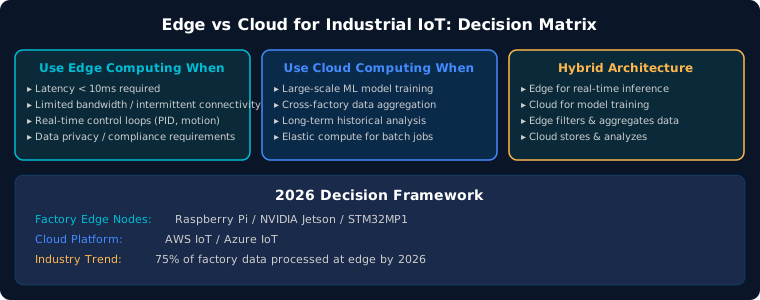
Edge computing processes data locally on or near the factory equipment, delivering sub-10ms latency that cloud computing cannot match. For industrial applications where timing is critical, edge computing is not optional — it’s mandatory.
Real-Time Control Loops: PID controllers for servo motors, conveyor systems, and linear actuators require deterministic response times under 1ms. A round-trip to the cloud introduces 50-200ms latency, making cloud-only architectures unsuitable for motion control. Edge processors running STM32 or Raspberry Pi with real-time Linux provide the necessary responsiveness.
Predictive Maintenance: Vibration analysis using FFT on the edge processor enables immediate anomaly detection. The STM32’s DSP instructions or Cortex-M7 FPU compute FFT on sensor data in milliseconds, triggering alerts when vibration signatures exceed thresholds. Only summary statistics and alerts need to reach the cloud.
Machine Vision Inspection: NVIDIA Jetson edge devices running TensorRT-optimized models can classify defects at 60+ fps on the production line, rejecting faulty products instantly without cloud dependency. In 2026, these edge AI systems have become standard in quality control.
3. When Cloud Computing Wins: Scale and Analytics
Cloud computing excels where edge computing cannot compete: unlimited storage, elastic compute, and enterprise-wide analytics. For industrial IoT in 2026, the cloud remains essential for:
ML Model Training: Training deep learning models for predictive maintenance, quality inspection, or process optimization requires GPU clusters that are impractical at the edge. Cloud platforms like AWS SageMaker and Azure Machine Learning provide the training infrastructure. The trained models are then deployed to edge devices for inference.
Cross-Factory Analytics: A manufacturer with five factories needs a unified view. Cloud platforms aggregate data from all sites, enabling comparison of OEE (Overall Equipment Effectiveness) across factories, identification of best practices, and enterprise-wide reporting.
Long-Term Historical Analysis: Edge devices have limited local storage. Cloud object storage (S3, Blob Storage) provides cost-effective retention of years of factory data. When a quality issue surfaces months later, historical cloud data enables root cause analysis across production batches.
4. The Hybrid Architecture: Best of Both Worlds
The dominant industrial IoT architecture in 2026 is a three-tier hybrid model: edge devices at each machine, a factory-level gateway, and cloud platforms for enterprise analytics.
Tier 1 — Machine Edge: STM32 microcontrollers or Raspberry Pi devices connected directly to sensors, handling real-time control and data acquisition. They run inference on lightweight ML models for immediate anomaly detection. Data is filtered locally — only significant events and aggregated statistics are transmitted upstream.
Tier 2 — Factory Gateway: An on-premise server or industrial PC running AWS IoT Greengrass or Azure IoT Edge. The gateway aggregates data from all machine-edge devices, runs more complex analytics, stores local historical data, and manages the connection to the cloud. It also provides failover — if cloud connectivity is lost, the factory continues operating autonomously.
Tier 3 — Cloud Platform: AWS IoT Core, Azure IoT Hub, or Google Cloud IoT receives curated data from factory gateways. It provides dashboards, ML training pipelines, long-term storage, and integration with ERP and MES systems. Analytics engineers access cloud data for developing new models that improve factory performance.
5. Hardware Options for Edge Computing in 2026
| Device | Processor | AI Capability | Best Use Case |
|---|---|---|---|
| STM32MP1 | Cortex-A7 + M4 | Basic inference via CMSIS-NN | Sensor fusion, motor control |
| Raspberry Pi 5 | BCM2712 quad-core | Edge Impulse, TensorFlow Lite | Prototyping, factory gateways |
| NVIDIA Jetson Orin | Ampere GPU + ARM CPU | Full TensorRT, 275 TOPS | Vision inspection, complex AI |
| Intel NUC | Core i7/i5 | OpenVINO inference | Factory gateway, data aggregation |
6. Decision Framework for Factory Architects
When designing an industrial IoT system in 2026, use this framework to decide between edge computing and cloud computing:
Latency Requirement: If sub-10ms response is needed, use edge. If 100ms+ is acceptable, cloud can handle it. For mixed requirements, deploy edge with cloud backup.
Data Volume: If the sensor generates more than 100 MB/hour, process at the edge and transmit only summaries. Low-volume periodic readings can go directly to the cloud.
Connectivity: Factory floors with unreliable internet need edge computing for core operations. Sites with dedicated fiber connections can offload more processing to the cloud.
Model Updates: ML models trained in the cloud and deployed to the edge enable continuous improvement. Plan for OTA update mechanisms using AWS IoT Device Management or Azure IoT Device Update.
7. 2026 Trends Shaping Edge vs Cloud Decisions
Three major trends are reshaping how manufacturers choose between edge computing and cloud computing in 2026. The first is the maturity of edge AI hardware. NVIDIA Jetson devices now deliver 275 TOPS in a form factor smaller than a smartphone, enabling complex inference at the edge that would have required cloud processing just two years ago.
Second, 5G private networks in factories provide reliable low-latency connectivity that changes the edge-cloud calculus. With 5G URLLC offering sub-5ms latency, some processing that previously required on-machine edge hardware can now run on factory-floor edge servers connected via 5G.
Third, the cost of cloud data egress has become a significant factor. With factory sensor data volumes growing 30% annually, cloud bandwidth costs are driving more processing to the edge. The economics increasingly favor filtering and compressing data at the edge before cloud transmission.
8. Frequently Asked Questions
Should I use edge computing or cloud computing for my factory’s predictive maintenance system?
Use a hybrid approach. Deploy edge computing for real-time vibration monitoring and anomaly detection on each machine. Send only anomaly alerts and daily summary statistics to the cloud. The cloud analyzes historical trends across all machines and retrains prediction models.
What is the latency difference between edge computing and cloud computing in industrial IoT?
Edge computing delivers 1-10ms latency for real-time control. Cloud round trips typically take 50-500ms depending on network quality and distance to the data center. For motion control and safety systems, only edge computing is viable.
How much factory data should be processed at the edge vs the cloud?
Industry best practice in 2026 is to process 75-80% of raw sensor data at the edge, transmitting only 20-25% (aggregated and filtered) to the cloud. This ratio balances real-time responsiveness with cloud storage and compute costs.
Can cloud computing replace edge computing in factories with 5G?
5G reduces but does not eliminate the need for edge computing. While 5G URLLC achieves sub-5ms latency, deterministic real-time control loops (motion control, PID) still benefit from local processing due to the elimination of network jitter and dependency.
What is the cost comparison between edge computing and cloud computing for industrial IoT?
Edge computing has higher upfront hardware cost but lower ongoing data transmission costs. Cloud computing offers zero upfront cost but recurring compute and bandwidth charges. For most factories, the total cost of ownership (TCO) over 3 years favors a hybrid approach with significant edge processing.
Related Reading
- STM32 in Industrial IoT: Building Precision Sensor Data Acquisition Systems for Factory Automation in 2026
- Predictive Maintenance for CNC Machines: IoT-Based Condition Monitoring Guide 2026
Sources
- Gartner — Edge Computing in Industrial IoT 2026
- AWS IoT — Industrial Edge Computing Solutions
- Microsoft Azure — Industrial IoT Edge Architecture
- NVIDIA Jetson — Edge AI Modules for Industrial Applications
- Raspberry Pi 5 — Industrial IoT Edge Platform
Disclosure: This article contains affiliate links. As an Amazon Associate, we earn from qualifying purchases. We may earn a commission if you purchase edge computing hardware through the links at no additional cost to you. Recommendations are based on technical evaluation and real-world testing.


