Key Takeaway: Predictive maintenance for CNC machines using IoT sensors and machine learning can reduce unplanned downtime by 30-50% and maintenance costs by 25-30%. The hardware stack costs just ₹15,000-30,000 per machine — vibration sensors on an ESP32/STM32 feeding data through MQTT to InfluxDB, with ML models (Isolation Forest, Random Forest, LSTM) running on a Raspberry Pi edge gateway. This is DIY-achievable for any shop with basic embedded systems skills.
📖 Table of Contents
1. Why Predictive Maintenance Matters
Unplanned downtime is the single largest source of lost productivity in CNC machining. When a spindle motor fails mid-production, the cost extends beyond repair bills — it includes scrapped work-in-progress, missed delivery deadlines, overtime for catch-up production, and reputational damage with customers.
Predictive maintenance for CNC machines uses continuous condition monitoring and machine learning to predict failures before they happen. Unlike preventive maintenance (which replaces parts on a fixed schedule regardless of actual condition) or reactive maintenance (which fixes failures after they occur), predictive maintenance optimizes the timing of interventions based on real machine health data.
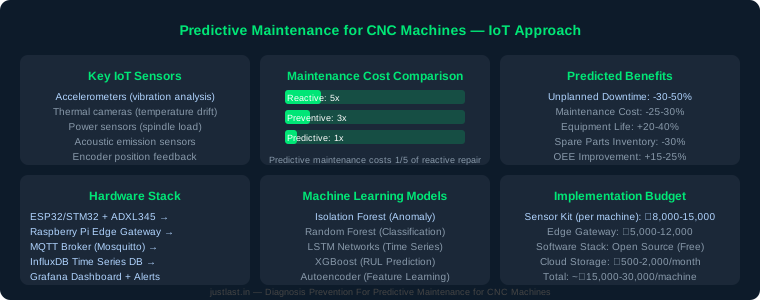
The cost differences are dramatic. Studies consistently show that reactive maintenance costs 5x more than predictive maintenance, while preventive maintenance costs 3x more. The economics are driven by multiple factors: unplanned downtime costs far more than planned downtime because it disrupts production schedules and often damages workpieces; parts replaced on a schedule are often replaced prematurely, wasting their remaining useful life; and emergency repairs typically command premium pricing for labor and expedited shipping.
Beyond cost, predictive maintenance for CNC machines delivers operational benefits: 30-50% reduction in unplanned downtime, 25-30% lower maintenance costs, 20-40% longer equipment life, 30% reduction in spare parts inventory, and 15-25% improvement in Overall Equipment Effectiveness (OEE).
2. Sensor Selection and Installation
The foundation of any predictive maintenance system is the sensor layer. For CNC machines, the key signals to monitor are vibration, temperature, power consumption, and acoustic emissions.
Vibration sensors (accelerometers) are the most important. The ADXL345 is a popular choice — a 3-axis accelerometer with ±16g range, I2C/SPI interface, and ₹300-500 cost. Mount it on the spindle housing near the front bearing, oriented to capture the three axes of vibration. For higher precision, the MPU6050 (6-axis with gyroscope) adds angular velocity data for detecting spindle imbalance.
Temperature sensors: DS18B20 digital temperature sensors (₹150-250 each) placed on spindle bearings, motor windings, and way covers provide critical thermal data. Thermal drift is a common precursor to bearing failure.
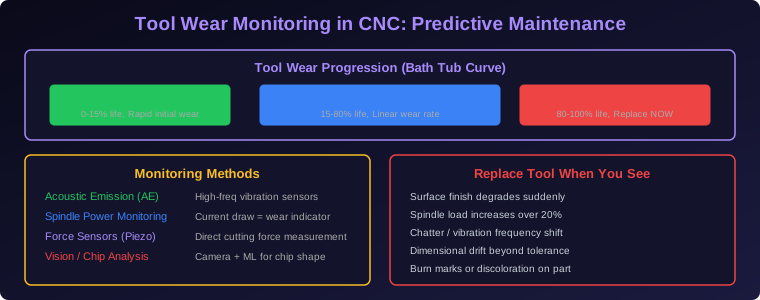
Power monitoring: Current transformers (CT clamps) on spindle drive phases measure power consumption. Sudden increases in current indicate increased cutting loads, tool wear, or mechanical binding.
Acoustic emission sensors: Piezoelectric contact microphones (₹500-1,000) detect high-frequency stress waves from crack propagation, bearing spalling, and tool chipping that vibration sensors may miss at early stages.
3. Hardware Stack Architecture
The recommended hardware stack for an affordable, DIY-friendly predictive maintenance system is:
Edge Sensor Node: ESP32 or STM32 microcontroller collecting sensor data every 100ms. ESP32 has built-in WiFi/Bluetooth and costs ₹500-800. STM32 (STM32F103 or STM32G4 series) offers superior ADC precision and real-time performance for ₹700-1,200. Connect sensors via I2C bus (ADXL345, MPU6050) or OneWire (DS18B20).
Edge Gateway: Raspberry Pi 4 or 5 (₹4,000-8,000) running the data pipeline. The Pi collects sensor data from the ESP32/STM32 via serial or WiFi, processes it, and forwards it to the database. Node-RED on the Pi provides visual flow programming for data routing without writing extensive code.
Message Broker: Mosquitto MQTT broker on the Pi handles message queuing. MQTT is lightweight, reliable, and ideal for machine data.
Time-Series Database: InfluxDB (free tier or self-hosted) stores sensor data with timestamps. The TICK stack (Telegraf, InfluxDB, Chronograf, Kapacitor) provides a complete data pipeline.
Visualization: Grafana dashboards display real-time and historical sensor data, with alerting rules for anomaly detection thresholds.
Total cost per machine: Approximately ₹15,000-30,000 including sensors, microcontroller, edge gateway share, and cabling.
4. Machine Learning Models for Predictive Maintenance
The ML models transform raw sensor data into actionable maintenance predictions. Different algorithms serve different purposes:
Isolation Forest is the best starting point for anomaly detection. It isolates unusual data points in the sensor stream — sudden vibration spikes, temperature excursions, or power draw changes. Training requires only normal operation data (no failure examples needed), making it practical for shops that have never tracked failures systematically.
Random Forest classifiers categorize machine states: normal operation, early wear developing, critical wear, and imminent failure. Training requires labeled data from past failures, but public datasets from NASA and others provide pre-trained models for common machine types.
LSTM (Long Short-Term Memory) Networks excel at time-series prediction. Given a sequence of recent sensor readings, an LSTM predicts the expected next values. Deviations between predicted and actual values indicate developing faults. LSTMs can predict remaining useful life (RUL) with remarkable accuracy given sufficient training data.
XGBoost is a gradient-boosting framework that performs well on tabular sensor features (RMS vibration, peak acceleration, temperature gradients, power harmonics). It is faster to train than neural networks and often achieves comparable accuracy on structured data.
All these models are available in open-source libraries (scikit-learn, TensorFlow, PyTorch, XGBoost) and can run on the Raspberry Pi gateway for real-time inference.
5. DIY Implementation Guide (14-Day Timeline)
Here is a practical 2-week implementation plan:
Days 1-3 — Hardware Setup: Mount ADXL345 accelerometer on spindle housing of one critical CNC machine. Connect ESP32 via I2C. Set up MQTT broker on Raspberry Pi. Verify data streaming at 10Hz.
Days 4-7 — Data Collection: Run the machine through normal production cycles for 3-4 days. Collect baseline vibration, temperature, and power data. Store in InfluxDB.
Days 8-10 — Model Training: Train Isolation Forest anomaly detector on baseline data. Train XGBoost classifier if any labeled failure data exists. Configure Grafana dashboard showing real-time sensor values and anomaly scores.
Days 11-14 — Validation and Alerting: Set alert thresholds based on model outputs. Configure email or SMS alerts via Grafana. Create a weekly condition report for the maintenance team.
Frequently Asked Questions
Do I need an internet connection for predictive maintenance?
No. The entire pipeline can run locally on the Raspberry Pi. Edge processing means sensor data never leaves your shop floor. Cloud storage is optional for historical analysis and remote monitoring.
What if my CNC machine is 20 years old?
Age does not matter. External sensor retrofits work on any CNC machine regardless of controller age. Many older machines benefit most from predictive maintenance because their failure modes are well-understood and parts are harder to source.
Can I use the same system for multiple machines?
Yes. One Raspberry Pi gateway can handle 5-10 machines. Each machine needs its own sensor node (ESP32 + sensors). The MQTT broker on the Pi handles multiple publishers, and Grafana can display all machines on a single dashboard.
How accurate are the ML predictions?
Anomaly detection models typically achieve 85-95% accuracy after 2-4 weeks of baseline data. RUL predictions improve with more failure data and can reach ±10% accuracy after 6-12 months of operation.
Is this system production-ready or just a prototype?
The same open-source stack — MQTT + InfluxDB + Grafana — runs in thousands of industrial deployments. The difference is scale and redundancy. For a production-critical deployment, add redundant power supplies, industrial-rated enclosures, and watchdog timers.
Related Reading
Sources
- AI on the Factory Floor — Manufacturing.net
- Smart Factories: AI and Edge Computing — Forbes
- Why Your ERP is Now a Liability — Manufacturing.net
- Rise of AI in US Manufacturing — NIST
Disclosure: Some links in this article are affiliate links. We may earn a commission if you purchase through these links at no additional cost to you.