Key Takeaway: Digital twin technology has become a cornerstone of modern manufacturing in 2026, with virtual replicas of physical assets enabling real-time monitoring, predictive simulation, and closed-loop optimization. Manufacturers implementing digital twins report 25-35% reduction in downtime, 15-20% improvement in overall equipment effectiveness (OEE), and 30% faster new product introductions through virtual prototyping and simulation-driven design.
Table of Contents
1. Digital Twin Architecture
A digital twin is a virtual representation of a physical asset, process, or system that is continuously updated with real-time data from sensors, PLCs, and other data sources. Unlike static 3D models or CAD files, a true digital twin maintains bidirectional communication with its physical counterpart — changes in the physical world are reflected in the digital model, and simulations run on the digital model can inform decisions about the physical asset.
The modern digital twin architecture in 2026 consists of four layers:
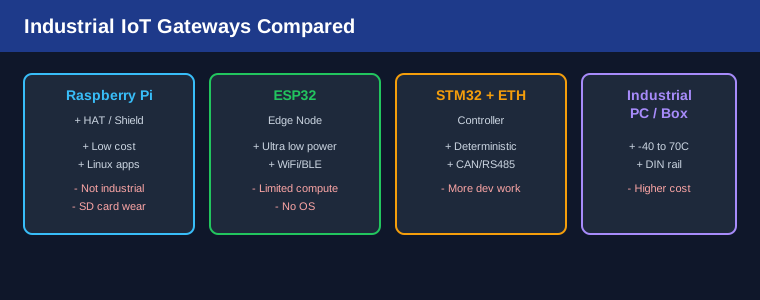
Physical Layer: The actual manufacturing equipment — CNC machines, robotic arms, conveyor systems, industrial robots, and inspection stations. These assets are instrumented with sensors (vibration, temperature, current, position) connected through industrial IoT gateways.
Communication Layer: Industrial protocols (OPC UA, MQTT, Modbus TCP) transmit sensor data to the twin platform. Edge gateways perform initial data cleaning, normalization, and compression before forwarding to the twin engine. The communication layer must handle data from hundreds to thousands of assets with latencies under 100ms for real-time applications.
Twin Engine: The core software platform that maintains the virtual representation. It combines 3D visualization, physics-based simulation models, data analytics, and machine learning. Leading platforms include Siemens Xcelerator, PTC ThingWorx, Microsoft Azure Digital Twins, and AWS TwinMaker. The twin engine runs both real-time analytics (current state) and what-if simulations (future states).
Application Layer: End-user applications for production monitoring, predictive maintenance, quality analysis, and simulation. These applications present twin data through dashboards, AR/VR interfaces, and automated workflow triggers.
2. Implementation Framework
Deploying digital twins in manufacturing requires a systematic approach. The proven five-phase framework in 2026 is:
Phase 1 — Asset Assessment: Identify which assets will benefit most from digital twinning. Prioritize critical-path equipment, bottleneck operations, and assets with high maintenance costs. Create an asset hierarchy that defines relationships between production lines, cells, machines, and components.
Phase 2 — Data Infrastructure: Deploy necessary sensors and connectivity. For existing equipment, retrofit with vibration and temperature sensors. For new equipment, specify OPC UA compliance in procurement contracts. Establish data pipelines that capture operational data at the required frequency — typically 1-100 Hz for process monitoring, up to 10 kHz for vibration analysis.
Phase 3 — Model Development: Create the digital models. Start with a geometric/3D model of the asset, then layer in behavioral models based on physics simulations (finite element analysis, multibody dynamics). Finally, add data-driven models using machine learning trained on historical operational data. The level of fidelity depends on the use case — a predictive maintenance twin needs less geometric detail but more behavioral accuracy than a training simulation twin.
Phase 4 — Integration and Calibration: Connect the digital twin to live data streams and calibrate the model against real-world measurements. Calibration is an iterative process — the model should predict the asset’s behavior within 5% error before being put into production use. A calibration period of 2-4 weeks is typical for most manufacturing assets.
Phase 5 — Deployment and Continuous Improvement: Put the digital twin into production use. Monitor prediction accuracy and retrain models as equipment ages or operating conditions change. Digital twins are living systems that improve over time as more data is collected and models are refined.
3. IIoT and Sensor Integration
Digital twins depend on reliable sensor data. The integration architecture in 2026 typically includes:
Vibration Monitoring: MEMS accelerometers on motor bearings, spindle housings, and pump casings measure vibration signatures. IEPE sensors provide higher fidelity for critical assets. Data collected at 10-50 kHz is processed through FFT to identify bearing wear, imbalance, misalignment, and cavitation.
Thermal Imaging: Fixed thermal cameras monitor electrical panels, motor surfaces, and process temperatures. AI-powered analysis detects hotspots before they cause failures. Thermal data is particularly valuable for predicting bearing failures and electrical connection degradation.
Energy Monitoring: Smart power meters at the machine and line level track energy consumption patterns. Deviations from baseline energy profiles often indicate mechanical wear, process drift, or impending failures before they are detectable by vibration monitoring alone.
Production Data: PLCs and SCADA systems provide cycle times, production counts, reject rates, and machine states. This data is combined with sensor data in the digital twin to correlate process parameters with product quality outcomes.
4. Manufacturing Use Cases
Digital twins are transforming manufacturing operations across several key use cases:
Predictive Maintenance: The most common digital twin application. The twin continuously compares actual equipment behavior against the expected model. When deviations exceed thresholds, it predicts remaining useful life and recommends maintenance actions. One automotive manufacturer reported reducing unplanned downtime by 40% after implementing digital twins on 200 critical production machines.
Production Simulation: Engineers use digital twins to simulate production changes before implementing them on the factory floor. A new product introduction that previously required a 3-day production line shutdown for changeover can now be validated virtually in hours. The optimized changeover sequence is then downloaded directly to the PLCs.
Quality Optimization: Digital twins correlate process parameters with product quality measurements. When quality drift is detected, the twin identifies the root cause — temperature variation, tool wear, material batch differences — and recommends corrective actions. Some systems automatically adjust process parameters to maintain quality within specification.
Operator Training: Digital twins power immersive training simulations where operators learn to run equipment, respond to alarms, and handle emergency situations without risk to production equipment or materials. Training time for new operators has been reduced by 50% using twin-based simulation training.
5. Enabling Technologies
Several technology advances in 2026 have accelerated digital twin adoption:
Edge AI: On-device machine learning at the sensor and gateway level reduces the data volume that must be sent to the twin platform. Edge processors can run inference models for anomaly detection, vibration classification, and temperature prediction, sending only alerts and summary statistics to the cloud.
5G and Private Networks: Private 5G networks in factories provide the bandwidth, low latency, and device density needed for real-time digital twins. A private 5G network can support thousands of sensors per cell with deterministic latency under 10ms.
GPU-Accelerated Simulation: NVIDIA Omniverse and similar platforms use GPU acceleration to run physics simulations in real-time. What previously required hours of batch processing can now be computed in seconds, enabling interactive what-if analysis during production.
6. Challenges and Best Practices
Key challenges manufacturers face with digital twin deployment include:
Data Quality: Digital twins are only as good as the data feeding them. Sensor drift, network interruptions, and data synchronization issues can degrade model accuracy. Implement data quality monitoring that tracks sensor health, data completeness, and model confidence scores.
Model Maintenance: Equipment changes over time — bearings wear, alignments shift, controllers are retuned. Digital twin models must be periodically recalibrated. Plan for quarterly model reviews and retraining cycles.
Skill Requirements: Building and maintaining digital twins requires a combination of domain expertise (manufacturing processes) and technical skills (data science, simulation, software engineering). Most manufacturers use a center-of-excellence model with a dedicated digital twin team supporting multiple plant locations.
7. ROI and Business Case
The business case for digital twins in manufacturing is compelling. Based on 2026 industry surveys:
Average Payback Period: 8-14 months for focused deployments on critical assets. Plant-wide deployments typically achieve payback in 12-18 months.
Downtime Reduction: 25-40% reduction in unplanned downtime through predictive maintenance and simulation-driven optimization.
Quality Improvement: 15-25% reduction in defect rates through real-time process optimization and root cause analysis.
Energy Savings: 10-15% reduction in energy consumption through optimized machine scheduling and operating parameters.
Faster Ramp-Up: 30-50% faster new product introductions through virtual commissioning and simulation-driven process design.
Frequently Asked Questions
What is the difference between a digital twin and a simulation?
A simulation is a one-time or periodic analysis of a system. A digital twin is a continuously updated virtual representation that maintains real-time synchronization with its physical counterpart. Simulations answer “what if” questions; digital twins answer “what is happening now” and “what will happen next.”
Do I need a 3D model for a digital twin?
Not necessarily. While 3D visualization is helpful for human understanding, the core value of a digital twin comes from its data models and behavioral models. Many successful digital twins use simple schematic representations or dashboards rather than photo-realistic 3D environments.
Can I create digital twins for legacy equipment?
Yes. Retrofit sensors can instrument legacy equipment without built-in connectivity. Vibration and temperature sensors with wireless transmitters can be installed on machines from any era. The digital model can be built from engineering documentation and calibration data.
What software platforms support digital twins?
Major platforms include Siemens Xcelerator, PTC ThingWorx, Microsoft Azure Digital Twins, AWS TwinMaker, GE Digital Proficy, and IBM Maximo. Open-source options include Eclipse Ditto and thingsboard. The choice depends on your existing technology stack, scale requirements, and use case priorities.
Related Reading
- Edge Computing in Manufacturing 2026: Architecture, Benefits, and Real-World Deployments
- Industrial IoT Sensor Networks 2026: Wireless Protocols, Edge Processing, and Predictive Maintenance Architecture
Sources
- Siemens Xcelerator Digital Twin Platform
- PTC ThingWorx Industrial IoT Platform
- Microsoft Azure Digital Twins
- AWS IoT TwinMaker
- NVIDIA Omniverse for Digital Twins