Key Takeaway: Industrial IoT sensor networks in 2026 have matured into a three-layer architecture combining wireless mesh sensor nodes, edge processing gateways, and cloud-based analytics. With LoRaWAN, Matter, and Thread protocols reaching production maturity and edge AI enabling real-time anomaly detection, manufacturers can now deploy predictive maintenance systems that reduce unplanned downtime by up to 45% while cutting cabling costs by 60% compared to traditional wired sensor installations.
Table of Contents
1. Three-Layer IIoT Architecture
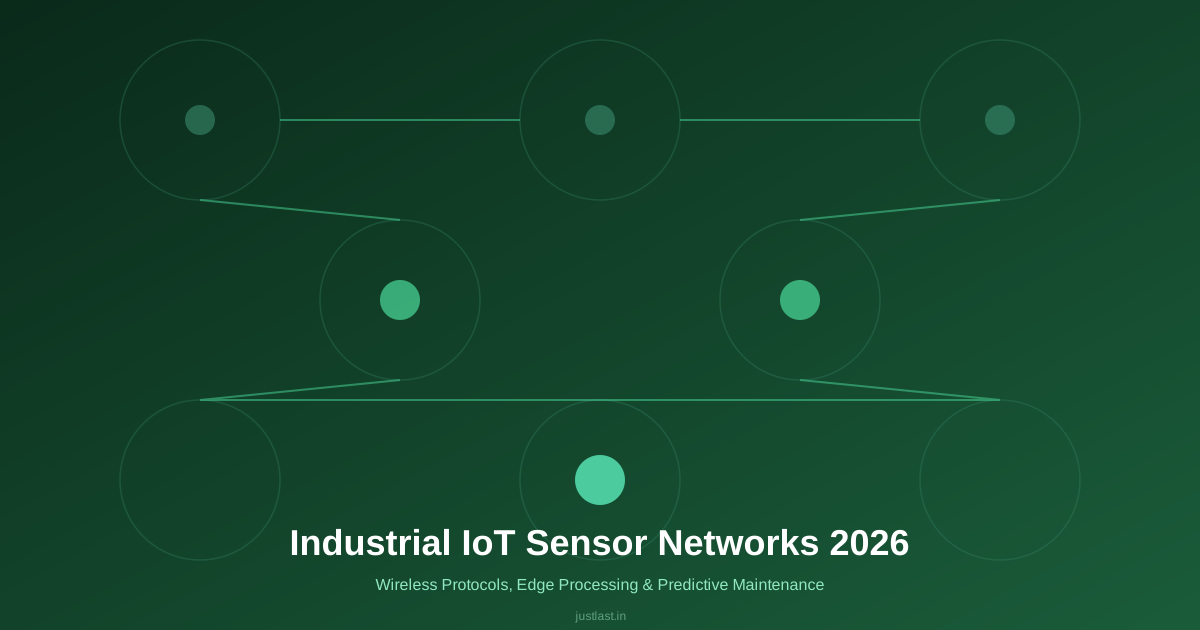
Modern industrial IoT sensor networks follow a three-layer architecture that balances cost, reliability, and intelligence:
Layer 1 — Sensor Nodes: Low-power wireless sensors deployed on or near equipment. These nodes measure temperature, vibration, current draw, pressure, humidity, and other parameters. Each node runs on battery or energy harvesting and communicates via low-power wireless protocols. Typical battery life ranges from 2-5 years depending on transmission frequency, with newer energy-harvesting nodes promising indefinite operation in many scenarios.
Layer 2 — Edge Gateways: Local processing hubs that aggregate data from multiple sensor nodes. The gateway runs edge analytics — filtering noise, detecting immediate anomalies, and compressing data before forwarding to the cloud. In 2026, most gateways include onboard AI acceleration capable of running trained models for vibration analysis, temperature trend prediction, and motor fault detection without cloud connectivity.
Layer 3 — Cloud Platform: Centralized analytics, storage, and dashboard infrastructure. The cloud layer handles long-term trend analysis, fleet-wide anomaly detection, model training, and integration with ERP and CMMS systems. Data from multiple factory sites can be aggregated for enterprise-wide optimization.
2. Wireless Protocol Comparison for 2026
Choosing the right wireless protocol is critical for IIoT sensor network success. Here are the leading options:
LoRaWAN: Long-range, low-power protocol ideal for sensors that transmit small amounts of data over distances up to 15 km. Perfect for environmental monitoring, tank level sensing, and outdoor asset tracking. Data rate is limited to 50 kbps, making it unsuitable for high-frequency vibration or audio monitoring. Module costs have dropped below $5 per node in 2026.
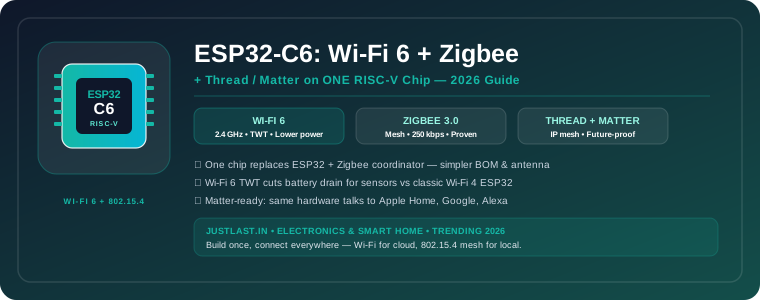
Thread/Matter: Mesh networking protocol optimized for industrial and commercial building environments. Supports thousands of nodes per network with self-healing mesh topology. Data rates of up to 250 kbps make it suitable for moderate-frequency sensor data. Thread is gaining traction as the physical layer for Matter, the unified smart home and building standard that has strong industry backing from Apple, Google, Amazon, and Samsung.
BLE 5.4: Bluetooth Low Energy continues to improve. The 5.4 specification adds periodic advertising with responses (PAwR), enabling more reliable data collection from hundreds of sensor nodes. BLE is ideal for short-range, high-density sensor deployments in machine cabinets and production lines, with typical ranges of 10-100 meters.
Wi-Fi HaLow (802.11ah): Sub-1 GHz Wi-Fi variant offering ranges of up to 1 km with data rates suitable for sensor applications. HaLow is becoming the protocol of choice for video-enabled IIoT applications and scenarios requiring higher data throughput than LoRaWAN can provide.
3. Edge Processing and AI at the Node
The most significant advancement in IIoT sensor networks in 2026 is the shift toward edge intelligence. Rather than sending all sensor data to the cloud, modern systems process data locally:
Embedded ML on Microcontrollers: TinyML frameworks like TensorFlow Lite Micro and Edge Impulse now run on ultra-low-power microcontrollers consuming under 1 mW. A vibration sensor node can run a trained anomaly detection model locally, only transmitting alerts when it detects unusual patterns. This reduces bandwidth requirements by 90% or more and enables real-time response without network latency.
STM32 and RISC-V Edge Nodes: The STM32U5 and ESP32-P4 (RISC-V based) microcontrollers include hardware neural network accelerators capable of running simple inference models. These chips can perform FFT analysis on vibration data, classify motor states, and detect bearing wear patterns using less than 10 mW of power.
Gateway-Level Aggregation: Edge gateways built on platforms like the Raspberry Pi CM4 or NVIDIA Jetson Orin aggregate data from multiple sensor nodes and run more complex models. A single gateway can monitor 50-200 sensor nodes, performing real-time analysis for an entire production cell or assembly line.
4. Predictive Maintenance Implementation
Predictive maintenance is the primary ROI driver for IIoT sensor networks. Here is the implementation workflow:
Step 1 — Baseline Collection: Deploy sensors and collect 2-4 weeks of baseline data from equipment operating normally. This establishes the fingerprint of healthy operation: normal vibration envelopes, temperature ranges, current draw patterns, and so on.
Step 2 — Model Training: Use the baseline data to train anomaly detection models. Techniques range from simple statistical thresholding (standard deviation-based) to more sophisticated approaches like autoencoder neural networks that learn the normal operating profile and flag deviations.
Step 3 — Deployment: Deploy the trained model to edge gateways. Configure alert thresholds based on severity levels: advisory (minor deviation), warning (requires attention within shift), critical (immediate shutdown risk), and emergency (automatic equipment stop).
Step 4 — Continuous Learning: As the system operates, it continues to refine its models. Seasonal temperature changes, equipment aging, and process modifications are all incorporated into updated baselines automatically.
Manufacturers implementing this workflow report 30-45% reduction in unplanned downtime, 15-25% extension in equipment lifespan, and 20-30% reduction in maintenance costs according to industry surveys from 2026.
5. Sensor Types and Selection
Choosing the right sensor for each measurement point is essential for reliable data. Here are the key sensor categories for IIoT:
Vibration Sensors: MEMS accelerometers (ADXL355, LIS2DW12) for general machinery monitoring, piezoelectric sensors (PCB Piezotronics) for high-frequency bearing analysis. IEPE-compatible sensors remain the gold standard for critical rotating equipment, while MEMS sensors are adequate for most pump, fan, and motor monitoring applications.
Temperature Sensors: RTD (PT100/PT1000) for 0.1°C precision in process monitoring, thermocouples for high-temperature applications above 300°C, and infrared temperature sensors for non-contact monitoring of electrical panels and rotating equipment surfaces.
Current Sensors: Split-core current transformers (CTs) are the most practical for retrofitting on existing equipment. Hall-effect sensors for DC current monitoring in servo drives and battery systems. Smart CTs with integrated energy measurement (like the SCT-013 series) are popular for motor energy monitoring.
Environmental Sensors: Temperature, humidity, air pressure, gas detection (CO2, VOCs, methane), and particulate matter (PM2.5, PM10) sensors for workplace environmental monitoring. These are increasingly integrated into multi-sensor modules costing under $20.
6. Security Considerations
IIoT security requires a defense-in-depth approach. Key considerations include:
Hardware Security: Use MCUs with hardware security features — secure boot, trusted execution environment, cryptographic accelerator, and hardware random number generator. The ESP32-C6 and STM32U5 both include these features.
Encryption: All sensor data should be encrypted in transit using TLS 1.3 or DTLS. LoRaWAN uses AES-128 encryption by default. BLE 5.4 supports LE Secure Connections with 128-bit AES.
Network Segmentation: IIoT sensor networks should be on a separate VLAN from production control networks and IT networks. Use firewall rules to restrict which gateways can communicate with cloud platforms.
Certificate Management: Each sensor node should have a unique device identity certificate. Plan for certificate rotation at scale — managing thousands of sensor certificates requires an automated PKI infrastructure.
7. Deployment Best Practices
Based on field experience across dozens of installations, here are the key deployment guidelines:
Start Small: Begin with 10-20 sensors on critical equipment. Prove the ROI before scaling. Most successful deployments start with vibration monitoring on pumps, motors, and compressors — equipment categories where unexpected failures cause the most production disruption.
Plan for Connectivity: Conduct a wireless site survey before installation. Industrial environments are RF-hostile with metal structures, electrical noise, and machinery interference. Map signal strength across the facility and position gateways strategically.
Power Budget Carefully: For battery-powered sensors, calculate the power budget: sensor reading power × reading frequency + transmission power × transmission frequency + sleep power. Most LoRaWAN sensors can achieve 3-5 year battery life with hourly readings; daily readings can extend battery life to 8-10 years.
Implement Alert Escalation: Define clear alert pathways: sensor → gateway → operator dashboard → maintenance team → supervisor escalation. Confirm that each step has defined response times and responsibilities.
Frequently Asked Questions
What is the typical ROI timeline for IIoT sensor networks?
Most manufacturers achieve ROI within 6-18 months depending on deployment scale. The average payback period reported in 2026 industry surveys is 11 months, driven primarily by prevented downtime events. A single unplanned downtime event prevented can pay for an entire sensor network.
Can I use consumer IoT protocols for industrial applications?
Consumer protocols like standard Wi-Fi and BLE can work for light industrial applications but lack the reliability, range, and interference immunity of industrial protocols like LoRaWAN and Thread. For production-critical monitoring, use protocols designed for industrial environments.
How much data do IIoT sensors generate?
A typical vibration sensor transmitting hourly FFT summary data generates about 1-5 MB per month. At higher frequencies (every 10 minutes the same sensor might generate 20-50 MB monthly. Plan edge filtering to reduce cloud data volumes.
What maintenance do the sensor nodes themselves require?
Battery-powered nodes require battery changes every 2-5 years depending on transmission frequency. Hardwired nodes are maintenance-free beyond periodic calibration checks. All nodes benefit from annual visual inspection for physical damage.
How reliable are wireless IIoT networks in factory environments?
With proper site planning, modern wireless IIoT networks achieve 99.5-99.9% reliability. Mesh protocols like Thread provide self-healing capability — if one node fails, traffic automatically routes through neighboring nodes.
Related Reading
- Edge Computing vs Cloud Computing for Industrial IoT in 2026
- STM32 Precision Sensor Data Acquisition for Factory Automation
Sources
- LoRa Alliance Official Website
- Bluetooth SIG Specifications
- Thread Group Official Site
- Edge Impulse Official Platform
- IBM: Guide to Predictive Maintenance