
Key Takeaway: Edge computing in manufacturing delivers 1-10ms latency for real-time machine control — 50x faster than cloud-only architectures — making it essential for predictive maintenance, quality inspection, and autonomous mobile robots on the factory floor.
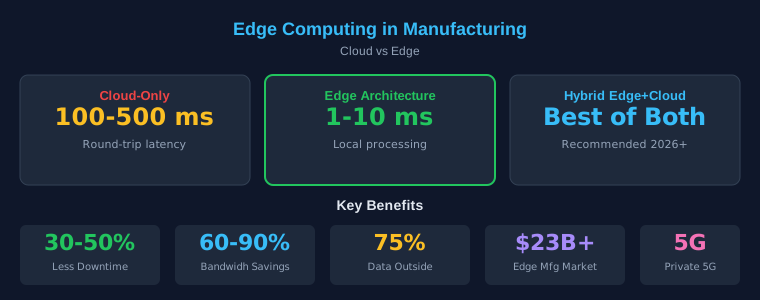
Table of Contents
1. What Is Edge Computing in Manufacturing?
Edge computing in manufacturing refers to processing data at or near the source of data generation — on the factory floor itself — rather than sending everything to a centralized cloud data center. For industrial automation and embedded systems, this means deploying compute resources (edge servers, industrial PCs, or even microcontrollers like STM32 boards) directly alongside PLCs, CNC machines, sensors, and actuators.
The concept directly addresses a critical limitation of cloud computing for industrial applications: latency. When a CNC machine detects a vibration anomaly that could indicate spindle bearing failure, waiting 100-500ms for a cloud round-trip response is simply too slow. Edge computing brings that decision loop down to 1-10ms, enabling real-time control and immediate corrective action.
In the context of Industry 4.0 and IIoT (Industrial Internet of Things), edge computing serves as the bridge between operational technology (OT) on the factory floor and information technology (IT) in the cloud. It processes raw sensor data locally, runs ML inference models, and sends only relevant insights — not raw data streams — to the cloud for long-term storage and analysis.
2. Cloud vs Edge Architecture Comparison
Understanding when to use cloud, edge, or a hybrid approach is critical for factory automation planning. Here is a practical comparison:
| Feature | Cloud-Only | Edge | Hybrid Edge+Cloud |
|---|---|---|---|
| Latency | 100-500ms | 1-10ms | 1-10ms local, cloud for analytics |
| Real-time control | Not suitable | Excellent | Best of both |
| Bandwidth usage | High (all data sent) | Low (filtered locally) | Optimized |
| Connectivity dependency | Critical (downtime = stopped) | None for local ops | Graceful degradation |
| Data sovereignty | Data leaves premises | Data stays local | Configurable |
| Best for | Analytics, reporting, long-term storage | Real-time control, safety, quality | Modern factory (recommended 2026+) |
3. Key Benefits for Factory Floors
Edge computing delivers measurable advantages for manufacturing operations. Here is why factories are investing heavily in edge infrastructure:
Ultra-Low Latency for Machine Control
Edge nodes process sensor data locally, reducing the decision loop from hundreds of milliseconds to single-digit milliseconds. This is critical for closed-loop motor control, emergency stop systems, collision avoidance in robotic cells, and real-time quality inspection at line speed. For example, an AI-powered vision system running on an edge node can inspect 100+ parts per second — something impossible with cloud round-trip latency.
Predictive Maintenance
Edge-based ML models analyze vibration, temperature, and acoustic signals from CNC spindles, servo motors, and conveyor drives in real time. They detect anomalies before they become failures, reducing unplanned downtime by 30-50%. The key advantage is that the inference runs locally — no need to send terabytes of vibration data to the cloud.
Bandwidth and Cost Savings
A typical CNC machine with multiple sensors generates gigabytes of raw data per day. Edge processing reduces data transmission to the cloud by 60-90% by filtering, aggregating, and analyzing locally. Only KPIs, alerts, and compressed summaries reach the cloud. This dramatically lowers cloud storage costs and network infrastructure requirements.
Operational Resilience
When cloud connectivity drops — which happens more often in industrial environments than people realize — edge-processed operations continue without interruption. The factory floor stays productive. This operational resilience is non-negotiable for continuous manufacturing environments.
Security and Compliance
Keeping sensitive production data, quality metrics, and process parameters on-premises simplifies data sovereignty compliance. Edge architectures reduce the attack surface by limiting what leaves the factory network. Sensitive data like proprietary machining parameters or product quality data never traverses public networks.
4. Real-World Use Cases
Edge computing is already transforming manufacturing operations across multiple domains:
Predictive Maintenance on CNC Machines
Edge nodes mounted on or near CNC machines run anomaly detection models on spindle vibration data collected via accelerometers. When a bearing starts degrading, the system alerts operators weeks before failure, scheduling maintenance during planned downtime. This is far more cost-effective than replacing a spindle that has already seized.
Automated Quality Inspection
Computer vision models running on edge GPUs (like NVIDIA Jetson) inspect parts at line speed. They detect surface defects, dimensional deviations, and assembly errors in real time. The edge node processes camera images locally and sends pass/fail signals to the production line controller — all within a single machine cycle.
Autonomous Mobile Robots (AMRs)
AMRs in factory environments rely on edge computing for real-time navigation, obstacle avoidance, and coordination. Cloud latency is too slow for safe autonomous movement. Edge nodes on the AMR itself process LIDAR and camera data, making movement decisions in milliseconds.
Digital Twin Synchronization
Edge nodes maintain local digital twin models that mirror the current state of production equipment. They process sensor data locally to keep the virtual model synchronized with the physical machine in real time, enabling predictive simulations without cloud dependency.
5. Implementation Guide: Getting Started
Implementing edge computing in manufacturing does not require ripping out existing infrastructure. A phased approach works best:
Phase 1: Assessment (Weeks 1-2)
Identify the highest-value use cases. Map existing sensor infrastructure, data protocols (Modbus, OPC UA, MQTT), and compute requirements. Prioritize applications where latency reduction delivers the most business value — typically predictive maintenance and quality inspection.
Phase 2: Infrastructure (Weeks 3-6)
Deploy edge hardware. Options include industrial PCs (Advantech, Dell Edge), NVIDIA Jetson for AI inference, or even Raspberry Pi 4 clusters for simpler monitoring. Connect to existing PLC and sensor networks via OPC UA gateways or protocol converters. Install an edge platform (AWS IoT Greengrass, Azure IoT Edge, or open-source options like EdgeX Foundry).
Phase 3: Development (Weeks 7-10)
Develop or deploy ML models for your priority use cases. Many vendors offer pre-trained models for common manufacturing applications (vibration analysis, thermal monitoring, visual inspection). Use ONNX Runtime or TensorFlow Lite for lightweight inference on edge hardware.
Phase 4: Integration (Weeks 11-14)
Connect edge outputs to existing MES/SCADA systems. Configure cloud synchronization for the data that matters — aggregated KPIs, alerts, and model performance metrics. Establish monitoring for the edge nodes themselves (health, uptime, resource utilization).
Phase 5: Scale (Ongoing)
Expand to additional machines, lines, and facilities. Refine models based on real production data. Add new use cases as the platform matures. The edge architecture should be designed for horizontal scaling from day one.
6. Challenges and Considerations
Edge computing in manufacturing is not without challenges:
Legacy Protocol Integration
Many factories still run Modbus RTU, PROFINET, or other legacy protocols. Bridging these to edge computing platforms requires protocol converters or gateway hardware. OPC UA serves as a universal translator but adds complexity. See our detailed comparison of Modbus TCP vs EtherNet/IP for industrial Ethernet options.
Security of Distributed Nodes
Every edge node is a potential attack surface. Industrial cybersecurity must account for physical access to nodes, network segmentation between OT and IT, encrypted communications, and regular firmware updates. Zero-trust architectures are increasingly recommended for edge deployments.
Skills Gap
Most factory floor technicians understand PLCs and mechanical systems but not edge computing, containerization, or ML inference. Training programs and hiring strategies must bridge the gap between OT expertise and IT/edge skills. The convergence of OT and IT requires personnel who understand both worlds.
ROI Justification
While edge computing delivers clear technical benefits, quantifying ROI for CFOs requires connecting latency reduction to concrete business outcomes: reduced downtime cost, lower scrap rates, improved OEE, and decreased cloud infrastructure spend. Build the business case around these measurable metrics.
7. 2026 Trends: AI at the Edge
Several trends are accelerating edge computing adoption in manufacturing this year:
- TinyML on Embedded Controllers — Lightweight ML models now run directly on microcontrollers like STM32 and ESP32, enabling ML inference without dedicated edge servers. Sensor nodes can classify anomalies locally using models trained in TensorFlow Lite.
- Private 5G + Edge — Private 5G networks provide wireless, low-latency connectivity across factory floors, enabling edge nodes to communicate without Ethernet cabling. This is particularly valuable for mobile equipment and flexible manufacturing cells.
- Edge-Cloud Orchestration — Kubernetes-based platforms (K3s, MicroK8s) enable seamless workload migration between edge and cloud based on latency requirements and available compute. Processing shifts dynamically based on real-time conditions.
- Generative AI at the Edge — Small language models are being deployed on edge nodes for operator assistance, natural-language root-cause analysis, and maintenance log interpretation — all without cloud connectivity requirements.
8. Frequently Asked Questions
What is the difference between edge computing and cloud computing for manufacturing?
Cloud computing processes data in centralized data centers far from the factory floor, resulting in 100-500ms latency. Edge computing processes data locally — at or near the machine — delivering 1-10ms latency. For real-time machine control, quality inspection, and safety systems, edge computing is essential. The cloud is better suited for long-term analytics, reporting, and cross-facility data aggregation.
How much does edge computing infrastructure cost for a factory?
Edge computing costs vary widely based on scope. A single-machine edge node with industrial PC and sensor integration costs $2,000-5,000. A production line with multiple CNC machines, AI vision inspection, and predictive maintenance might cost $15,000-50,000. A facility-wide edge deployment typically ranges from $100,000-500,000, with ROI typically achieved within 12-18 months through reduced downtime and improved quality.
Can edge computing work without cloud connectivity?
Yes. Edge computing is specifically designed to operate independently of cloud connectivity. Edge nodes process data locally and make real-time decisions without requiring internet access. This is a key advantage over cloud-only architectures, where loss of connectivity stops all data processing. When connectivity is restored, edge nodes sync relevant data to the cloud.
What protocols does edge computing support for industrial automation?
Edge platforms support major industrial protocols including OPC UA, MQTT, Modbus TCP, EtherNet/IP, PROFINET, and EtherCAT. OPC UA is the recommended standard for new deployments due to its platform independence and built-in security. Protocol gateways bridge legacy protocols to modern edge platforms.
What hardware is recommended for edge computing in manufacturing?
For general-purpose edge processing, industrial PCs from Advantech, Dell, or HPE are recommended. For AI inference workloads, NVIDIA Jetson (Orin Nano/NX) offers excellent performance per watt. For simpler monitoring tasks, Raspberry Pi 4 or industrial-grade single-board computers may suffice. The choice depends on processing requirements, environmental conditions, and integration needs.
Related Reading
- OPC UA for Factory Automation: Complete Implementation Guide
- Modbus TCP vs EtherNet/IP: Industrial Ethernet Protocols Compared
- Digital Twin Technology: Building Virtual Factory Models
- STM32 PWM for Motor Control: Timers, Duty Cycle Explained
Sources
- Gartner: 75% of Enterprise Data Will Be Processed Outside Data Centers by 2025
- NVIDIA EGX Edge Computing Platform
- Linux Foundation Akraino Edge Stack
- EdgeX Foundry: Open Source Edge Computing Framework
- AWS IoT Greengrass: Edge Computing for IoT
Disclosure: This post contains affiliate links. If you purchase hardware or software through these links, we may earn a commission at no additional cost to you.