

Key Takeaway: Drills offer precision and clutch control for clean holes and delicate screws, while impact drivers deliver 2-3x more torque for structural fastening without wrist fatigue. Serious DIYers and professionals should own both tools for maximum versatility.
Table of Contents
1. Understanding the Basics: Drill vs Impact Driver
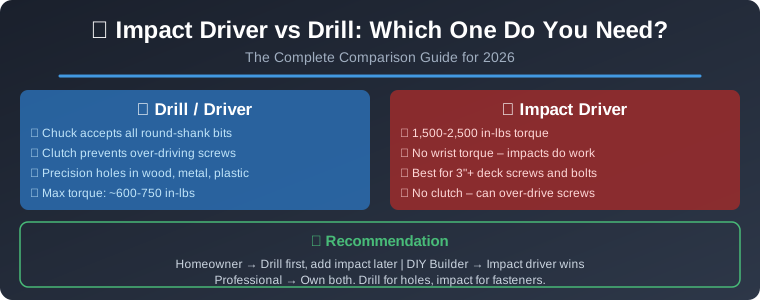
Drills and impact drivers look similar and both turn fasteners, which creates endless confusion for first-time buyers. But they work differently under the hood, and each excels at different tasks. The drill/driver uses a chuck that accepts all round-shank bits and delivers smooth, controllable rotation. Its adjustable clutch prevents over-driving screws — a critical feature for finish work and delicate materials.
An impact driver uses a 1/4″ hex collet (not a chuck) and delivers torque through rapid concussive rotational blows — typically 3,000-4,000 impacts per minute. When it senses resistance, the impact mechanism kicks in, multiplying torque dramatically without transferring the reaction force to your wrist. This is why professionals can drive 3-inch deck screws all day without fatigue.
The key specification difference is torque: most cordless drills top out around 600-750 in-lbs of torque, while even mid-range impact drivers deliver 1,500-2,300 in-lbs. That’s not a small gap — the impact driver can easily drive fasteners that would stall or damage a standard drill.
2. When to Use Each Tool
Use a drill when: Drilling holes in wood, metal, or plastic (the chuck accepts all round-shank bits); boring large holes with hole saws or spade bits; driving short screws into cabinets or drywall where clutch control matters; any delicate work involving electronics, thin wood, or furniture assembly where precise depth control is essential.
Use an impact driver when: Driving 3-inch or longer deck screws into dimensional lumber; installing lag bolts and structural fasteners; removing stuck or rusted fasteners that a drill would just strip; repetitive bulk fastening where speed is important; working in tight spaces where the impact driver’s shorter length helps.
3. Top Models Compared: 2026
Consumer Reports and Pro Tool Reviews consistently rate the Milwaukee M18 FUEL 2953-20 as the best professional impact driver (4.8/5, 2,000 in-lbs torque), with the DeWalt DCF887B 20V MAX XR as runner-up (4.7/5, 1,825 in-lbs). For drills, the DeWalt DCD791 20V MAX Brushless Drill/Driver scores 4.7/5.
For budget-conscious buyers, the Ryobi 18V One+ HP Brushless PBLID04 impact driver (4.3/5, 2,300 in-lbs torque) offers exceptional value while challenging pro-level brands on performance.
4. Which One Should You Buy?
Homeowners doing general maintenance and furniture assembly should start with a drill/driver. The clutch control saves you from stripping screws and over-driving into drywall — the two most common frustrations for new tool owners. DIYers tackling outdoor projects like fencing and decking should choose an impact driver first. The combination of raw torque and zero wrist fatigue makes structural fastening genuinely enjoyable. Professionals should own both tools and use them as a system — one for pilot holes and one for fasteners.
5. Best Combo Kits 2026
The DeWalt DCK240C2 and DCK277D2 combo kits (both rated 8.7-8.8/10) include a drill and impact driver with two batteries, charger, and bag. These typically save $60-80 compared to buying the tools separately, making them the smartest entry point for anyone building their toolkit.
Frequently Asked Questions
Can I use drill bits in an impact driver?
Not effectively. Impact drivers use a 1/4″ hex collet that only accepts hex-shank bits. The concussive action also makes slightly out-of-round holes and can snap smaller bits in metal.
Will an impact driver damage screws?
Yes, in soft materials. Without a clutch, the tool can drive a screw too deep before you react. Use speed modes or practice trigger control for finish work.
Is a brushless motor worth paying extra for?
Absolutely. Brushless motors deliver 25-50% longer runtime, more torque, and significantly longer tool life compared to brushed designs. Every recommendation in this article is brushless.
Related Reading
Sources
- Pro Tool Reviews — Best Impact Driver 2025
- Tool Shed Tested — Impact Driver vs Drill 2026
- Tool Shed Tested — Milwaukee vs DeWalt 2026
- Consumer Reports — Cordless Drill and Impact Driver Ratings
- Cordless Drill Set Guru — Best Combo Sets 2026
Disclosure: This post contains affiliate links. As an Amazon Associate, we earn from qualifying purchases.


