
Edge computing manufacturing infographic - Cloud vs Edge latency comparison
Edge Computing Manufacturing Infographic

Edge Computing in Manufacturing: Real-Time Processing for Smart Factory Floors in 2026

Key Takeaway: Edge computing in manufacturing processes data at the source — on the factory floor — reducing latency from 100–500ms (cloud) to 1–10ms (edge), cutting bandwidth costs by 60–90%,…
Continue ReadingEdge Computing in Manufacturing: Real-Time Processing for Smart Factory Floors in 2026

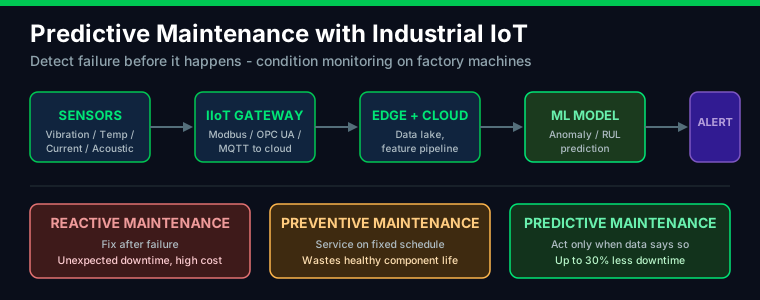
Predictive Maintenance with Industrial IoT: Complete Condition Monitoring Guide for Factory Machines

Key Takeaway: Predictive maintenance with industrial IoT combines vibration, temperature and current sensors with machine learning models running on edge gateways and the cloud, letting factories detect equipment faults weeks…

Continue ReadingPredictive Maintenance with Industrial IoT: Complete Condition Monitoring Guide for Factory Machines

Industrial Edge Computing with Raspberry Pi in 2026: Build a Complete Factory Monitoring System

Key Takeaway: A Raspberry Pi 5 can function as a full industrial edge gateway for under $100, replacing commercial edge devices that cost $1,000-5,000. By combining sensors (vibration, temperature, current)…

Continue ReadingIndustrial Edge Computing with Raspberry Pi in 2026: Build a Complete Factory Monitoring System
Edge Computing vs Cloud Computing in Manufacturing comparison diagram 2026
Edge Computing vs Cloud Computing: Where each workload belongs in manufacturing

Edge Computing vs Cloud Computing in Manufacturing 2026: Where Each Workload Belongs

Key Takeaway: Edge computing and cloud computing are not competing architectures in modern manufacturing — they are complementary layers. Edge handles sub-50ms real-time control, OEE calculations, and offline resilience on…

Continue ReadingEdge Computing vs Cloud Computing in Manufacturing 2026: Where Each Workload Belongs

Digital Twins in Manufacturing 2026: How Virtual Replicas Drive Real Production Efficiency Gains

Key Takeaways The digital twin market in manufacturing is projected to reach $47.2 billion by 2027, driven by real-time sensor integration and AI. Digital twins reduce prototyping cycles by 60%…

Continue ReadingDigital Twins in Manufacturing 2026: How Virtual Replicas Drive Real Production Efficiency Gains
Digital Twins in Manufacturing 2026 - Virtual Replicas in Industrial Operations
Digital Twins in Manufacturing 2026

Digital Twins in Manufacturing 2026: How Virtual Replicas Are Revolutionizing Industrial Operations

Key Takeaway: Digital twin technology has emerged as one of the most transformative forces in modern manufacturing, enabling factories to create virtual replicas of physical assets that continuously synchronize with…

Continue ReadingDigital Twins in Manufacturing 2026: How Virtual Replicas Are Revolutionizing Industrial Operations