Key Takeaway: A Raspberry Pi 5 can function as a full industrial edge gateway for under $100, replacing commercial edge devices that cost $1,000-5,000. By combining sensors (vibration, temperature, current) with OPC UA for OT integration and MQTT for IT data flow, you can build a factory monitoring system that collects real-time machine data, runs YOLOv8-based vision inspection at 16-18 FPS, and alerts operators via Telegram or Slack — all on a single $80 single-board computer.

The Edge Computing Revolution in Manufacturing
Every factory faces the same fundamental question: how do you get sensor data from the shop floor to the systems that need it? Traditional industrial edge gateways from Siemens, Beckhoff, and Softing implement proven patterns but cost $1,000-5,000 per unit. The Raspberry Pi 5, equipped with a quad-core ARM Cortex-A76 processor and up to 8GB RAM, provides sufficient computational capability for running lightweight AI models, protocol translation, and real-time monitoring — all at a fraction of the cost. In 2026, this approach has moved from hobbyist prototype to production-ready industrial deployment.
Why Raspberry Pi for Industrial Edge?
The modern Raspberry Pi (models 4 and 5) offers quad-core 64-bit processors capable of running full Linux distributions, executing machine-level processes, hosting dashboards, running edge analytics, and interacting with industrial IoT platforms. Key advantages include:
- Flexible I/O: GPIO pins for direct digital control, UART/SPI/I²C for industrial sensors, Ethernet for stable networking, and optional PoE support
- Protocol support: OPC UA (via asyncua Python library), MQTT, Modbus RTU over RS485 HATs, and CAN bus via HAT modules
- Edge AI: Google Coral TPU acceleration, YOLOv8-nano inference at 16-18 FPS for vision inspection
- Cost advantage: Complete edge gateway stack (Pi 5 + sensors + HATs) for ~$100 vs. $2,000+ for commercial alternatives
System Architecture: The Three-Layer Model
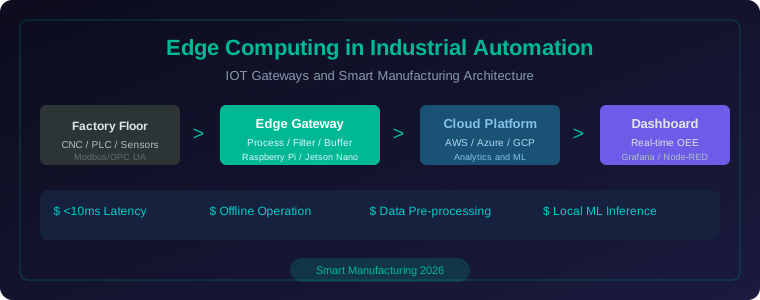
A production-grade edge monitoring system follows a three-layer architecture that mirrors the ISA-95 / Purdue model:
Layer 1: Sensors and Field Devices
The sensing layer captures machine health data through multiple modalities. Common choices include the ADXL345 accelerometer (SPI, 3200 Hz sampling for vibration analysis), DS18B20 digital temperature sensor (±0.5°C accuracy, 1-Wire interface, up to 100m cable length), ACS712 current sensor (measures motor current draw through MCP3008 ADC), and the Raspberry Pi Camera Module v3 for computer vision. In production environments, replace these with industrial-grade counterparts — vibration transmitters (4-20mA), PT100 RTD temperature sensors, and industrial IP67 cameras.
Layer 2: Edge Gateway (Raspberry Pi 5)
The Pi 5 runs a complete software stack typically deployed via Docker Compose. Mosquitto serves as the MQTT broker for lightweight data transport. Node-RED provides low-code flow programming for protocol translation, data preprocessing, and rule-based alerts. InfluxDB stores time-series sensor data for historical analysis. Grafana hosts real-time dashboards for operators. OpenCV 4.9 with YOLOv8-nano runs computer vision inference for quality inspection and anomaly detection.
The MING stack (Mosquitto, InfluxDB, Node-RED, Grafana) is the most common open-source edge stack, effectively combining four technologies for IIoT data management. On the Raspberry Pi 5, Docker performance is strong enough to run the full stack simultaneously.
Layer 3: IT and Cloud Systems
Data from the edge gateway flows upward via MQTT to enterprise systems — dashboards, AI/ML pipelines, ERP integrations, and historian databases. Alert notifications route through Telegram Bot API, Slack webhooks, or SMTP email to operators and maintenance teams. The key architectural insight is that OPC UA handles horizontal OT integration (machine-to-machine on the plant floor) while MQTT handles vertical IT data flow (edge to cloud).
OPC UA and MQTT: The Protocol Power Couple
These two protocols are not competitors — they operate at complementary layers. OPC UA provides rich, typed, browsable data models for horizontal integration with SCADA, HMI, and MES systems on the plant floor LAN. MQTT provides lightweight (2-byte minimum header), outbound-only connections for vertical data flow to cloud dashboards and analytics platforms.
The Raspberry Pi runs both protocols from a single process. One sensor reading serves two worlds — OT systems browse the OPC UA server on the LAN, while IT systems subscribe to MQTT topics from anywhere. This is exactly what commercial edge gateways do, at a fraction of the cost.
Real Machine Vision with YOLOv8 on Pi 5
Perhaps the most surprising capability of the Pi 5 edge gateway is real-time computer vision. A 2026 study published in the Journal of Engineering and Computer Science demonstrated a system using YOLOv5 on a Raspberry Pi 5 that achieved 98.1% detection accuracy with ±0.42 mm measurement precision, processing 16-18 FPS. The system integrated with an Omron CP2E PLC via FINS protocol with 85ms average latency, enabling real-time quality inspection on conveyor lines up to 0.5 m/s. Compared with traditional manual inspection, the system achieved an 85% reduction in measurement time.
Cost Comparison: DIY vs Commercial
A DIY Raspberry Pi 5 edge gateway costs approximately $100 for the complete stack: Pi 5 8GB ($80), ADXL345 sensor ($6), DS18B20 sensor ($4), MCP3008 ADC ($5), and a 32GB SD card ($8). An industrial equivalent — Siemens Industrial Edge or Beckhoff EK9160 — costs $2,000-5,000. The architecture is identical. The difference is reliability certification, industrial temperature rating, and formal support.
Frequently Asked Questions
Can a Raspberry Pi really replace an industrial edge gateway?
For non-critical monitoring applications (data collection, dashboards, alerting), yes. For safety-critical control applications, use certified industrial hardware. The key distinction: edge gateways read data but do not control processes. If the edge gateway goes down, operations continue unaffected.
What is the MING stack?
MING stands for Mosquitto (MQTT broker), InfluxDB (time-series database), Node-RED (flow-based programming), and Grafana (dashboard visualization). It is the most common open-source edge stack for IIoT data management and runs well on a Raspberry Pi 5 via Docker.
What protocols does a Pi edge gateway support?
OPC UA (via asyncua), MQTT (via Mosquitto), Modbus RTU (via RS485 HAT), CAN bus (via CAN HAT), and HTTP/REST. Additional HATs add specific industrial interfaces as needed.
Can the Pi 5 run AI models for vision inspection?
Yes. YOLOv8-nano runs at 16-18 FPS on a Pi 5, sufficient for conveyor speeds up to 0.5 m/s. With a Google Coral TPU accelerator, performance improves further. A 2026 published study confirmed 98.1% detection accuracy for dimensional measurement applications.
How reliable is a Raspberry Pi in a factory environment?
With proper power management (PoE HAT, UPS HAT), industrial SD cards (high endurance), and a well-ventilated enclosure, Pi 5s can run 24/7 in factory environments. For dusty or extreme-temperature areas, industrial-rated single-board computers (like the Revolution Pi or Siemens IOT2050) are safer choices.
Related Reading
Sources
- Raspberry Pi in Real-World Industry – Circuit Cellar
- Building an IT/OT Edge Gateway with Raspberry Pi
- Hermes-Pi Factory Guardian – DEV Community
- IoT-Enabled Deep Learning Vision System – e-Komtek Journal
- Industrial IoT Monitoring Project – GitHub
Disclaimer: This article is for informational and educational purposes. Always follow safety guidelines when working with industrial equipment. Raspberry Pi-based systems are not certified for safety-critical control applications.