Key Takeaway: A cordless drill is the better first tool because it drills holes and drives screws with clutch precision, but an impact driver is dramatically better for long screws, lag bolts, and high-volume fastening — which is why most pros carry both on a shared battery platform.
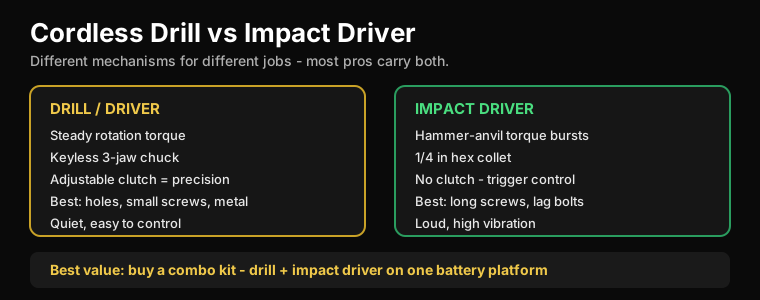
Table of Contents
1. Overview: Same Family, Different Tools
At a glance, a cordless drill and an impact driver look almost identical. Both spin a bit, both use rechargeable batteries, and both live in the same drawer. But under the plastic they work completely differently, and that difference decides which tool you should reach for. This cordless drill vs impact driver comparison breaks down the mechanisms, the jobs each one wins, and — most importantly — which one to buy first.
2. Cordless Drill vs Impact Driver: Head-to-Head
| Feature | Cordless Drill / Driver | Impact Driver |
|---|---|---|
| Mechanism | Steady rotational torque | Hammer-anvil torque bursts |
| Bit holder | Keyless 3-jaw chuck (round-shank bits) | 1/4-inch hex collet (hex-shank bits) |
| Clutch | Yes — adjustable precision | No — trigger control only |
| Max torque | Moderate (600–1,400 in-lb) | Very high (1,500–2,000+ in-lb) |
| Best at | Drilling holes, small screws, precision work | Long screws, lag bolts, stuck fasteners |
| Noise / vibration | Quiet, low vibration | Loud, high vibration |
| Size / weight | Longer and heavier | Shorter and lighter |
An impact driver starts with steady torque, then when it meets resistance its internal hammer slips, accelerates, and slams into the anvil — up to 60 strikes per second. Each strike delivers a burst of rotational force. That is why an impact driver can sink a 3-inch screw into hardwood without a pilot hole, while a drill bogs down and strains your wrist.
A drill, by contrast, delivers uninterrupted torque through the chuck. It is simpler, quieter, and its adjustable clutch prevents you from overdriving screws into drywall or MDF. The tradeoff is raw power: when a drill hits its limit, it just stops.
3. Which One Do You Actually Need?
Buy the drill first if you…
- Need to drill holes (any size) — the impact driver is a poor hole-borer
- Work with small screws and delicate materials — the clutch prevents stripping and overdriving
- Drill metal — steady low-speed rotation is what cuts clean steel
- Want one versatile tool for furniture assembly, drywall anchors, and light DIY
Buy the impact driver first if you…
- Drive a lot of long screws (decking, framing, 2.5-inch and up)
- Need to remove stuck or rusted fasteners
- Work in tight spaces — impact drivers are shorter and lighter
- Suffer from wrist fatigue — the impact action keeps torque out of your hand
The honest truth, echoed by every tool reviewer we cite: if you can only buy one tool, buy a drill — it is more versatile. But if your budget stretches, buy a combo kit and get both on one battery platform. You will use the drill for holes and the impact driver for fasteners, and you will never fight the wrong tool again.
4. Buying Guide: Combo Kits and Battery Platforms
The single best piece of buying advice for cordless tools is this: you are buying a battery platform, not a tool. The drill is the gateway — the next tools you buy (impact driver, circular saw, work light) will share that battery, so pick a platform with a wide ecosystem.
- Ryobi ONE+ (18V) — the widest ecosystem for homeowners, 200+ tools including yard equipment. Budget-friendly. Check price on Amazon.
- DeWalt 20V MAX / XR — pro-grade power and reliability, excellent for heavier work. Check price on Amazon.
- Makita 18V LXT — light, balanced, and popular with pros who work overhead. Check price on Amazon.
- Bosch (12V/18V) — excellent compact 12V line if weight matters most.
Brushless motors are worth the small premium: they run longer per charge, deliver more power, and last longer than brushed motors. For a homeowner, a brushless drill/driver kit in the ₹6,000–₹15,000 range covers 90% of household jobs.
5. FAQ
Can an impact driver drill holes?
Yes, with hex-shank drill bits it can make rough holes in wood and soft metal. But you lose the speed control and precision of a drill/driver. For clean, precise holes, use a drill.
Does an impact driver strip screws more than a drill?
Actually, less. The impact action reseats the bit between strikes, which resists cam-out. The bigger risk is overdriving — sinking the screw too deep or blowing through thin material — because impact drivers have no clutch.
Is a hammer drill the same as an impact driver?
No. A hammer drill uses a forward striking action (along the bit axis) to drill masonry and concrete. An impact driver delivers rotational impacts to drive fasteners. They solve different problems.
Which is better for a beginner: drill or impact driver?
A cordless drill/driver. It is more versatile, more forgiving, and its clutch teaches you to control torque. Add an impact driver later when you start doing heavier fastening work.
Should I buy a drill and impact driver combo kit?
Yes, if the budget allows. Combo kits cost less than buying each tool separately, and the tools share one battery platform — which is exactly how pros run their kits.
Related Reading
- Best Circular Saw in India 2026: Complete Buying Guide
- How to Build a Workbench: Complete DIY Guide
- Jigsaw vs Circular Saw vs Reciprocating Saw
Sources
- Impact Driver vs Drill: Differences and Uses — Pro Tool Reviews
- Impact Driver vs Drill: Which Do You Need? — Lowe’s
- Impact Drivers vs Drills — The Home Depot
- Impact Driver vs Drill 2026 — Power Tool Insider
- Hammer Drill vs Impact Driver vs Drill — Bob Vila
Disclosure: This post contains affiliate links. As an Amazon Associate I earn from qualifying purchases.