Key Takeaway: For a first saw in 2026, buy a jigsaw — it is the most versatile tool for curves, straight cuts, and plunge cuts on wood, plastic, and metal. Add a circular saw when you need fast, long straight cuts in sheet goods, and keep a reciprocating saw for demolition and pipe work.
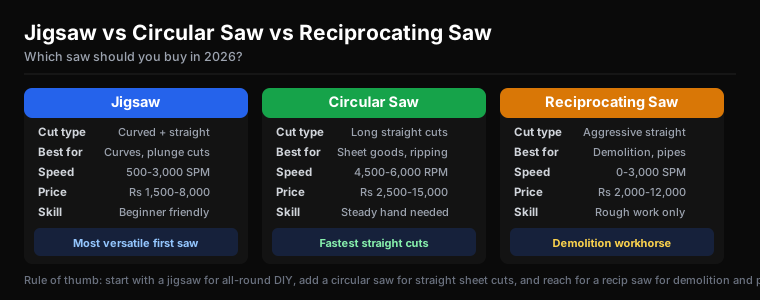
Table of Contents
1. Overview
Standing in the tool aisle trying to decide between a jigsaw, a circular saw, and a reciprocating saw is one of the most confusing moments for any DIYer. They all look like they cut things, and they all cost somewhere between Rs 1,500 and Rs 15,000. But these three saws are built for completely different jobs, and buying the wrong one — or worse, using one for the wrong job — is how beginners end up with tear-out, crooked cuts, or a blade that snaps mid-cut.
This jigsaw vs circular saw vs reciprocating saw guide explains exactly what each saw is for, compares them on the specs that actually matter, and gives you a decision framework based on the projects you actually plan to build.
2. Jigsaw vs Circular Saw vs Reciprocating Saw: Full Comparison
Here is the comparison table for the Indian market in 2026.
| Feature | Jigsaw | Circular Saw | Reciprocating Saw |
|---|---|---|---|
| Blade motion | Reciprocating up/down | Rotating circular blade | Reciprocating back/forth |
| Cut type | Curves + straight | Long straight cuts | Rough straight cuts |
| Best material | Wood, plastic, thin metal | Plywood, boards, sheet goods | Wood, pipes, demolition |
| Plunge cut | Yes (tilt base) | No | Yes (rough) |
| Cut speed | 500-3,000 SPM | 4,500-6,000 RPM | 0-3,000 SPM |
| Cut quality | Good | Excellent (with guide) | Rough |
| Skill needed | Beginner | Moderate | Beginner (rough work) |
| Typical price | Rs 1,500-8,000 | Rs 2,500-15,000 | Rs 2,000-12,000 |
Jigsaw: the all-rounder you should probably buy first
A jigsaw uses a short, straight blade that moves rapidly up and down. Because the blade is narrow, you can steer it — which is why the jigsaw is the only one of the three that can cut curves, circles, and shapes. It can also start a cut from the middle of a panel using a plunge cut, which no circular saw can do. With the right blade it cuts wood, plywood, laminate, plastic, and thin aluminium. The trade-off is speed: for a long, straight rip cut down an 8-foot plywood sheet, a jigsaw is slow and prone to wandering off-line unless you use a guide fence.
Circular saw: the speed king for straight cuts
A circular saw spins a toothed disc at thousands of RPM, giving it the fastest, cleanest straight cuts of the three. It is the tool of choice for breaking down plywood sheets, cutting boards to length, and ripping timber. With a straight-edge guide, a circular saw cuts as straight as a table saw for most DIY purposes. The catches: it cannot cut curves, it cannot start a cut in the middle of a panel, and it throws a lot of sawdust. It also needs two hands and a steady eye to keep on the line.
Reciprocating saw: the demolition workhorse
A reciprocating saw (or recip saw / Sabre saw) pushes a long blade back and forth with aggressive force. It is not built for clean joinery — it is built to tear things apart: cutting through old pipes, nails, framing lumber, tree branches, and bathroom renovation wreckage. Its long stroke lets you reach into awkward spaces, and you can bury the blade right into a wall. For any demolition, plumbing, or pruning job, nothing else in the workshop comes close. You would never use it for finish cuts, but you would not want to destroy a fine jigsaw blade on a rusted pipe either.
3. Buying Guide: Which Saw for Your Project?
Buy a jigsaw if you are starting out
- You are building your first tool kit and want one saw that does the most jobs.
- Your projects involve cutting shapes, curves, or openings — shelves, signboards, sink cut-outs, children’s toys.
- You work mostly with plywood, MDF, laminate, and plastic.
- You want something safe and easy for a beginner to control.
A decent corded or cordless jigsaw from Bosch, Black+Decker, or Makita starts around Rs 2,500. Look for variable speed, tool-free blade change, and an orbital action setting. Check current jigsaw prices on Amazon India.
Add a circular saw when straight cuts become your bottleneck
- You are cutting plywood sheets, boards, or timber to size regularly.
- You are building furniture, shelving, or a workbench and need long, straight, repeatable cuts.
- Speed and cut cleanliness matter more than versatility.
A 7-1/4 inch circular saw handles almost everything around the house and starts around Rs 3,000 for corded models. If you cut sheet goods often, buy a straight-edge guide or make one from a straight board — it transforms cut quality. See circular saw options on Amazon India. We also have a full best circular saw buying guide if you want a deep dive.
Reach for a reciprocating saw only when you need demolition power
- You are renovating — cutting pipes, drywall, old framing, nails.
- You prune trees or cut firewood.
- You need to cut into a wall or floor to find a leak.
A corded recip saw is inexpensive (around Rs 2,500) and never runs out of battery; a cordless one is handier on ladders and outdoors. Buy a set of bi-metal demolition blades — the blades matter more than the saw. Compare reciprocating saws on Amazon India.
The smart workshop combo for 2026
If you can only afford one saw, buy a jigsaw. If you can stretch to two, make the second a circular saw — together they cover nearly every home woodworking job. Add a reciprocating saw only when a renovation project demands it. That order lets you spend money on good blades and a proper straight-edge guide, which improve results far more than a pricier brand badge. For building a dedicated space to use these tools, our complete DIY workbench build guide is the perfect companion project.
4. Frequently Asked Questions
Which saw is best for a beginner?
A jigsaw is the best first saw for beginners. It is easy to control, can cut curves and straight lines, and is safer for light woodwork than a circular saw. Use a circular saw only after you are comfortable measuring and following a straight line.
Can a jigsaw cut straight lines?
Yes, short-to-medium straight cuts are easy with a jigsaw, especially with a guide fence. For long straight cuts in thick boards or plywood sheets, a circular saw is faster and straighter.
Can a circular saw cut curves?
No. A circular saw is designed for straight cuts only. For curves, use a jigsaw, a bandsaw, or a router.
What is the difference between a jigsaw and a reciprocating saw?
A jigsaw has a short, fine blade and makes clean, accurate cuts in wood, plastic, and thin metal — ideal for curves and joinery. A reciprocating saw has a long, aggressive blade and is designed for rough demolition cuts through pipes, nails, and framing.
Can one saw do everything?
No single saw does everything well. A jigsaw is the most versatile, but it is slow on long straight cuts. Most workshops eventually own all three because each has a distinct job.
Related Reading
- Best Circular Saw in India 2026: Complete Buying Guide
- How to Build a Workbench: Complete DIY Guide with Plans
- Impact Driver vs Drill: Key Differences
- Best Cordless Drill in India 2026
Sources
- Family Handyman — Jigsaw vs Circular Saw
- Fine Power Tools — Reciprocating Saw vs Jigsaw
- Bosch Power Tools — Jigsaws
Disclosure: This post contains affiliate links. As an Amazon Associate I earn from qualifying purchases.