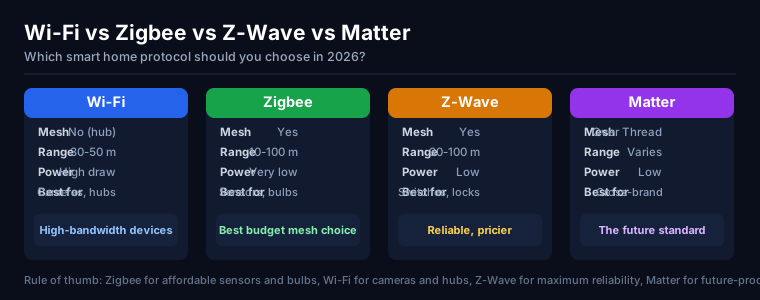

Key Takeaway: Wi-Fi wins for cameras and smart speakers, Zigbee offers the best balance of power efficiency and device variety, and Z-Wave excels in reliability for mission-critical devices — but Matter/Thread is rapidly becoming the future-proof choice.

Table of Contents
1. Why Your Smart Home Protocol Matters
Choosing the wrong smart home protocol is like building a house on the wrong foundation — everything works until it doesn’t. The protocol determines how your smart devices communicate, affecting range, reliability, battery life, and which products you can buy.
In 2026, the landscape has never been more complex — or more exciting. Wi-Fi, Zigbee, and Z-Wave remain the established players, while Matter (backed by Apple, Google, Amazon, and Samsung) is reshaping the entire ecosystem. Understanding these protocols helps you build a smart home that actually works reliably.
2. Wi-Fi: The Universal Connector
Wi-Fi is the protocol most people already know. It uses your existing home router and internet connection — no hub required. That simplicity makes it the entry point for most smart home beginners.
Advantages
- No hub needed: Devices connect directly to your router
- High bandwidth: Perfect for cameras, streaming devices, and video doorbells
- Universal compatibility: Works with every smartphone and smart assistant
- Mature ecosystem: Largest selection of smart home products
Disadvantages
- High power consumption: Battery-powered devices drain in days, not months
- No mesh network: Each device must reach the router — dead zones are real
- Router congestion: 30+ smart devices competing with laptops, phones, and streaming
- Internet dependency: Many Wi-Fi devices stop working if your internet goes down
Best For
Cameras (Ring, Arlo), smart displays, speakers (Echo, Google Nest), smart TVs, and any device that needs high bandwidth. Also good for smart plugs and switches that don’t need battery power.
3. Zigbee: The Power-Efficient Mesh
Zigbee operates on the 2.4 GHz frequency and creates a mesh network where devices relay signals to each other. Think of it like a bucket brigade — each device extends the network’s reach without straining your router.
Advantages
- Mesh networking: Every mains-powered device acts as a repeater, extending range automatically
- Ultra-low power: Battery sensors last 2-5 years on a coin cell
- Massive device support: Theoretically 65,000+ devices per network (practical: hundreds)
- Wide ecosystem: Philips Hue, Aqara, IKEA TRADFRI, and most budget smart home brands
- Low interference: While on 2.4 GHz, Zigbee uses channels that avoid common Wi-Fi overlap
Disadvantages
- Hub required: Needs a Zigbee coordinator (Amazon Echo 4th gen, SmartThings, Home Assistant)
- 2.4 GHz congestion: Shares frequency band with Wi-Fi (though on different channels)
- Compatibility issues: Not all Zigbee devices work with all hubs — check Blakadder’s compatibility database
Best For
Sensors (motion, door/window, temperature), smart lighting (Hue, IKEA), and devices that need to run on batteries for years. The go-to choice for building a large, reliable smart home network.
4. Z-Wave: The Reliability Champion
Z-Wave operates on the sub-1 GHz band (908 MHz in the US), which gives it a significant advantage in crowded RF environments. Walls and interference that cripple 2.4 GHz signals barely affect Z-Wave.
Advantages
- 908 MHz frequency: Minimal interference from Wi-Fi, Bluetooth, and microwaves
- Mesh networking: Like Zigbee, devices relay signals to extend range
- 232 devices per network: More than enough for most homes
- Rigorous certification: The Z-Wave Alliance enforces strict compatibility standards — devices always work together
- Reliability: Preferred for locks, thermostats, and security systems where failure is not an option
Disadvantages
- Higher device costs: Z-Wave chips cost more than Zigbee, reflected in product prices
- Smaller ecosystem: Fewer device options compared to Wi-Fi and Zigbee
- Hub required: Needs a Z-Wave controller (SmartThings, Home Assistant with Z-Wave stick)
- Lower bandwidth: 100 kbps — fine for sensors and switches, but not cameras
Best For
Security-critical devices (door locks, alarm sensors), thermostats, and any application where rock-solid reliability matters more than price. The Home Assistant community particularly favors Z-Wave for its consistency.
5. Matter & Thread: The Future Standard
Matter isn’t a new protocol — it’s a unification standard built on top of existing technologies. Apple, Google, Amazon, and Samsung all committed to Matter support, meaning a Matter device works across all ecosystems out of the box.
Thread is the networking layer many Matter devices use. It’s a mesh protocol similar to Zigbee but designed for IP-based communication. Think of it as Zigbee’s more modern, internet-native cousin.
Why It Matters in 2026
- One device, every ecosystem: Buy once, use with Alexa, Google, HomeKit, or SmartThings
- Thread mesh networking: Low-power, reliable, self-healing mesh like Zigbee
- Local control: Many Thread devices work without cloud connectivity
- Growing adoption: Most new smart home devices in 2026 support Matter
The catch? The ecosystem is still maturing. Some features (like multi-admin pairing) are being rolled out incrementally. If you’re starting fresh, prioritize Matter-compatible devices. If you have an existing Zigbee or Z-Wave setup, don’t rip it out — these protocols remain fully supported.
6. Side-by-Side Comparison
| Feature | Wi-Fi | Zigbee | Z-Wave | Matter/Thread |
|---|---|---|---|---|
| Frequency | 2.4/5 GHz | 2.4 GHz | 908 MHz | 2.4 GHz |
| Hub Required? | No | Yes | Yes | Border Router |
| Mesh Network | No | Yes | Yes | Yes |
| Battery Life | Days | 2-5 years | 2-5 years | 2-5 years |
| Max Devices | Router limit | 65,000+ | 232 | 250+ |
| Interference | High | Moderate | Low | Low |
| Ecosystem Size | Largest | Large | Medium | Growing fast |
| Price Range | $ | $$ | $$$ | $$ |
7. How to Choose the Right Protocol
Choose Wi-Fi If:
- You have fewer than 20 smart devices
- You need cameras or video doorbells
- You want the simplest setup with no hub
- Your router can handle the load (upgrade to a mesh router for 20+ devices)
Choose Zigbee If:
- You want battery-powered sensors that last years
- You’re building a large smart home (30+ devices)
- You use Philips Hue, Aqara, or IKEA TRADFRI products
- You already own an Echo 4th gen (has built-in Zigbee hub)
Choose Z-Wave If:
- Reliability is non-negotiable (door locks, security sensors)
- You live in a dense apartment building with heavy RF interference
- You’re a Home Assistant power user
- You’re willing to pay more for rock-solid performance
Choose Matter/Thread If:
- You’re building a smart home from scratch
- You want cross-platform compatibility (Apple + Google + Amazon)
- You value local control without cloud dependency
- You want future-proof investment
8. Frequently Asked Questions
Can I mix protocols in my smart home?
Absolutely — and most people do. A typical setup might use Wi-Fi for cameras, Zigbee for sensors and lighting, Z-Wave for door locks, and Thread for newer devices. Smart home hubs like Home Assistant, SmartThings, and Hubitat support all protocols simultaneously. Matter’s whole purpose is making cross-protocol control seamless.
Do I need a hub if I use Google Home or Alexa?
It depends. Amazon Echo 4th gen has a built-in Zigbee hub, and some Echo models support Matter/Thread. Google Nest Hub (2nd gen) also has a built-in Thread border router. For Z-Wave, you’ll always need a separate controller like a SmartThings hub or a Z-Wave USB stick for Home Assistant.
Will Z-Wave and Zigbee become obsolete?
No — not anytime soon. Millions of devices are already installed, and both protocols continue to receive new product releases. Matter is complementary rather than replacement, at least through 2030. Think of it as VHS and DVD coexisting rather than one obliterating the other.
Which protocol is best for smart locks?
Z-Wave is the gold standard for smart locks. Brands like Schlage and Yale prioritize Z-Wave for its reliability and low interference. Zigbee locks exist but are less common. Wi-Fi locks work but drain batteries faster. The best smart home setups use Z-Wave for security devices.
How does Matter change the smart home landscape?
Matter eliminates the “which ecosystem?” question. Buy any Matter-certified device and it works with Apple HomeKit, Google Home, Amazon Alexa, and Samsung SmartThings — all at once. No more checking compatibility charts. It’s the USB-C moment for smart homes.
9. Related Reading
- Best Smart Plugs Under $25 in 2026: Top Picks Reviewed
- ESP32 vs ESP8266: Which Is Better for Smart Home Projects?
- Home Automation with Smart Switches: Complete Beginner Guide
Sources
- CSA-IoT — Matter Smart Home Standard
- Blakadder — Zigbee Device Compatibility Repository
- Home Assistant — Z-Wave JS Integration Guide
- Z-Wave Alliance — Technology Overview
Disclosure: This post contains affiliate links. As an Amazon Associate I earn from qualifying purchases.