AI Tool Wear Detection in 2026: How CNC Shops Are Cutting Scrap Before the Tool Fails
Key Takeaway
AI tool wear detection watches spindle load, vibration, and acoustic emission data in real time and predicts when a cutter is about to fail, so you can change it on a schedule instead of after it damages a part. For shops running 24/7, that single change often pays for the sensors within months.
Figure 1: How AI tool wear detection works on a CNC machine
Table of Contents
- 1. Why Tool Wear Is a Money Problem
- 2. The Signals That Reveal Wear
- 3. How the AI Model Actually Works
- 4. Hardware: What You Actually Buy
- 5. Deployment: Edge vs Cloud in an Indian Shop
- 6. The Numbers: Payback in Real Shops
- 7. Pitfalls That Kill These Projects
- 8. Frequently Asked Questions
- 9. Related Reading
- 10. Sources
1. Why Tool Wear Is a Money Problem
Tooling is one of the quiet biggest costs in a CNC shop. A cutter does not fail all at once; it wears in a curve. Early on it cuts well, then wear creeps, then there is a sudden breakage zone. Most shops today manage this by time: change the tool after N hours, whatever happens. That means you throw away half the tool’s useful life on a schedule, and occasionally the tool beats your schedule and breaks inside an expensive part.
The cost of that second event is not the tool. It is the part, the crash risk, the chip cleanup, the rework, and the machine sitting down. On a 24/7 machine, a single tool breakage event with a scrapped aerospace part can wipe out weeks of tooling budget. AI tool wear detection exists to move the decision from “time” to “actual condition”.
2. The Signals That Reveal Wear
Wear changes the cutting physics, and those changes show up in measurable signals:
- Spindle motor current / drive load: A worn or chipped tool needs more torque at the same feed and depth of cut. This is the cheapest signal and often enough on its own for steady-state turning and milling.
- Vibration (accelerometer on the head or way): Wear shifts the vibration spectrum; chipping shows up as high-frequency events. Very effective, but sensitive to mounting and machine condition.
- Acoustic emission (AE): A piezo sensor hears the cutting. Breakage is a sharp AE spike; gradual wear is a slow change in the AE energy signature. AE is the classic sensor for this and is cheap.
- Feed force / pressure in the feed ball screw: A load cell or a spindle load reading gives a direct force proxy. Reliable but needs calibration per setup.
In practice you combine two or three. Spindle load plus one AE or vibration channel is a strong, affordable starting point. Adding more sensors helps, but only after the first two are dialed in.
3. How the AI Model Actually Works
Forget the “black box AI” marketing. A practical tool wear model is simpler than people assume:
- Feature extraction: From the raw signal you compute per-pass features: RMS of the load, peak current, AE energy, dominant vibration frequency, and their trend over the last N passes.
- Wear index: A small model (often a gradient-boosted tree or a small neural net, not a giant LLM) maps those features to a wear index and an estimated remaining life. Training data comes from your own machines: log the signals, note when each tool was changed and why.
- Threshold + drift logic: The system alerts at a wear threshold you set per material and tool, and it watches its own accuracy over time (drift) so a changed machine condition does not silently break the model.
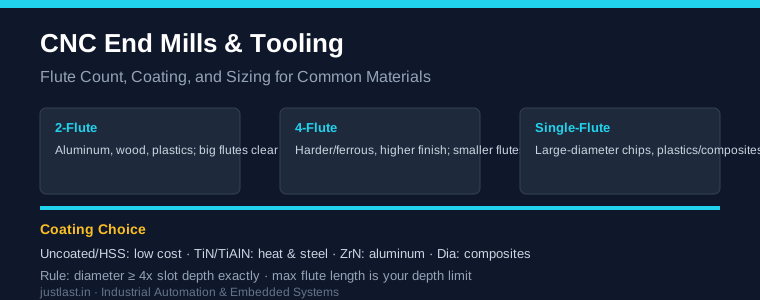
The key discipline is that the model is per-machine-family, per-tool-type, per-material. A model trained on 12mm carbide endmills in aluminum will not transfer to drills in steel. Budget your data collection accordingly.
4. Hardware: What You Actually Buy
For a typical retrofit on an existing machine you are looking at:
- One or two accelerometers or an AE sensor on the spindle head (a few thousand INR each, industrial grade).
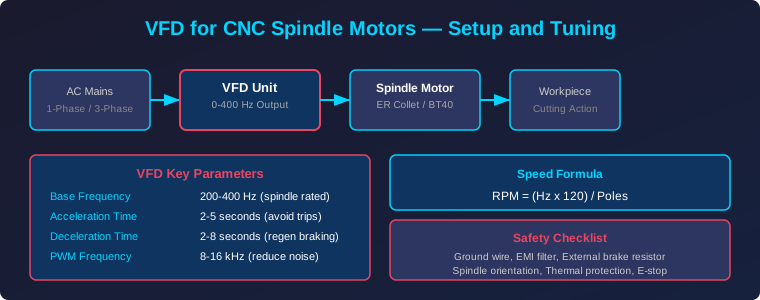
- Access to spindle load. Many modern VFDs and spindles already expose this; if not, a clamp-on current sensor on the spindle drive is the cheap path.
- An acquisition node: an industrial edge logger (think an industrial SBC or a dedicated data logger) with the right inputs, sampling at a few kHz, and an Ethernet connection to your shop network.
- The software: either a packaged predictive-maintenance platform, or a self-hosted setup that ingests the stream, runs the model, and pushes alerts to your SCADA or a dashboard.
For a new machine, this is much easier: the OEM control often already records spindle load and can be tapped through its bus, so the retrofit is mostly the acquisition node and the model.
5. Deployment: Edge vs Cloud in an Indian Shop
Run the model at the edge, keep the cloud for long-term storage and retraining. The alert decision (is the tool about to fail, slow the feed, plan the change) has to happen locally in under a second, and it has to keep working if the internet drops. The cloud (or a server in your plant) is where you store months of signal history, retrain the model as tools and machines change, and build the trend dashboards your production team actually looks at. For a single machine, an industrial edge node on your LAN is all you need; there is no reason to pay for a per-machine SaaS on day one.
6. The Numbers: Payback in Real Shops
Be skeptical of vendor demos, but the direction is real. Across published case studies, the recurring outcomes are: a 25-40 percent reduction in unplanned tooling downtime, a 10-20 percent cut in scrap attributed to tool failure, and a 15-30 percent extension of effective tool life from adaptive feed control. On a machine running around 1400 hours a year where a tool-breakage event costs a few lakh INR in parts and downtime, avoiding even one or two of those events a year typically pays back the sensor and software spend inside 6-12 months. Your own payback number will be dominated by two inputs: the average cost of a breakage event at your shop, and how often you currently change tools early. Write those two numbers down before you look at any vendor quote.
7. Pitfalls That Kill These Projects
- Buying a vendor model without your own data. Their “trained AI” does not know your machines, your tools, or your materials. Plan the data-collection phase as the real project; the sensors are the easy part.
- Too many sensors on day one. Start with spindle load plus one AE or vibration channel per machine. Scale after the first model is useful.
- No drift monitoring. A new machine condition, a new tool supplier batch, or a changed workholding will silently invalidate the model. Watch the model’s own errors, not just the machines.
- Alerts nobody acts on. If the alert lands in a dashboard nobody watches, the system is decoration. Wire the threshold into something the operator sees at the machine, and into the planner’s changeover list.
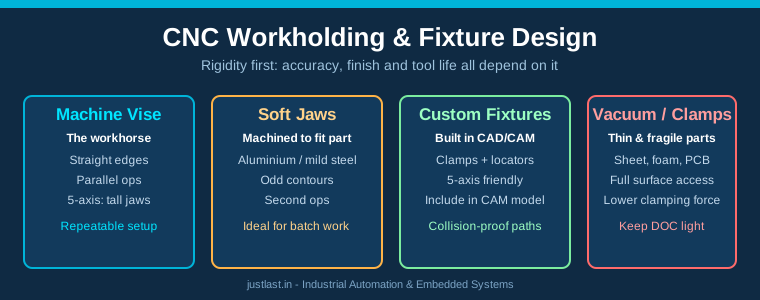
- Ignoring tool supplier variation. “The same” endmill from a different vendor is not the same tool. Retrain or at least revalidate when you switch suppliers.
8. Frequently Asked Questions
Can I just use spindle current and skip the other sensors?
Often yes for a first system. Spindle load is the cheapest and surprisingly informative signal. Add AE or vibration when you need better early-warning on chipping or on high-value parts where the cost of a late warning is high.
How much data do I need before the model works?
As a rule, a few full tool lives per material-tool combination, with the changeover reason recorded each time. That means weeks of logging before the model is reliable, which is why the data phase should be scheduled, not improvised.
Does this work on older machines without modern controls?
Yes, because the retrofit is sensor-based: accelerometers and clamp-on current sensors do not need the machine’s control to cooperate. That is precisely why it is attractive for an installed base of older machines.
Edge or cloud?
Edge for the alert, cloud or a plant server for storage and retraining. The alert has to be local and sub-second; the learning can be central.
9. Related Reading
- 5-Axis CNC Machining in 2026: Why Indian Manufacturers Are Moving Beyond 3-Axis
- CNC Material Selection Guide: Wood, Acrylic, Aluminum
- STM32 Bootloader Tutorial: UART DFU Firmware Update
10. Sources
- Schaeffler – Acoustic Emission Sensors for Tool Condition Monitoring
- Tool Condition Monitoring Technology Overview
- AI and Predictive Maintenance in Machine Shops
- MTConnect Standard – Machine Tool Data Exchange
Key Takeaways
- Tool wear is a money problem: the cost is in scrapped parts and downtime, not in the tool itself.
- Spindle load plus one AE or vibration channel is a strong, affordable starting sensor set.
- The model is per machine, per tool type, per material, and your own logged data is the real project.
- Run the alert at the edge, store and retrain centrally, and wire alerts to something operators actually see.
- Payback is usually 6-12 months on a heavily used machine; compute it from your own breakage cost and changeover frequency.