Key Takeaway: The global CNC machining market has surpassed $100 billion in 2026, growing at 7.1% CAGR. Five major trends define the landscape: AI-native machining with real-time adaptive control, digital twins as production backbones, lights-out automation for extended shift operations, hybrid additive-subtractive manufacturing, and sustainability-driven machining KPIs. Shops that invested in automation during 2023-2025 now operate with 18-36 month payback periods and significant competitive advantages.
CNC Machining Trends Shaping 2026
AI-native machining, digital twins, lights-out automation, and hybrid manufacturing
$100B+
Global CNC Market (2026)
7.1%
CAGR Growth Rate
$4-6M
Lights-out Cell Investment
AI-Native Machining
Real-time sensor feedback adjusts feeds/speeds/toolpaths
Tool wear prediction, adaptive correction, quality monitoring
Digital Twins
Living virtual replicas synced with real operational data
Virtual commissioning, clash detection, process simulation
Lights-Out Automation
Robot-tended cells, automated pallet changers
200-400 parts overnight without operator intervention
Hybrid Manufacturing
Metal deposition + CNC cutting in single platform
Aerospace, energy, medical, MRO applications
Key Insight: 18-36 month payback on automation investment. Shops winning in 2026 invested in AI and automation during 2023-2025.
Sustainability KPIs
MQL, dry cutting, carbon-footprint per part tracking
Reshoring & Nearshoring
Asia-Pac market $35-40B, reshoring accelerates capacity
AI tool wear prediction: days/weeks early
5-axis machines now baseline for job shops
CAM cycle time reduction: 20-30%
1. AI-Native Machining Goes Mainstream
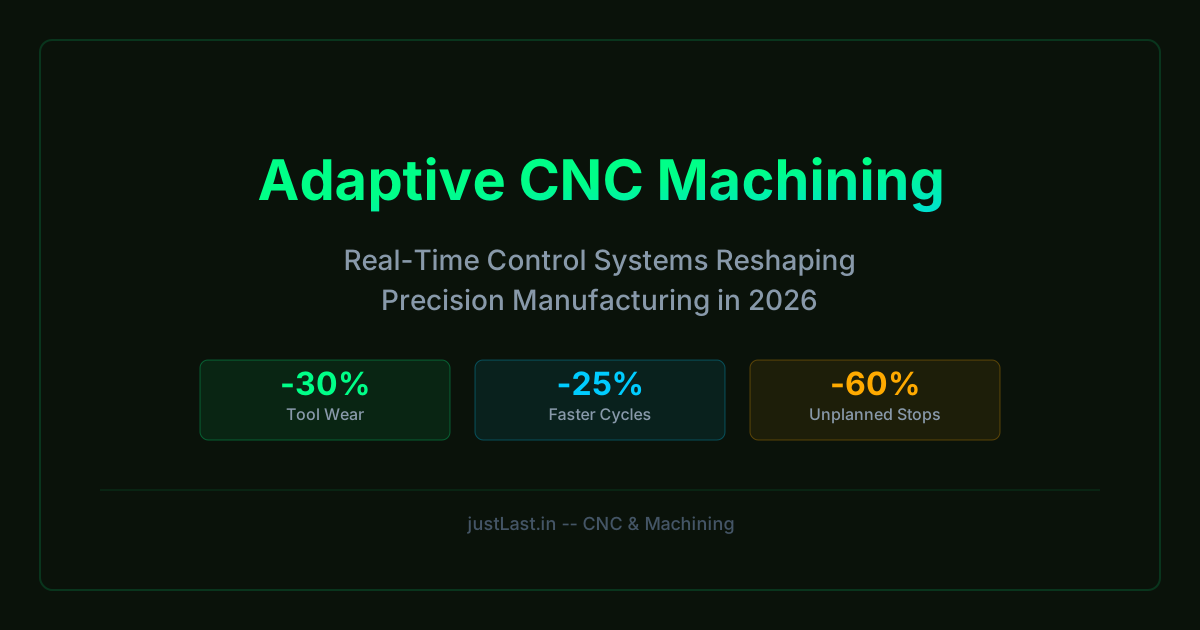
In 2026, artificial intelligence in CNC machining has moved decisively from experimental pilots to integral production control. AI-driven machining uses real-time sensor feedback from spindle motors, accelerometers, thermal sensors, and vision systems to automatically adjust feeds, speeds, and toolpaths. This closed-loop control responds to vibration, load, and temperature changes as they happen, resulting in more consistent surface quality, lower tool wear, and fewer production halts.
Tool wear prediction has emerged as the killer application. AI models analyze acoustic emissions, cutting forces, and power consumption to predict tool failure days or even weeks before traditional methods would trigger replacement. This translates directly to reduced scrap rates, fewer mid-cycle tool changes, and extended tool life through controlled adaptive cutting strategies.
The shift is also redefining the machinist’s role. Operators now spend less time reacting to machine alarms and more time validating data patterns, tuning algorithms, and improving process reliability.
2. Digital Twins Become the Production Backbone
Digital twins have evolved from buzzword-status into living ecosystems that mirror the entire machining process. Instead of merely visualizing toolpaths, the 2026 digital twin integrates design, process engineering, machining, and inspection into a continuously updated model.
A well-constructed digital twin enables engineers to simulate process variations and machine parameter changes in a virtual environment before committing to physical trials. A 5-axis aerospace part that might have required three or four physical setup iterations can now be optimized entirely in simulation, dramatically reducing both time to production and material waste during ramp-up.
Cloud platforms from Siemens (NX), Autodesk (Fusion Manufacturing), and specialized providers now offer plug-and-play integration with major CNC controllers, making digital twins increasingly accessible to shops without large IT departments.
3. Lights-Out Automation Reshapes Production Economics
Extended-shift autonomous operations have transitioned from a luxury of large aerospace suppliers to an achievable goal for mid-market shops. Modern lights-out cell architectures combine automated pallet changers with storage carousels enabling overnight production runs of 200-400 parts without operator intervention. Self-calibrating tool presetters and vision-guided robotic part loading eliminate steps that traditionally required operator presence.
The economic case is compelling. With a full-time CNC operator now costing $70,000-$85,000 annually plus benefits in key US markets, a 5-axis lights-out cell at $2.5 million that displaces two operators pays for itself in under 18 months while providing more consistent 24/7 capacity.
However, the capital requirements are significant. A fully integrated lights-out cell with robot loading, tool management, inspection, and AI monitoring typically runs $4-6 million. Shops that made these investments during 2023-2025 are now reaping the rewards with 18-36 month payback periods.
4. Hybrid Additive-Subtractive Manufacturing
Additive and subtractive processes are converging rapidly in 2026. Hybrid manufacturing platforms combining metal deposition with CNC cutting are gaining traction in aerospace, energy, medical, and MRO sectors. This evolution solves two long-standing manufacturing challenges: material waste (additive builds near-net shapes while machining finishes critical features) and complex geometry (hybrid enables internal channels, lattice structures, and conformal cooling paths impossible to machine conventionally).
Shops that master hybrid workflows early will secure a competitive edge as demand grows for lighter, more efficient, and customized components.
5. Sustainability and Reshoring Drive Investment
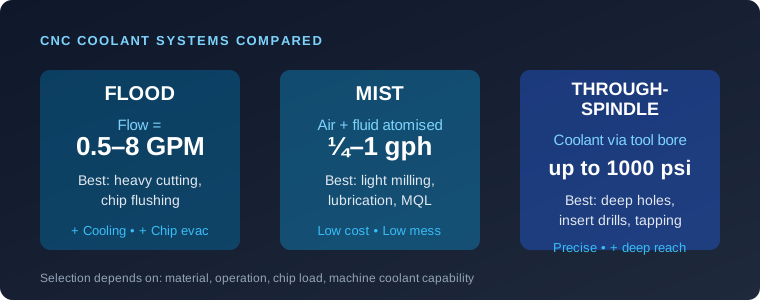
Sustainability has become a core machining KPI in 2026. Environmental performance is tied directly to operational efficiency. Minimum Quantity Lubrication (MQL), dry cutting, and coolant recycling systems are now standard practice in forward-thinking shops. Customers increasingly demand carbon-footprint data per part, pushing shops to measure energy use, coolant volume, and material waste with the same precision as dimensional tolerances.
Concurrently, reshoring and nearshoring trends have accelerated investment in domestic capacity. The Asia-Pacific CNC market alone is valued at $35-40 billion, driven by supply chain resilience priorities across governments and private enterprises.
The Bottom Line for Machine Shops
CNC machining in 2026 is defined by integration and insight. The factories that thrive treat every machine cycle as a data event — captured, analyzed, and used to improve the next. Key priorities for shops include building connected, AI-aware production workflows; using simulation to eliminate guesswork and unplanned downtime; investing in sustainable machining for both compliance and efficiency; and training teams to think in data loops rather than discrete tasks.
Frequently Asked Questions
What is the biggest trend in CNC machining in 2026?
Operational resilience through AI-native machining and broader automation is the dominant trend, heavily influencing capacity stability, lead times, and quality consistency across the industry.
How are machine shops using AI in 2026?
Most AI adoption on the shop floor is pragmatic: tool wear detection, predictive maintenance, and cutting parameter recommendations. Rather than autonomous machining, AI augments operator decision-making.
What is the CNC market size in 2026?
The global CNC machining market is estimated at over $100 billion in 2026, growing at 7.1% CAGR, driven by aerospace, automotive, medical device, and defense sector demand.
Is lights-out manufacturing realistic for small shops?
Pure 24/7 autonomous operations remain limited to high-volume scenarios, but extended-shift operations with human supervision during planned intervals are increasingly practical for mid-market shops.
How does CAM software impact CNC costs in 2026?
AI-driven CAM software can predict machining time within 10% accuracy and reduce cycle times by 20-30% through optimized toolpaths, making it a critical investment for competitive shops.
Related Reading
Sources
- 2026 CNC Machining Trends – Automation.com
- State of CNC Machining 2026 – InsideJob
- 2026 CNC Machining Trends – Dassault Systemes
- 6 CNC Machining Trends OEMs Must Watch – Stecker Machine
- CNC Machining in 2026 – Dashnode AI
Disclosure: Some links in this article are affiliate links. We may earn a commission if you purchase through these links at no additional cost to you.