Key Takeaway: A clamp meter and a multimeter measure the same basics but excel at different jobs — buy a clamp meter to measure current safely without breaking a live circuit (ideal for home wiring, motors, and panels), and keep a multimeter for precise testing of circuits, components, and electronics.
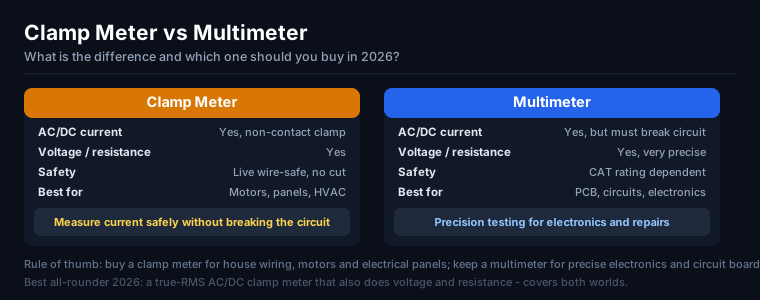
Table of Contents
1. Overview
Ask any electrician or electronics hobbyist what is the most used tool on their bench and the answer is almost always “my meter”. The confusion starts when you walk into a shop and see two similar-looking devices — a clamp meter and a multimeter — with overlapping features and very different prices. Which one measures current? Why does one have a giant jaw on top? Can one replace the other?
This guide explains the real difference between a clamp meter and a multimeter, shows you the exact jobs each is built for, and helps you decide which one (or which pair) belongs in your toolbox in 2026.
2. Clamp Meter vs Multimeter: Full Comparison
Here is the practical comparison table.
| Feature | Clamp Meter | Multimeter |
|---|---|---|
| AC current measurement | Yes — clamp around wire, no circuit break | Yes — but meter must be wired in series (circuit break) |
| DC current measurement | Only on AC/DC clamp models (Hall effect) | Yes, in series (limited to ~10A on most) |
| Voltage measurement | Yes | Yes — very precise |
| Resistance / continuity | Yes (basic) | Yes — excellent |
| Capacitance / frequency / diode test | Some models | Yes, most models |
| Safety for live wiring | Excellent — clamp is non-contact | Good with CAT-rated leads, but must connect probes |
| Best use case | House wiring, motors, AC units, panels, energy audits | PCBs, electronics, component testing, troubleshooting |
| Typical price (India) | Rs 1,200-6,000 | Rs 400-3,000 |
How a clamp meter measures current without touching the wire
The jaw of a clamp meter is a current transformer (or a Hall-effect sensor on DC-capable models). Clamp it around a single conductor and it measures the magnetic field produced by the current flowing through it — no need to disconnect the wire or break the circuit. This is a huge safety and convenience win when you are checking a live motor, an air conditioner, or a distribution board. You simply open the clamp, close it around the phase wire, and read the current.
The catch is that the clamp must go around a single conductor. If you clamp around a whole cable that carries both the live and neutral wires, the fields cancel out and the reading is zero. For a two-wire cable, you strip a little insulation or use a separator so the clamp sees only one wire.
How a multimeter measures current
A multimeter is the classic meter with two probes. To measure current with a standard multimeter, you must break the circuit and insert the meter in series — current flows through the meter. That means switching off the power, cutting a wire or connecting test leads in line, and staying under the meter’s current limit (usually 10A). For most people, this makes the multimeter impractical for measuring appliance or motor currents. Where the multimeter shines is precision: it measures small voltages, resistances, continuity, capacitance, frequency, and diode drops with far more accuracy and resolution than a typical clamp meter.
3. Buying Guide: Which One Do You Need?
Choose a clamp meter if…
- You do household electrical work — checking sockets, wiring, MCB boards, and appliances.
- You want to measure current on a live circuit safely and quickly.
- You troubleshoot motors, air conditioners, geysers, or water pumps.
- You want to check how much power an appliance is drawing.
Look for a true RMS model with a CAT III safety rating and AC/DC clamp capability — that combination handles everything from home wiring to solar and EV charging circuits. Good options start around Rs 1,500. Check current clamp meter prices on Amazon India.
Choose a multimeter if…
- You work on electronics — PCBs, Arduino, sensors, and circuit boards.
- You need precise voltage, resistance, continuity, and component checks.
- You are following electronics tutorials that expect a multimeter.
- You are a student or hobbyist building circuits on a budget.
Even a Rs 500-800 multimeter is fine for basic electronics. For serious work, look for auto-ranging, a capacitance mode, and a CAT II or CAT III rating. Browse digital multimeters on Amazon India. We also have a complete best multimeter buying guide and a how to use a multimeter tutorial if you are starting out.
The best all-rounder for 2026
If you can only buy one meter, the smart money is on a true-RMS AC/DC clamp meter that also measures voltage and resistance. It covers the live-wiring safety of a clamp meter and still does the everyday electronics checks a multimeter handles. If you are primarily an electronics hobbyist, buy the multimeter first and add a clamp meter later — the opposite is true if you are primarily doing home electrical work. Many professionals eventually own both: the clamp meter in the tool bag, the multimeter on the bench.
4. Frequently Asked Questions
Can a clamp meter measure DC current?
Only if it has an AC/DC clamp with a Hall-effect sensor — not all clamp meters do. Check the specifications before buying if you need to measure DC current, for example in solar panels or batteries. Standard AC-only clamp meters measure AC current only.
Is a clamp meter as accurate as a multimeter?
For current, a good true-RMS clamp meter is accurate enough for troubleshooting (typically 1-3% of reading). For small voltage and resistance measurements, a multimeter is more precise. That is why professionals use both.
Can I use a multimeter to measure AC current?
Yes, but you must connect it in series with the circuit — switch off power, open the circuit, insert the meter, and keep the current under the meter’s rated limit (usually 10A). For live circuits, a clamp meter is far safer and easier.
Do I need both a clamp meter and a multimeter?
Not necessarily. A true-RMS AC/DC clamp meter that also measures voltage and resistance covers most home and workshop needs. Electronics hobbyists working on circuit boards will still benefit from a dedicated multimeter for precision and component testing.
What does true RMS mean on a clamp meter?
True RMS (root mean square) means the meter accurately measures non-sinusoidal waveforms — like the current drawn by motor drives, LED drivers, and modern electronics. Cheap “average responding” meters under-read these loads, so true RMS is worth the premium.
Related Reading
- How to Use a Digital Multimeter: Complete Guide
- Best Digital Multimeter in India 2026
- How to Read Resistor Color Codes
- How to Use an Oscilloscope: Beginner’s Guide
Sources
- Fluke — Multimeter vs Clamp Meter
- Hioki — Clamp Meter Measurement Principles
- All About Circuits — Using a Multimeter
Disclosure: This post contains affiliate links. As an Amazon Associate I earn from qualifying purchases.