Key Takeaway: In this oscilloscope buying guide, the best scope for most beginners and hobbyists in 2026 is a 100 MHz, 2-channel digital storage scope with a 1 GSa/s sample rate and at least 1 Mpts of memory — you do not need to spend more than your signal actually demands.
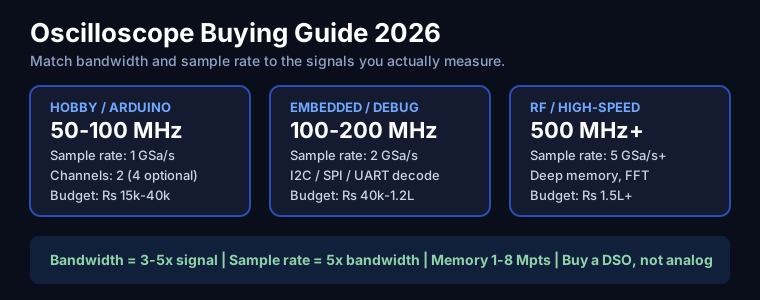
Table of Contents
1. Overview: Why You Need an Oscilloscope
If you work with microcontrollers, audio circuits, switching power supplies, or any electronics repair, an oscilloscope is the single most useful test instrument you can buy after a multimeter. A multimeter tells you a voltage is present; an oscilloscope shows you how that voltage changes over time. That difference is what lets you see noise on a power rail, glitches on an I2C bus, or a dying capacitor that a multimeter would never reveal.
In this oscilloscope buying guide for 2026, we cut through the spec-sheet jargon and tell you exactly which bandwidth, sample rate, channels, and memory depth you need for your projects — and exactly how much you should expect to pay in India.
2. Oscilloscope Buying Guide: The 5 Specs That Actually Matter
2.1 Bandwidth (MHz) — The #1 Spec
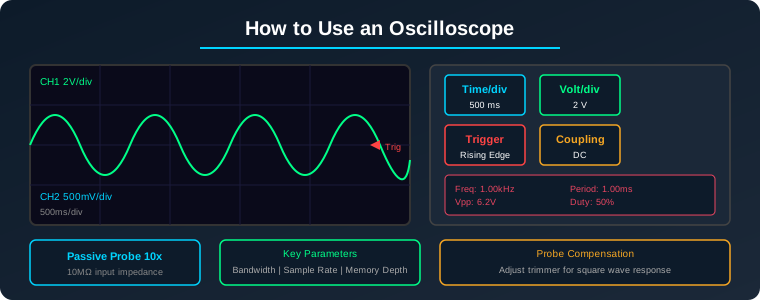
Bandwidth is the highest frequency signal the scope can measure reliably. Here is the rule that every engineer uses: pick a scope with 3–5× the frequency of your fastest signal. A 100 MHz scope is accurate up to roughly 20 MHz of real signal content, so for Arduino-class microcontrollers running at 8–80 MHz, a 50–100 MHz scope is plenty.
For complex digital signals you need more headroom. Rohde & Schwarz recommends 3–5× the fastest clock or data rate, and warns that “too much bandwidth can affect your measurement” by adding broadband noise — most scopes include a 20 MHz filter for power-supply work for exactly this reason.
2.2 Sample Rate (GSa/s) — How Often It Looks
The sample rate is how many times per second the scope digitizes the signal. The rule of thumb: sample rate should be at least 5× your bandwidth. A 100 MHz scope paired with 1 GSa/s is a very common and acceptable combination. Watch out — on many budget scopes the sample rate drops when you turn on both channels, so check the spec for dual-channel operation.
2.3 Number of Channels
Two channels are enough for most beginners and hobbyists. Four channels cost more but pay off when you are debugging a bus (clock + data + enable) or comparing two signals at once. The practical advice from every buying guide we reviewed: a good 2-channel scope beats a bad 4-channel one.
2.4 Memory Depth (Mpts)
Memory depth decides how long you can record at full sample rate. Deeper memory lets you zoom into a glitch that happened seconds ago. Aim for 1 Mpts as a minimum, and 8 Mpts+ if you debug rare, intermittent faults. Marketing likes to quote extreme sample rates, but without memory to back them they are useless.
2.5 Features Worth Paying For
- Protocol decoding (I2C, SPI, UART, CAN) — a huge time-saver for embedded work
- FFT / spectrum analysis — lets the scope double as a basic spectrum analyzer
- Built-in waveform generator — found on many budget models, useful for testing
- USB export / PC connectivity — for saving waveforms and screenshots
3. Buying Guide by Use Case and Budget
Hobby / Arduino / Raspberry Pi
Recommended: 50–100 MHz, 1 GSa/s, 2 channels, 1 Mpts. Budget in India: roughly ₹15,000–₹40,000. This covers audio circuits, basic microcontrollers, sensor debugging, and most repair work.
Embedded Systems Development
Recommended: 100–200 MHz, 2 GSa/s, 4 channels, 8 Mpts, protocol decoding. Budget: ₹40,000–₹1,20,000. If you debug I2C/SPI buses or timing between peripherals, the decoding and extra channels pay for themselves quickly.
RF and High-Speed Design
Recommended: 500 MHz–1 GHz+, 5 GSa/s+, deep memory. Budget: ₹1,50,000+. Unless you are doing serious RF work, do not buy here — you will pay a fortune for bandwidth you never use.
One of the most common mistakes beginners make is buying the cheapest possible scope and outgrowing it in weeks. The opposite mistake is overspending on a lab-grade instrument. A balanced 100 MHz, 1 GSa/s scope is the sweet spot that covers 90% of hobbyists, students, and repair work.
4. Best Oscilloscope Brands and Models in India 2026
Budget / Entry-Level (₹8,000–₹25,000)
- FNIRSI 1014D / DSO152 — the go-to beginner scope for Arduino projects; large display, built-in signal generator, very low price. Check price on Amazon.
- Hantek USB scopes — great entry-level PC-based options if you already own a laptop.
Mid-Range (₹30,000–₹80,000)
- Rigol DS1054Z (50 MHz, hackable to 100 MHz) — the classic hobbyist value pick, 4 channels, deep memory. Check price on Amazon.
- Siglent SDS1104X-E (100 MHz, 4 channels) — excellent long-term value, protocol decoding, widely considered one of the best budget 4-channel scopes. Check price on Amazon.
Pro / Bench (₹1,00,000+)
- Rohde & Schwarz, Keysight, Tektronix — premium instruments for professional and RF work; only if your income depends on the measurements.
5. FAQ
Is 50 MHz enough for an Arduino oscilloscope?
Yes. An Arduino-class board runs well under 50 MHz, and a 50–100 MHz scope can comfortably measure its signals. 100 MHz is the safer minimum if your projects will grow.
Do I need a 4-channel oscilloscope?
Only if you frequently compare more than two signals — for example debugging a communication bus. Most beginners are fine with 2 channels and can upgrade later.
What is the difference between analog and digital oscilloscope?
Digital storage oscilloscopes (DSOs) digitize and store the waveform, letting you freeze, zoom, and measure automatically. For anything beyond the most basic work, buy a DSO — analog scopes are a nostalgia purchase, not a practical one.
Can I use a PC-based USB oscilloscope instead?
Yes, and it is a legitimate low-cost entry point. The tradeoff is portability, trigger quality, and the “hands on the knobs” feel of a standalone scope. If you already have a good laptop, a USB scope is an excellent way to start.
What should my oscilloscope buying budget be in India 2026?
For a genuine hobbyist, budget ₹15,000–₹40,000. For serious embedded development, ₹40,000–₹1,20,000. Avoid both the ₹2,000 toy scopes and the ₹2,00,000 lab instruments until your needs justify them.
Related Reading
- Clamp Meter vs Multimeter: Complete Difference and Buying Guide for 2026
- I2C Communication Complete Guide for STM32 and Arduino
- How to Use a Breadboard: Complete Beginner’s Guide
- How to Read Resistor Color Codes: Complete Guide
Sources
- How to Choose an Oscilloscope: A Beginner-Friendly Guide — OneSDR
- Oscilloscope Specifications Explained — OneSDR
- Oscilloscope Buyer’s Guide — Rohde & Schwarz
- How to Choose Your First Oscilloscope — NextTechWorld
- Beginner Oscilloscope Buying Guide — S3 Semiconductor
Disclosure: This post contains affiliate links. As an Amazon Associate I earn from qualifying purchases.