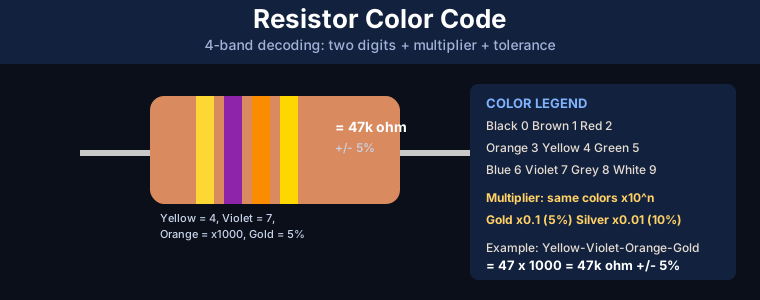
Key Takeaway: A 4-band resistor color code is read as two digits, one multiplier, and one tolerance band. For example, yellow-violet-orange-gold means 47 × 1,000 = 47,000 ohms (47kΩ) with ±5% tolerance. Learn the color chart once and you can read any resistor in seconds without a multimeter.
Table of Contents
1. Why Resistor Color Codes Matter
Resistors are the most common electronic component on a circuit board, and almost every one of them is marked with colored bands instead of printed numbers. That is because resistors are small, cylindrical components where a printed value would be too tiny to read. The color code system lets you identify a resistor’s value at a glance, which is essential for breadboarding, PCB design, and circuit troubleshooting.
Learning the resistor color code is one of the first skills every electronics engineer and hobbyist masters. It saves you from constantly reaching for a multimeter or a calculator, and it helps you spot a wrong component before it is soldered in place.
2. The Complete Color Chart
| Color | Digit Value | Multiplier | Tolerance |
|---|---|---|---|
| Black | 0 | ×1 (10⁰) | – |
| Brown | 1 | ×10 | ±1% |
| Red | 2 | ×100 | ±2% |
| Orange | 3 | ×1,000 | – |
| Yellow | 4 | ×10,000 | – |
| Green | 5 | ×100,000 | ±0.5% |
| Blue | 6 | ×1,000,000 | ±0.25% |
| Violet | 7 | ×10,000,000 | ±0.1% |
| Grey | 8 | – | ±0.05% |
| White | 9 | – | – |
| Gold | – | ×0.1 | ±5% |
| Silver | – | ×0.01 | ±10% |
Memory trick: “Black Brown Red Orange Yellow Green Blue Violet Grey White” — many engineers memorize it as “BB ROY of Great Britain has a Very Good Wife”. The first letters match the digit order 0 to 9.
3. How to Read a 4-Band Resistor
Four-band resistors are the most common. Reading them is a four-step process:
Step 1 — Find the tolerance band. Look for the gold or silver band, which is always the last band and is usually separated slightly from the others. Hold the resistor with this band on the right.
Step 2 — Read the first digit. The first band from the left is the first digit of the value. Brown = 1, red = 2, orange = 3, and so on.
Step 3 — Read the second digit. The second band is the second digit.
Step 4 — Read the multiplier. The third band tells you how many zeros to add. For example, orange = ×1,000 means add three zeros. The fourth band is the tolerance (gold = ±5%, silver = ±10%).
Example: Brown-Black-Red-Gold = 1, 0, then ×100 = 10 × 100 = 1,000 ohms (1kΩ), ±5%.
4. How to Read a 5-Band Resistor
Five-band resistors provide three significant digits for more precise values. The first three bands are the digits, the fourth band is the multiplier, and the fifth band is the tolerance. Precision resistors commonly use brown (±1%) as the fifth band.
Example: Brown-Black-Black-Red-Brown = 1, 0, 0, then ×100 = 100 × 100 = 10,000 ohms (10kΩ), ±1%.
A six-band resistor adds a sixth band that indicates the temperature coefficient, usually brown (100 ppm/°C). This matters only for precision and measurement applications.
5. Worked Examples and Common Values
| Band Colors | Value | Common Use |
|---|---|---|
| Brown-Black-Red-Gold | 1kΩ ±5% | LED current limiting |
| Red-Red-Orange-Gold | 22kΩ ±5% | Pull-up resistors |
| Yellow-Violet-Orange-Gold | 47kΩ ±5% | Audio circuits |
| Brown-Black-Orange-Gold | 10kΩ ±5% | Arduino pull-ups |
| Grey-Red-Brown-Gold | 820Ω ±5% | Transistor base bias |
| Blue-Grey-Brown-Gold | 680Ω ±5% | Indicator LED resistors |
6. Tolerance and Temperature Coefficient
Tolerance tells you how much the actual resistance can vary from the marked value. A 1kΩ resistor with ±5% tolerance can measure anywhere between 950Ω and 1,050Ω. Gold (±5%) and silver (±10%) are standard for general circuits. Brown (±1%) is used when precision matters, such as in voltage dividers and sensor circuits.
If you need a tighter value than your resistor’s tolerance allows, use a multimeter to measure the actual resistance — the measured value is what really matters in the circuit.
7. Tips for Beginners
- Read from the tolerance band. The gold or silver band is always on the right, so rotate the resistor so that band faces right before you read.
- Watch the lighting. Red and orange, blue and grey, and brown and red can be confused under yellow workshop light. Use natural daylight or a white LED lamp.
- Use a calculator to verify. When in doubt, check with an online resistor color code calculator such as the DigiKey one linked in Sources.
- Confirm with a multimeter. For critical circuits, always verify with a multimeter set to the ohms range.
- Keep a colour chart printed. Tape a small printed chart to your workbench until you have memorized it.
8. Frequently Asked Questions
How do I read the resistor color code for beginners?
Hold the resistor with the gold or silver tolerance band on the right. The first band is the first digit, the second band is the second digit, and the third band is the multiplier (the number of zeros). For brown-black-red-gold, that is 1, 0, and ×100, giving 1,000 ohms or 1kΩ.
What does the fourth color band on a resistor mean?
The fourth band is the tolerance. Gold means ±5%, silver means ±10%, and no band means ±20%. A 1kΩ resistor with a gold band will measure between 950Ω and 1,050Ω.
What is the resistor color code for 10k ohms?
10kΩ with ±5% tolerance is brown-black-orange-gold: digits 1 and 0, then ×1,000 gives 10 × 1,000 = 10,000 ohms.
What is the difference between 4-band and 5-band resistors?
4-band resistors have two digits, a multiplier, and a tolerance band. 5-band resistors add a third digit for higher precision values, and the tolerance moves to the fifth band.
Which way do I read a resistor color code?
Read from the end opposite the tolerance band. The gold or silver band identifies the right-hand end, so rotate the resistor so that band is on the right, then read left to right.
Related Reading
- How to Use a Digital Multimeter: Complete Guide
- How to Solder Through-Hole Components: Beginner’s Guide
- How to Use an Oscilloscope: Beginner’s Guide
Sources
- All About Circuits – Resistor Color Codes
- Electronics Tutorials – Resistor Colour Code
- DigiKey – Resistor Color Code Calculator
- EEPower – Resistor Color Code Guide
Disclosure: As an Amazon Associate, we earn from qualifying purchases. Some links on this page are affiliate links that help support our content at no extra cost to you.