Key Takeaway: The line between stepper motors and servo motors has blurred dramatically. Closed-loop stepper systems now compete directly with traditional servos in precision motion control applications, offering encoder feedback and improved torque control at significantly lower cost. This guide provides a practical engineering framework for choosing between closed-loop steppers, open-loop steppers, and servo motors based on your application’s actual torque requirements, speed profile, precision needs, and budget constraints.
📖 Table of Contents
Introduction
For decades, the choice between stepper motors and servo motors was straightforward. Steppers were the low-cost, simple solution for applications requiring moderate precision. Servos were reserved for high-speed, high-accuracy motion where cost was secondary. Advances in feedback technology, current control, and control-loop integration have fundamentally changed this landscape.
This guide examines the stepper versus servo question from a control-system perspective — looking at how torque is produced, how control loops behave, and how cost-performance tradeoffs play out in real CNC machines, pick-and-place systems, conveyor lines, and actuator applications.
Understanding the Motor Types
Open-Loop Stepper Motors
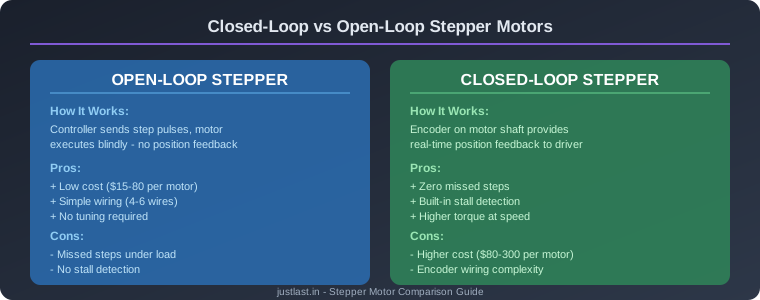
Traditional stepper motors operate without position feedback. The controller sends step pulses and the motor rotates in discrete increments. Simple and cost-effective but with limitations: missed steps under load, resonance at certain speeds, and torque dropping off rapidly as speed increases.
Closed-Loop Stepper Motors
A closed-loop stepper combines a traditional stepper motor with an encoder. The controller monitors actual position and adjusts commanded current to correct errors in real time, eliminating missed steps and improving accuracy.
Servo Motors (BLDC)
Servo motors produce continuous torque through sinusoidal commutation. They excel at high speed, smooth motion, and sustained torque across a wide speed range — at higher cost and more complex tuning.
Performance Comparison
| Parameter | Open-Loop Stepper | Closed-Loop Stepper | Servo (BLDC) |
|---|---|---|---|
| Low-speed torque | Excellent | Excellent | Good |
| High-speed torque | Poor | Fair | Excellent |
| Position accuracy | Good | Excellent | Excellent |
| Speed smoothness | Fair | Good | Excellent |
| Holding torque | Excellent | Excellent | Good |
| Energy efficiency | Low | Medium | High |
| System cost (NEMA 23) | $50-120 | $100-250 | $300-800 |
| Tuning complexity | None | Low | Medium-High |
Closed-Loop Stepper Advantages
Elimination of Missed Steps: Real-time encoder feedback prevents position errors that ruin workpieces in CNC and pick-and-place machines.
Improved Torque Utilization: Without the 30-50% safety margin required for open-loop, you can use a smaller motor for the same job.
Lower Audible Noise: Anti-resonance algorithms make closed-loop steppers significantly quieter than their open-loop counterparts.
Cost Advantage: For applications below ~1000 RPM, closed-loop stepper systems cost 50-70% less than equivalent servo systems.
When Servos Excel
High-Speed Operation: Sustained torque above 1500-2000 RPM is servo territory — spindles, high-speed conveyors, fast robots.
Ultra-Smooth Motion: Sinusoidal commutation produces glass-smooth finishes that steppers cannot match.
Energy Efficiency: Servo drives draw current proportional to load, consuming significantly less power in variable-load applications.
Selection Framework
Step 1: Define your speed-torque envelope. Step 2: Assess precision needs. Step 3: Evaluate duty cycle. Step 4: Consider your control ecosystem (OpenPNP vs PLC). Step 5: Calculate total system cost including motor, drive, cabling, and installation.
Frequently Asked Questions
Can a closed-loop stepper completely replace a servo motor?
No. Closed-loop steppers excel below ~1000 RPM but cannot match servo performance in high-speed or ultra-smooth applications.
Does a closed-loop stepper consume less power than open-loop?
Yes. Closed-loop steppers often consume 20-40% less power because the drive only delivers the current needed rather than full rated current.
What encoder is best for closed-loop steppers?
Incremental optical encoders (1000-4000 CPR) are most common. Magnetic encoders are gaining popularity for dusty factory environments.
Are closed-loop steppers worth the cost for a hobbyist CNC?
Yes, especially for cutting aluminum or steel. The $50-150 per axis prevents scrapped workpieces from missed steps.
Related Reading
External Resources
Sources: Performance Motion Devices, Texas Instruments, IoT Analytics