Key Takeaway: Closed-loop stepper motors eliminate missed steps and provide stall detection at a fraction of servo motor cost, making them the ideal upgrade for CNC machines, 3D printers, and industrial motion control systems that need reliability without servo-level complexity.
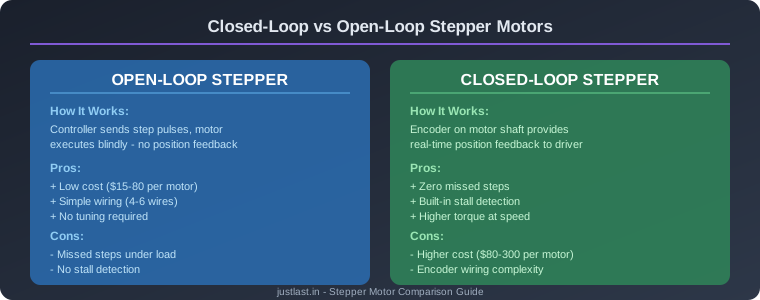
Table of Contents
1. How Stepper Motors Work
Stepper motors are brushless DC motors that divide a full rotation into discrete steps. A standard 1.8-degree stepper motor has 200 steps per revolution, achieving precise angular positioning without any feedback mechanism. Unlike servo motors that use continuous rotation with position feedback, steppers move in fixed increments — each step produces a known angular displacement.
The fundamental advantage of stepper motors is simplicity: no encoder, no feedback loop, no complex tuning. The controller sends step pulses at a specific rate, and the motor follows. This makes stepper systems ideal for applications requiring precise positioning at moderate speeds, such as CNC machines, 3D printers, laser cutters, and pick-and-place systems.
Key stepper motor specifications:
- Holding torque: The torque available when the motor is energized but not moving (typically 0.3–12 Nm for NEMA 17 and NEMA 23 frames)
- Step angle: 1.8° (200 steps/rev) or 0.9° (400 steps/rev) for standard motors
- Rated current: 0.5–6A per phase depending on motor size
- Detent torque: Resistance to rotation when unpowered (typically 5–10% of holding torque)
2. Open-Loop Stepper Motors
Open-loop steppers are the traditional and most common configuration. The driver sends step pulses to the motor, and the motor executes them without any position verification. If the motor encounters too much resistance (overload), it simply stalls or misses steps — and the system has no way of knowing.
How open-loop control works:
- The controller (CNC controller, Arduino, STM32) generates step pulses at a specific frequency
- The stepper driver converts pulses into phase currents that energize the motor windings
- The motor rotates one step per pulse — position is assumed, not measured
- After power-off, the controller has no knowledge of actual motor position
Open-loop pros:
- Low cost: NEMA 17 motor + A4988 driver = under $20 total
- Simple wiring: 4–6 wires, no encoder cable
- No tuning required: Works out of the box
- Proven technology: Decades of industrial use
Open-loop cons:
- Missed steps under load: No stall detection — position error accumulates silently
- Oversizing required: Must choose motors 2–3x larger than needed to prevent stalls
- No feedback: Cannot verify actual position after a missed step
- Speed-torque limitation: Torque drops sharply above 60% of maximum speed
In CNC applications, missed steps are catastrophic. A single missed step during a cutting operation ruins the workpiece. This is why many CNC builders oversize their stepper motors — using NEMA 23 (2.8 Nm) where NEMA 17 (0.4 Nm) would theoretically suffice. The excess torque provides a safety margin against stalls.
3. Closed-Loop Stepper Motors
Closed-loop steppers add an encoder (typically 1000–5000 CPR) to the motor shaft, creating a feedback loop. The driver reads the encoder and compares the actual position to the commanded position, adjusting in real-time to correct any error. If the motor stalls or misses steps, the system detects it immediately.
How closed-loop stepper control works:
- The controller sends step pulses as before
- The encoder on the motor shaft continuously reports actual position
- The driver compares commanded vs actual position in real-time
- If error exceeds threshold, the driver increases current to regain position
- If stall is detected (position error growing), the system can halt and alarm
Closed-loop pros:
- Zero missed steps: Feedback ensures position accuracy at all times
- Stall detection: System knows immediately if the motor stalls
- Higher torque at speed: Can deliver 30–50% more torque than equivalent open-loop motors
- No oversizing needed: Motor can be sized for actual load without safety margin
- Self-tuning: Modern closed-loop drivers auto-adjust current based on load
Closed-loop cons:
- Higher cost: Complete system (motor + driver + encoder) = $80–$300 per axis
- Encoder wiring: Additional cable (shielded) from motor to driver
- Tuning required: Some systems need PID tuning for optimal performance
- Complexity: More components mean more potential failure points
4. Head-to-Head Comparison
| Parameter | Open-Loop | Closed-Loop | Winner |
|---|---|---|---|
| Cost per axis | $15–$80 | $80–$300 | Open-loop |
| Missed steps | Possible under load | Zero | Closed-loop |
| Stall detection | None | Built-in | Closed-loop |
| Wiring complexity | 4–6 wires | 6–8 wires + encoder | Open-loop |
| Torque at high speed | Drops fast above 60% | Maintains 70–80% | Closed-loop |
| Setup complexity | Plug and play | Requires tuning | Open-loop |
| Position accuracy | Assumed (not verified) | Verified (±1 step) | Closed-loop |
| Motor sizing | 2–3x oversized | Right-sized | Closed-loop |
5. Which Application Needs Which
Choose open-loop steppers for:
- 3D printers: Low load, low speed, low cost — open-loop is perfectly adequate
- Laser cutters: Minimal cutting forces, positioning is the primary concern
- Currency counters / labelers: Light duty, repetitive, low risk of missed steps
- Educational projects: Learning motion control basics without complexity
- Budget CNC builds: Under $500 total machine cost, acceptable quality trade-off
Choose closed-loop steppers for:
- CNC mills and routers: Cutting forces cause missed steps — closed-loop prevents ruined workpieces
- Pick-and-place machines: Position accuracy is critical — OpenPnP systems benefit enormously
- Industrial automation: Reliability requirements demand stall detection
- CNC retrofits: Upgrade existing open-loop machines without full servo conversion
- High-speed applications: Closed-loop maintains torque where open-loop falls off
Consider servo motors when:
- Speed exceeds 3,000 RPM consistently
- High dynamic loads (rapid acceleration/deceleration)
- Continuous operation (24/7 production)
- Position accuracy requirements exceed stepper capability (< 0.001mm)
Frequently Asked Questions
Can I upgrade my existing CNC from open-loop to closed-loop steppers?
Yes, most CNC controllers that output step/dir signals work with closed-loop stepper drivers. You replace the motor (adding an encoder) and the driver. The controller-side wiring remains the same. Popular upgrade kits from Leadshine, MOONS, and others include motor + driver bundles that are drop-in replacements.
Do closed-loop steppers require a separate power supply?
Most closed-loop stepper systems run on 24–48V DC, the same as open-loop systems. Some high-torque models require 60–80V. Check the driver specifications. A quality switching power supply with 20% headroom is recommended for stable operation.
What encoder resolution do I need for CNC applications?
For most CNC applications, 1000 CPR (counts per revolution) is sufficient. This gives 4000 counts/rev after quadrature decoding, providing 0.09° resolution. For high-precision work, 2500–5000 CPR encoders are available but rarely necessary for stepper motor applications.
Are closed-loop steppers as good as servo motors?
No. Closed-loop steppers bridge the gap between open-loop steppers and servos but don’t match servo performance. Servos excel at high speed (> 3000 RPM), high dynamic loads, and continuous duty cycles. Closed-loop steppers are best for moderate speed (up to 1500 RPM), moderate loads, and intermittent duty cycles typical of CNC machining.
Related Reading
- Stepper Motor Driver Comparison: A4988 vs DRV8825 vs TMC2209
- STM32 vs Arduino: Which Microcontroller for Motion Control?
- Arduino Servo Motor Control: Complete PWM and Angle Guide
- CNC End Mills: Complete Guide to Types, Materials and Selection
Sources
- Leadshine — Closed-Loop Stepper Motor Systems
- Lin Engineering — Stepper Motor Basics and Closed-Loop Control
- MOONS — Closed-Loop Stepper Motor Product Guide
- Practical Machinist — Closed-Loop Steppers vs Servos Discussion
Disclosure: This post contains affiliate links. If you purchase through these links, we may earn a commission at no additional cost to you. This helps support our content creation.