Digital Twin Technology in Smart Manufacturing: Why Indian Factories Are Adopting It Fast
Key Takeaway
Digital twin technology is transforming Indian smart manufacturing by enabling real-time simulation of production lines, reducing unplanned downtime by up to 50%, and cutting new product development cycles by 30-40%.
Figure 1: Digital twin architecture connecting physical factory sensors to AI-driven action layers
Table of Contents
1. What Is a Digital Twin
A digital twin is a virtual replica of a physical manufacturing asset, process, or entire production line that updates in real-time through sensor data. It combines 3D geometry, physics-based simulation, and machine learning to predict how a factory will behave under different conditions. Unlike traditional CAD models, digital twins evolve continuously as the physical asset changes, making them a living reference for engineering and operations teams.
For Indian manufacturers, digital twins bridge the gap between shop floor reality and management dashboards. A digital twin of a CNC machining line, for example, shows not just throughput numbers but also tool wear progression, thermal deformation, and vibration signatures that indicate impending failure.
2. Why Indian Factories Need It Now
Indian manufacturing is under pressure from three directions: global competition demanding zero-defect quality, rising labor costs in urban industrial zones, and government mandates around Industry 4.0 adoption. Digital twin technology addresses all three simultaneously. Manufacturing plants in Pune, Chennai, and the Delhi-NCR corridor are already deploying digital twins to stay competitive in automotive, pharmaceutical, and electronics supply chains.
The Indian digital twin market is projected to reach 2.1 billion USD by 2028, growing at a compound annual growth rate of 35-40%. PLI scheme incentives for advanced manufacturing cover digital twin investments, reducing effective project costs by 10-15%. Early adopters report 20-30% reduction in unplanned downtime and 15-25% improvement in first-pass yield.
3. Types of Digital Twins
There are three main types relevant to Indian manufacturing. Asset twins model individual machines like CNC centers, injection molding machines, or robotic cells. Process twins simulate entire production workflows including material flow, queuing, and resource allocation. System twins represent the full factory ecosystem with supply chain connections, energy systems, and logistics.
Start with an asset twin for your highest-value or highest-downtime machine. This gives you the fastest ROI within 3-6 months. Process twins require more sensor infrastructure and integration but deliver larger gains for high-volume production lines. System twins are the most complex and typically justified only for plants with annual output exceeding 100 crores.
4. Technology Stack and Platforms
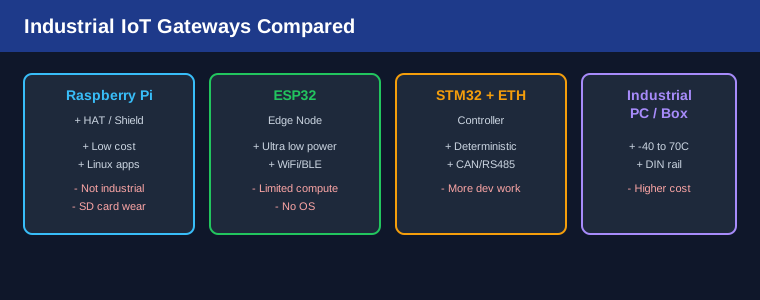
The technology stack for a digital twin has four layers. The sensor layer collects data from PLCs, SCADA systems, IoT sensors, and machine controllers via OPC-UA or MQTT protocols. The connectivity layer uses edge gateways to aggregate and pre-process data before sending it to the cloud or on-premise servers. The platform layer hosts the 3D model, physics engine, and analytics. The application layer provides dashboards, alerts, and integration with MES and ERP systems.
Major platforms available in India include Siemens MindSphere and NX, PTC ThingWorx, Azure Digital Twins, AWS IoT TwinMaker, and NVIDIA Omniverse for advanced visualization. Siemens and PTC have established Indian support teams. Open-source alternatives like Eclipse Ditto and Apache NiFi reduce licensing costs for SMEs with strong internal IT teams.
5. Implementation Roadmap
A typical digital twin implementation follows five phases over 6-12 months. Phase 1 (weeks 1-4): sensor audit and data gap analysis. Phase 2 (weeks 5-12): edge connectivity and data pipeline setup. Phase 3 (weeks 13-20): 3D model development and physics calibration. Phase 4 (weeks 21-28): analytics model training with historical data. Phase 5 (weeks 29-36): deployment, user training, and continuous improvement.
Budget 5-15 lakhs for a single-asset digital twin pilot. For a process-level twin covering an entire production line, expect 25-60 lakhs including sensors, software licenses, and integration. Government PLI schemes can offset 10-15% of qualifying expenses.
6. Cost Analysis for Indian SMEs
The total cost of ownership for a digital twin includes sensors (2-5 lakhs per machine), edge connectivity hardware (1-3 lakhs), platform licensing (5-20 lakhs per year), integration services (3-8 lakhs), and ongoing maintenance (2-5 lakhs per year). A typical Indian SME with 10 CNC machines should budget 40-80 lakhs for a full-factory digital twin over 3 years.
The payback period ranges from 12-18 months for high-downtime environments to 24-36 months for greenfield installations. Track ROI through four metrics: unplanned downtime reduction, first-pass yield improvement, energy consumption optimization, and new product development acceleration.
7. Real-World Case Studies
Tata Motors deployed a digital twin for their Pune stamping plant in 2025, reducing die-changeover time by 25% and scrap rate by 18%. Godrej Aerospace implemented digital twins for their precision component line, achieving 99.7% first-pass yield on critical aerospace parts. Bharat Forge uses Siemens digital twins for their forging operations, enabling virtual tryout of new die designs before committing to physical tooling.
Smaller adopters include a Pune-based auto component manufacturer with 50 employees who deployed a digital twin on their 3 CNC machining cells for 12 lakhs. Within 6 months, they reduced unplanned downtime by 40% and saved 8 lakhs annually in maintenance costs alone.
8. Challenges and How to Overcome Them
The biggest challenge in Indian manufacturing is data quality. Many legacy machines lack digital sensors, and existing SCADA systems may not provide the granularity needed. Solution: start with retrofit sensor kits (20,000-50,000 per machine) for vibration, temperature, and current monitoring. These provide 80% of the data needed for a useful digital twin.
Skilled workforce gaps are the second challenge. Digital twin management requires engineers who understand both manufacturing processes and data science. Partner with engineering colleges near your facility for internship programs, and invest in 40-60 hours of platform-specific training for your core team. The third challenge is organizational resistance. Address this by starting with a non-critical machine to demonstrate value before expanding to production-critical assets.
9. Related Reading
- Industrial Robotics 2026: Implementation Strategies for Indian Manufacturing
- Edge AI for Industrial Quality Inspection
- PLC Scan Time: Why It Matters for Real-Time Control
10. Sources
- MarketsandMarkets, “Digital Twin Market – Global Forecast to 2028”
- NASSCOM, “Industry 4.0 Adoption Survey India 2025-26”
- Siemens AG, “Digital Twin Implementation Guide for Manufacturing 2026”
- Ministry of Heavy Industries, PLI Scheme Guidelines for Advanced Manufacturing
- Tata Technologies, “Smart Manufacturing Roadmap for Indian OEMs” (2025)
Key Takeaways
- Start with one asset: A single-machine digital twin delivers ROI in 3-6 months and builds internal capability
- Data quality is everything: Invest in retrofit sensors for legacy machines before buying expensive software
- Leverage government schemes: PLI and Make in India incentives cover digital twin investments
- Train your team: 40-60 hours of platform training bridges the skills gap
- Measure ROI religiously: Track downtime, yield, energy, and cycle time to justify expansion