Key Takeaway: The ESP32 microcontroller, costing under $10, can replace traditional PLCs costing $500+ for many industrial automation tasks by running open-source ladder logic runtimes, Modbus RTU/TCP communication, and MQTT-based cloud connectivity — making factory automation accessible to small and medium manufacturers in 2026.
📖 Table of Contents
1. Why ESP32 for Industrial PLC Applications
The industrial automation landscape is undergoing a quiet revolution. Traditional Programmable Logic Controllers (PLCs) from Siemens, Allen-Bradley, and Mitsubishi have long been the standard for factory automation, but their cost — often $500 to $2,000 per unit — puts them out of reach for small workshops and budget-conscious manufacturers. Enter the ESP32, a dual-core 240MHz microcontroller with built-in WiFi and Bluetooth, priced at under $10.
In 2026, the open-source community has matured several projects that transform the ESP32 industrial PLC concept from a hobby experiment into a viable production tool. These projects implement the IEC 61131-3 ladder logic standard, support Modbus RTU and TCP industrial protocols, and integrate with MQTT for cloud connectivity — all running on $10 hardware.
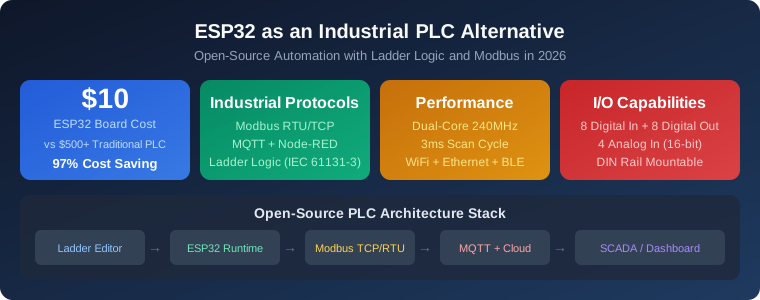
The key advantage of using an ESP32 as a PLC is not just cost — it is connectivity. Traditional PLCs often require expensive gateway modules for Ethernet, WiFi, or cloud connectivity. The ESP32 includes all of these natively. This makes it an ideal choice for Industry 4.0 applications where machine data needs to flow from the factory floor to cloud dashboards without intermediary hardware.
For Indian manufacturers and automation engineers, the ESP32 PLC approach is particularly compelling. With the government’s Production Linked Incentive (PLI) scheme driving manufacturing growth, there is increasing demand for cost-effective automation solutions that can be deployed without significant capital expenditure. An ESP32 industrial PLC system costing under Rs 1,000 per controller can automate conveyor systems, packaging lines, and quality inspection stations at a fraction of traditional costs.
Reliability concerns are valid — the ESP32 operates at commercial temperature ranges (0°C to 85°C) versus industrial-rated PLCs (-40°C to 85°C). However, for indoor factory environments typical of Indian manufacturing, the ESP32’s temperature range is more than adequate. Projects like GZ7-OpenAutomation target a deterministic 3ms scan cycle, matching the performance requirements of most discrete manufacturing applications.
2. Open-Source PLC Projects for ESP32
Several open-source projects in 2026 have matured to the point where they can be used in production environments. These projects provide the full toolchain from ladder logic editors to ESP32 runtime firmware.
GZ7-OpenAutomation is the most comprehensive open-source PLC platform for ESP32. It provides a complete compiler chain that converts ladder logic diagrams into bytecode executed on a Rust-based runtime. The platform targets a 3ms scan cycle, supports 50+ opcodes including timers, counters, and math operations, and runs efficiently within the ESP32’s 520KB SRAM. The project is MIT-licensed and has reached v0.5.0 with full Modbus support.
ModBee Node-UIO is another noteworthy ESP32-based industrial controller platform. Built on the ESP32-S3, it offers 8 digital inputs, 8 digital outputs, 4 analog inputs (16-bit via ADS1115), and 2 analog outputs. It supports Modbus RTU master/slave modes and a custom ModBee peer-to-peer protocol for decentralized automation networks. The hardware is DIN-rail mountable, uses RS485 for industrial communication, and features automatic network healing for fault-tolerant operation.
hiperiondev/ESP32-PLC uses the ESP-IDF framework and the ladderlib C library to execute IEC 61131-3 compliant ladder logic programs. It integrates with a web-based ladder editor that supports real-time monitoring via WebSockets, making it particularly suitable for educational and light industrial applications.
For those looking for a complete PLC and HMI solution in one package, the PLsi project offers a $20 ESP32-based PLC with a 320×240 touchscreen display, 8 isolated inputs, 6 relay outputs, SD card storage, and DIN-rail mounting — all as open-source hardware.
3. Hardware Requirements and I/O Design
Building a reliable ESP32 industrial PLC requires attention to hardware design. A basic setup needs:
- ESP32 Development Board: ESP32-WROOM-32 or ESP32-S3 ($5-$10). For better industrial specs, consider the ESP32-P4 with RISC-V core.
- Input Protection: Optocouplers (PC817) for isolating 24V industrial signals from the 3.3V ESP32 GPIOs.
- Output Drivers: ULN2003 darlington arrays for 500mA outputs or mechanical relays for higher current loads.
- Power Supply: 24V DC industrial supply with a buck converter to 3.3V for the ESP32.
- RS485 Transceiver: MAX485 or ISO3082 for Modbus RTU communication over long distances.
- DIN Rail Enclosure: Standard 35mm DIN-rail mountable enclosure with terminal blocks.
For analog input handling, the ADS1115 16-bit ADC over I2C provides 4 channels of 0-10V or 4-20mA input, suitable for pressure sensors, temperature probes, and flow meters. Analog outputs can be implemented using the MCP4725 12-bit DAC or dedicated industrial DAC modules.
The complete bill of materials for an 8-input, 8-output ESP32 PLC with analog capabilities is approximately $15-$25, compared to $150-$500 for an equivalent traditional PLC with networking capabilities.
4. Modbus Integration for Factory Networks
Modbus remains the most widely supported industrial protocol, and ESP32 implementations support both Modbus RTU (RS485) and Modbus TCP (Ethernet/WiFi). The ESP32 can operate as a Modbus master, controlling multiple slave devices like variable frequency drives, sensors, and actuators. It can also function as a Modbus slave, integrating into existing PLC and SCADA systems as remote I/O.
The ModBee Node-UIO exemplifies this flexibility with five operating modes: standalone local control, Modbus slave for integration with existing systems, Modbus master for controlling other devices, remote I/O for PLC systems, and ModBee remote I/O for decentralized peer-to-peer networks. This versatility makes the ESP32 suitable for both new installations and retrofitting existing equipment.
For wireless factory networks, the ESP32’s WiFi enables MQTT communication with Node-RED dashboards, cloud platforms like AWS IoT or Azure IoT Hub, and SCADA systems. This eliminates the need for separate IoT gateways and reduces the total system cost.
5. Ladder Logic Programming on ESP32
IEC 61131-3 is the international standard for PLC programming, and ladder logic is its most recognizable language. Open-source projects for ESP32 implement ladder logic through a compilation pipeline: the user draws ladder diagrams in a web-based editor, which are compiled to an intermediate language (IL) and then to bytecode for the ESP32 runtime.
The GZ7-OpenAutomation platform supports over 50 ladder logic instructions including normally open and closed contacts, coils, timers (TON, TOF, TP), counters (CTU, CTD), comparison operators, arithmetic operations, and move instructions. The JSON project format is human-readable and version-controllable, making it suitable for professional engineering workflows.
For engineers familiar with traditional PLC programming, the learning curve is minimal. The ladder editor interfaces are intentionally similar to those found in Siemens TIA Portal or Rockwell Studio 5000, but accessible through any web browser without installing proprietary software.
6. ESP32 PLC vs Traditional PLC Comparison
| Feature | ESP32 PLC | Traditional PLC |
|---|---|---|
| Cost | $10-$25 | $500-$2,000 |
| Processor | Dual-core 240MHz | Single-core 100-400MHz |
| Connectivity | WiFi + BLE + Ethernet | Ethernet (requires add-on) |
| Programming | Open-source, web-based | Proprietary, licensed software |
| Scan Cycle | 3-10ms target | 1-10ms typical |
| Temperature Range | 0°C to 85°C | -40°C to 85°C |
| Protocols | Modbus RTU/TCP, MQTT | Profinet, EtherCAT, Modbus |
| License | MIT / GPL (free) | Proprietary (annual fees) |
Frequently Asked Questions
Can an ESP32 replace a Siemens or Allen-Bradley PLC?
For many discrete automation tasks like conveyor control, packaging machines, and simple process control, yes. For safety-critical applications requiring SIL certification, extreme environments, or high-speed motion control (sub-millisecond), traditional PLCs remain necessary.
Is the ESP32 reliable for 24/7 industrial operation?
With proper hardware design — including optocouplers for input isolation, voltage regulators with adequate headroom, and industrial-grade connectors — ESP32-based PLCs can run reliably for years. The ESP32’s average lifespan in industrial environments is comparable to entry-level PLCs when properly deployed.
What is the maximum number of I/O points supported?
Through GPIO expansion, I2C/SPI port expanders, and Modbus networking, ESP32 PLCs can support 100+ I/O points. However, for large-scale systems with hundreds of I/O points, traditional PLC architectures remain more practical.
What programming languages are supported?
Most open-source ESP32 PLC projects support Ladder Logic (IEC 61131-3). Some also support Structured Text, Function Block Diagram, and sequential function charts. For advanced users, C/C++ code can be integrated directly.
Can I integrate an ESP32 PLC with existing SCADA systems?
Yes. Through Modbus TCP and MQTT, ESP32 PLCs can connect to SCADA platforms like SCADA-BR, Inductive Automation Ignition, and open-source alternatives. OPC-UA support is also available through additional libraries.
Related Reading
- STM32 BME280 Interface Guide: Building an I2C Environmental Monitoring System with HAL Drivers
- Edge AI in Industrial IoT 2026: How On-Device Intelligence Is Reshaping Factory Automation
- Digital Twins in Manufacturing 2026
Sources
- GZ7-OpenAutomation: Open-Source Industrial Automation Platform for ESP32
- ModBee Node-UIO: Modular IoT Controller with Industrial I/O
- ESP32-PLC: Ladder Logic Programming for ESP32
- Pilab P4: Browser-first PLC on ESP32-P4
- ESP-IDF Programming Guide