
Key Takeaway: A power drill handles precise drilling and controlled screw driving, while an impact driver delivers 3-4x more torque for heavy fastening — most DIYers need both, but if you can only buy one, get the drill first.
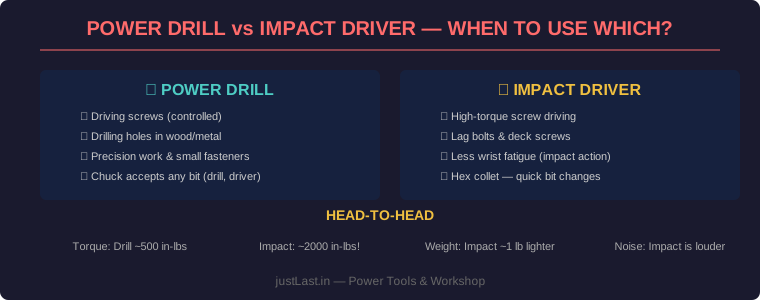
Table of Contents
1. Understanding the Difference
Walk into any hardware store and you’ll see two similar-looking tools side by side: the power drill and the impact driver. They look almost identical, use the same battery platforms, and both spin bits. But the internal mechanism and ideal use cases are fundamentally different.
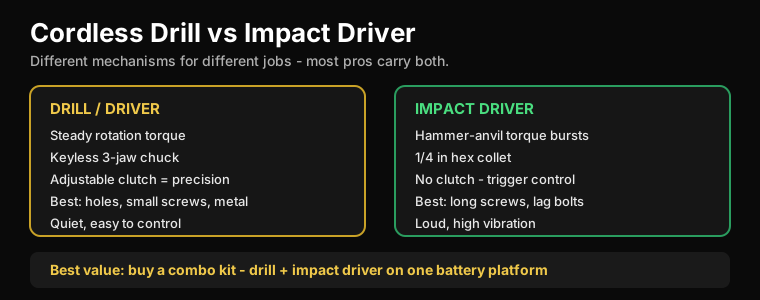
A power drill uses a chuck (usually keyless, 3-jaw) that grips round-shank drill bits and driver bits. It delivers smooth, consistent rotational force. An impact driver uses a hex collet (1/4-inch) and delivers concussive rotational blows — tiny hammer-like strikes that multiply torque dramatically. Understanding this difference is key to choosing the right tool for your workshop setup.
2. How Each Tool Works
Power Drill Mechanism
A power drill uses a motor connected to a chuck through a gearbox. The trigger controls speed, and many models include a clutch ring with numbered torque settings. When driving a screw, the clutch slips at the preset torque, preventing over-driving. This makes drills ideal for tasks requiring precision and control.
Impact Driver Mechanism
An impact driver uses a rotating hammer-and-anvil mechanism inside the tool. As resistance increases (like driving a long screw into hardwood), the internal hammer begins striking the anvil, delivering rapid rotational impacts. Each impact adds instantaneous torque — typically 1,200–2,000 in-lbs compared to a drill’s 300–600 in-lbs. The hex collet allows one-handed bit changes without tightening a chuck.
3. Head-to-Head Comparison
| Feature | Power Drill | Impact Driver |
|---|---|---|
| Typical Torque | 300–600 in-lbs | 1,200–2,000+ in-lbs |
| Chuck Type | 3-jaw keyless chuck | 1/4″ hex collet |
| Drilling Ability | ✅ Excellent | ⚠️ Limited (hex bits only) |
| Screw Driving | ✅ Controlled, precise | ✅ Fast, powerful |
| Weight | ~3.5 lbs | ~2.8 lbs |
| Noise Level | Quiet (hum) | Loud (rat-a-tat impact) |
| Wrist Fatigue | Higher (torque reaction) | Lower (impact handles force) |
| Price Range | $60–$200 | $70–$180 |
4. Best Uses for Each
Choose the Power Drill When:
- Drilling holes in wood, metal, masonry (with hammer mode), or plastic
- Driving small to medium screws in softwood or drywall
- You need precision (cabinetry, furniture assembly, finish work)
- Using specialty bits (spade, hole saw, Forstner, countersink)
- Working with the clutch for consistent depth control
Choose the Impact Driver When:
- Driving long screws (3″+ deck screws, lag bolts, structural screws)
- Working with hardwood (oak, maple, walnut)
- Assembling decks, fences, or framing
- You’ll drive 50+ screws in a session (less wrist fatigue)
- Driving bolts and fasteners with hex-heads
5. Top Picks 2026
Best Power Drills
- DeWalt DCD998 — 20V MAX, 1,200 in-lbs, 3-speed, brushless ($180)
- Milwaukee M18 FUEL 2904 — 18V, 1,400 in-lbs, ONE-KEY compatible ($190)
- Makita XFD14 — 18V LXT, 1,250 in-lbs, extreme runtime ($160)
- Ryobi 18V ONE+ — Budget king, 550 in-lbs, great for DIY ($80)
Best Impact Drivers
- DeWalt DCF845 — 20V MAX, 1,825 in-lbs, 3-speed, brushless ($170)
- Milwaukee M18 FUEL 2953 — 18V, 2,000 in-lbs, ONE-KEY ($180)
- Makita XDT16 — 18V LXT, 1,600 in-lbs, 4-speed ($155)
- Ryobi 18V ONE+ PBLID02 — Budget-friendly, 1,800 in-lbs ($90)
6. Combo Kits Worth Buying
For most homeowners and DIYers, a combo kit is the best value. You get both tools, batteries, charger, and a bag for less than buying separately:
- DeWalt DCK694E2 — Drill + Impact + 4 batteries, 2 bags (~$280)
- Milwaukee M18 FUEL 2997-22 — Drill + Impact + 2 batteries (~$300)
- Makita XT269M — Drill + Impact + 4 batteries (~$260)
- Ryobi PBLCK02K2 — Drill + Impact + 2 batteries (~$160)
For factory or production environments where you need reliable, high-torque tools daily, the Milwaukee and DeWalt combo kits offer the best durability. For weekend DIY projects, Ryobi’s ONE+ ecosystem offers unbeatable value with 280+ compatible tools.
Frequently Asked Questions
Can an impact driver replace a drill?
Not entirely. An impact driver can’t accept standard round-shank drill bits, limiting your drilling options. You can buy hex-shank drill bit sets, but they’re less versatile. For occasional drilling, an impact driver works fine, but a dedicated drill is essential for hole saws, spade bits, and precision work.
Why are impact drivers lighter than drills?
Impact drivers have simpler internals — no gearbox, no clutch mechanism. The hex collet is smaller and lighter than a 3-jaw chuck. The hammer-and-anvil mechanism is compact, resulting in a lighter overall tool (typically 1 lb less than a comparable drill).
Will an impact driver strip screws?
It can if you’re not careful. The high torque can over-drive screws, especially in softwood. Use the lowest speed setting and let the impact mechanism do the work. For finish work and cabinetry, stick with a drill and clutch.
Do I need brushless motors?
Brushless motors run cooler, last longer, and deliver more runtime per charge. They’re worth the premium if you use tools regularly. For occasional weekend use, brushed motors are fine and save $30–$50 per tool.
What voltage should I buy — 18V or 20V MAX?
18V and 20V MAX are essentially the same — 20V MAX is the marketing name for DeWalt’s 18V nominal system (20V peak). Choose based on battery ecosystem compatibility: if you already own DeWalt 20V tools, stay in that platform. Same for Milwaukee M18, Makita 18V LXT, or Ryobi ONE+.
Related Reading
- Best Cordless Drill 2026: Complete Buying Guide
- Workshop Organization Ideas for Small Spaces
- DIY Arduino-Powered Workshop Monitoring
Sources
- Pro Tool Reviews — Independent Power Tool Testing
- Family Handyman — Drill vs Impact Driver Guide
- DeWalt — Power Tool Specifications
- Milwaukee Tool — M18 FUEL Platform
Disclosure: This post contains affiliate links. As an Amazon Associate I earn from qualifying purchases.