Key Takeaway: Use the 75°C ampacity column of NEC Table 310.16 when sizing household copper wire — 14 AWG for 15 A lighting circuits, 12 AWG for 20 A outlets, 10 AWG for 30 A appliances, and 6 AWG for EV chargers — and always size wire to carry 125% of a continuous load.
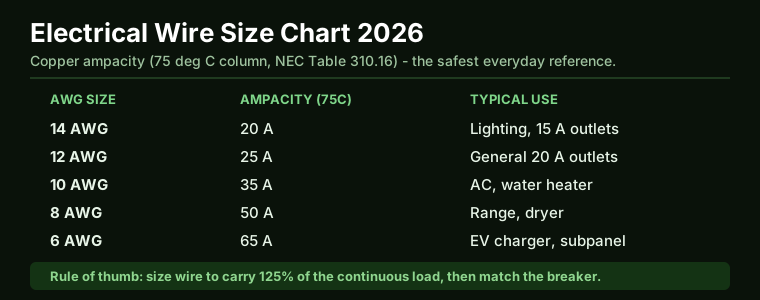
Table of Contents
1. Overview: Why Wire Size Matters
Choosing the wrong wire size is one of the most common — and most dangerous — mistakes in electrical work. Too-small wire overheats, melts insulation, and starts fires. Oversized wire wastes money and is harder to terminate. The wire size chart in this guide gives you the exact AWG (American Wire Gauge) you need for common household and workshop loads, based on NEC Table 310.16.
In the AWG system, a smaller gauge number means a larger conductor. So 6 AWG wire is physically thicker than 10 AWG wire and can safely carry more current. This guide focuses on copper conductors, which carry more current than aluminum of the same gauge and are the standard for household wiring.
2. The Complete Wire Size Chart (AWG Ampacity)
The table below shows copper ampacity at the 75°C column, the standard reference used for most residential and commercial terminations (per NEC 110.14(C)). These are base values for not more than three current-carrying conductors in a raceway at 30°C ambient.
| AWG Size | Copper Ampacity (75°C) | Typical Use |
|---|---|---|
| 14 AWG | 20 A | Lighting circuits, 15 A outlets |
| 12 AWG | 25 A | General-purpose 20 A outlets |
| 10 AWG | 35 A | Air conditioners, water heaters |
| 8 AWG | 50 A | Ranges, dryers, subpanels |
| 6 AWG | 65 A | EV chargers, 60 A subpanels |
| 4 AWG | 85 A | Large feeders, 70–80 A circuits |
Values are reference ampacities only. Always verify against the current edition of the National Electrical Code (NFPA 70) and local amendments, and follow the manufacturer’s termination ratings.
3. How to Choose the Right Wire Size
Step 1: Calculate the load
Add up the wattage of everything on the circuit, then divide by the voltage (120 V or 240 V) to get the current in amps. For example, 2,400 W of lighting on a 120 V circuit draws 20 A.
Step 2: Apply the 125% continuous-load rule
For loads that run continuously (3+ hours, like an EV charger, space heater, or refrigerator), the circuit must be sized at at least 125% of the continuous load. A 16 A continuous EV charger needs a circuit capable of 20 A.
Step 3: Match the breaker
NEC 240.4(D) caps small conductors: 14 AWG at 15 A, 12 AWG at 20 A, 10 AWG at 30 A overcurrent protection. This is why 12 AWG wire — which can carry 25 A — is still only allowed on a 20 A breaker.
4. Derating, Voltage Drop, and Safety Rules
Ampacity tables are a starting point, not the final answer. Three factors can force you to a bigger wire:
- Ambient temperature — hot attics and machine rooms reduce ampacity; the NEC has correction factors for this.
- Bundling — when more than three current-carrying conductors run together, heat builds up and ampacity drops (NEC 310.15(C)(1)).
- Voltage drop — on long runs (50 ft+), voltage drop can starve your equipment. The general guideline is to keep total voltage drop under 3% for feeders and 5% combined.
As the wire-sizing experts at wiresizes.com note, “the output of NEC 310.16 only sets ampacity — overcurrent protection is a separate calculation.” If your tools, EV charger, or subpanel are in a garage at the end of a long cable run, err on the side of one gauge bigger.
5. FAQ
What size wire do I need for a 20 amp circuit?
12 AWG copper is the standard for a 20 A circuit. Per NEC 240.4(D), a 20 A breaker protects 12 AWG, and 12 AWG at the 75°C rating carries 25 A.
Is 14 gauge or 12 gauge wire better?
12 AWG is thicker, carries more current (25 A vs 20 A), and has less voltage drop, but it is also harder to bend and costs more. Use 14 AWG for 15 A lighting circuits and 12 AWG for 20 A outlet circuits.
Can I use 10 gauge wire on a 20 amp breaker?
Yes, you can always use larger wire than the minimum. The breaker, not the wire, determines the protection limit — but the wire must be rated for the breaker’s current. 10 AWG on a 20 A breaker is safe, just more expensive than necessary.
What size wire for an EV charger?
For a typical 32 A EV charger in India, use 6 AWG copper or larger. Our guide to home EV charging in India covers the full installation requirements. Note that most home chargers are continuous loads, so the 125% rule applies.
Does wire size affect electricity bills?
Indirectly — undersized wire wastes energy as heat (I²R losses) and can cause voltage drop that makes motors and appliances run hot. Properly sized wire is both safer and more efficient.
Related Reading
- Home EV Charging in India 2026: Complete Setup Guide
- Clamp Meter vs Multimeter: Complete Difference and Buying Guide
- How to Read Resistor Color Codes: Complete Guide
Sources
- AWG Wire Gauge Chart (NEC Ampacity) — ElectricalCalcTools
- Wire Ampacity Chart: NEC 2023 Table 310.16 — WireRef
- Ampacity Charts and Wire Gauge Chart — Cerrowire
- NEC Table 310.16 Conductor Ampacities — WireSizes.com
Disclosure: This post contains affiliate links. As an Amazon Associate I earn from qualifying purchases.