Key Takeaway: For short daily power cuts, an inverter with a battery is the best home backup solution; for long outages or heavy loads, a generator wins on runtime; and for the lowest long-term cost, a solar hybrid system pays for itself in 4-7 years. Many Indian homes in 2026 combine an inverter with a small solar rooftop to get the best of all three.
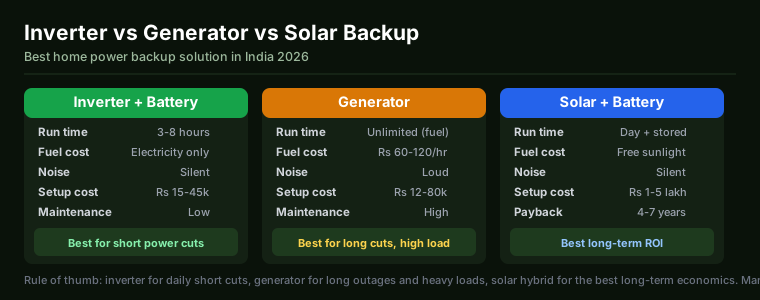
Table of Contents
1. Overview
Every Indian household knows the drill: the fans slow down, the lights flicker, and someone mutters “power is gone again”. The question of how to back up your home against power cuts is one every family faces, and the options in 2026 have never been more confusing — or more affordable. Do you buy an inverter with a battery, a diesel or petrol generator, or go straight to solar with battery storage?
This guide compares the three main home power backup solutions on the factors that actually matter — runtime, cost, noise, maintenance, and long-term economics — and gives you a clear recommendation based on how often you lose power and what you need to keep running.
2. Inverter vs Generator vs Solar: Full Comparison
Here is the practical comparison table for Indian homes in 2026.
| Feature | Inverter + Battery | Generator | Solar + Battery |
|---|---|---|---|
| Typical runtime | 3-8 hours (battery capacity) | Unlimited (while fuel lasts) | Daylight + stored energy |
| Fuel / running cost | Electricity only (~Rs 2-5/day) | Rs 60-120/hour of petrol/diesel | Free sunlight, minimal grid |
| Noise | Silent | Loud (65-90 dB) | Silent |
| Setup cost | Rs 15,000-45,000 | Rs 12,000-80,000 | Rs 1,00,000-5,00,000 |
| Maintenance | Low (battery check every few months) | High (oil, spark plug, fuel, service) | Very low (panel cleaning) |
| Can power heavy loads (AC, motor)? | Limited by inverter VA rating | Yes, sized to load | Yes, sized to system |
| Bills impact | None | None | Reduces monthly electricity bill |
| Typical payback | N/A | N/A | 4-7 years |
Inverter + battery: the daily-workhorse choice
An inverter converts DC from a battery into the AC your home appliances use. When mains power fails, a transfer switch swaps your home to the inverter in milliseconds — lights stay on, fans keep spinning, and there is zero noise. A standard 150 Ah tubular battery with a 900 VA inverter costs around Rs 20,000-35,000 and runs a fan-and-light load for 4-8 hours. It is the cheapest, cleanest solution for the short, frequent power cuts most Indian towns face. The limitation: an inverter cannot run heavy loads like air conditioners, water pumps, or geysers for long, and the battery needs replacement every 4-5 years.
Generator: raw power for long outages
A generator burns petrol or diesel to spin an alternator and produce electricity directly. It is the only backup that can run your whole house — including an air conditioner, water pump, and refrigerator — for as long as you keep pouring fuel in. That makes it the right tool for areas with 6+ hour outages or for running power tools during renovations. The costs are real: fuel runs Rs 60-120 per hour, engines need regular servicing (oil, spark plugs, fuel stabilization), and they are loud enough to annoy neighbours. Inverter-type generators are quieter but cost substantially more.
Solar + battery: the long-term winner
A solar system with battery storage converts sunlight into electricity, powers your home during the day, and stores the surplus to run through the evening — doubling as both a bill-reducer and a backup. With the PM Surya Ghar subsidy, a 3-5 kW rooftop system with battery can cost Rs 1-3 lakh after subsidy and cut your electricity bill by 60-90%. Because it generates rather than just stores energy, a solar hybrid system is the only option that pays you back over time — typically breaking even in 4-7 years, then delivering free power for another 15-20 years. The trade-offs: higher upfront cost and a need for rooftop space and sunshine.
3. Buying Guide: Which Backup Solution for Your Home?
Choose an inverter + battery if…
- Your power cuts are short and frequent (under 4-6 hours).
- You mainly need lights, fans, TV, router, and a fridge to keep running.
- You want a silent, maintenance-light, low-cost solution.
- You want to start small and add solar later.
A 900 VA inverter with a 150 Ah tubular battery is the sweet spot for most 2-3 BHK homes. Brands like Luminous, Microtek, and Exide dominate the Indian market. Compare inverter and battery bundles on Amazon India.
Choose a generator if…
- You face long outages (6+ hours) or load shedding during heatwaves.
- You need to run heavy loads — air conditioners, water pumps, power tools.
- You have outdoor space for a quiet, well-ventilated enclosure.
- You are okay with fuel costs and regular servicing.
Size a generator at roughly 1.5x your maximum simultaneous load. A 2.5-3.5 kVA generator covers fans, lights, TV, and a fridge; you need 5 kVA or more for a 1.5-ton AC. See home generator options on Amazon India.
Choose solar + battery if…
- You want to cut your monthly electricity bill as well as get backup.
- You have 150-400 square feet of unshaded rooftop.
- You can manage the higher upfront investment (helped by the PM Surya Ghar subsidy).
- You plan to stay in your home for 5+ years to capture the payback.
For most homes, a 3-5 kW solar system with a hybrid inverter and a lithium or tubular battery gives the best balance of backup and bill savings. Our complete rooftop solar installation and cost guide covers sizing, subsidy, and vendors, and our on-grid vs off-grid vs hybrid inverter comparison explains which system type you need.
The best combination for most Indian homes in 2026
For the best home power backup, the winning formula for most families is a hybrid solar inverter with a battery, sized to run essentials through the evening, plus the option of a small generator for rare long outages. The solar hybrid cuts your bill every single month, gives you silent overnight backup, and the generator sits as an emergency reserve. If budget is tight, start with a quality inverter + battery now and add solar panels to the same system later — most modern inverters are solar-ready.
4. Frequently Asked Questions
Which is better, an inverter or a generator for home?
For short, frequent power cuts, an inverter with a battery is better — it is silent, clean, and cheap to run. For long outages or heavy loads like air conditioners and water pumps, a generator is better because it can run as long as you supply fuel. Many homes use both.
Is a solar home backup system worth it in 2026?
Yes, especially with the PM Surya Ghar subsidy. A solar + battery system cuts your electricity bill by 60-90%, provides backup, and typically pays for itself in 4-7 years, after which power is effectively free for 15-20 more years.
How long can an inverter run a fan, lights, and TV?
With a standard 150 Ah tubular battery, an inverter can run 3-4 fans, 4-6 LED lights, and a TV for roughly 4-8 hours, depending on load. Running a refrigerator reduces that significantly.
Can solar panels charge an inverter battery?
Yes — that is exactly how a solar hybrid system works. The solar panels charge the battery during the day, the battery powers your home at night, and the grid tops up only when needed. Most modern inverters accept solar input directly.
Do generators damage sensitive electronics?
Conventional generators can produce voltage and frequency fluctuations that some electronics dislike. Use an inverter-type generator, or connect sensitive devices through a voltage stabilizer or UPS. Solar inverters produce the cleanest power of all.
Related Reading
- Rooftop Solar Panel Installation in India 2026: Complete Cost Guide
- On-Grid vs Off-Grid vs Hybrid Solar Inverters
- EV vs Petrol vs Diesel Cars in India 2026
- Home EV Charging in India 2026: Complete Setup Guide
Sources
- PM Surya Ghar Muft Bijli Yojana — Official Portal
- Ministry of New and Renewable Energy — Solar Schemes
- Bijli Bachao — Inverter and Battery Backup Calculator
Disclosure: This post contains affiliate links. As an Amazon Associate I earn from qualifying purchases.