
Key Takeaway: The best home EV charger in 2026 depends on your car and budget — the ChargePoint Home Flex offers the most flexibility for most drivers, the Tesla Wall Connector delivers the fastest NACS charging at $450, and the Emporia Classic delivers 95% of the experience at 60% of the premium price.
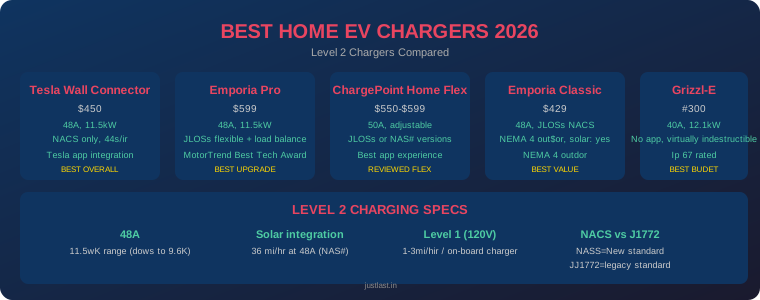
Table of Contents
1. Why You Need a Level 2 Home Charger in 2026
Eighty percent of EV charging happens at home. A good Level 2 charger pays for itself within the first year through convenience and off-peak electricity savings. But with home chargers ranging from $300 to $700, picking the right one matters.
In 2026, the home EV charger market has become fiercely competitive. The Car and Driver test team spent months charging more than 100 EVs and plug-in hybrids using a dozen different products. MotorTrend named the Emporia Pro its 2026 Best Tech Award winner. And ChargeCompared tested every model side by side for six months across summer heat and winter freezes.
This guide breaks down the five best home EV chargers you can buy right now, compares their real-world performance, and helps you pick the right setup for your vehicle, electrical panel, and budget.
2. Level 1 vs Level 2 EV Charging Explained
Understanding the difference between charging levels is critical before buying:
| Feature | Level 1 (120V) | Level 2 (240V) |
|---|---|---|
| Power Output | 1.2–1.8 kW | 7.2–19.2 kW |
| Charge Rate | 3–5 miles per hour | 12–44 miles per hour |
| Installation | None — standard outlet | 240V circuit + electrician |
| Cost | Free (comes with car) | $300–$700 + $200–$1,500 install |
| Best For | Plug-in hybrids, short commutes | Full EVs, overnight charging |
For a typical daily commute under 50 miles, a 40A Level 2 charger charges fast enough overnight without forcing a 60A breaker. If you have an Extended Range truck or run the battery low regularly, step up to a 48A charger. We recommend a minimum of 9.6 kW (40A) for any EV owner — even plug-in hybrids benefit from the faster charge rate.
The connector type matters too. NACS (Tesla’s North American Charging Standard, now J3400) is becoming the new default — most 2025+ non-Tesla EVs ship with NACS ports. J1772 is the legacy standard still found on many existing EVs. Adapters are widely available, so your choice isn’t locked in forever.
3. Top 5 Home EV Chargers Compared
1. ChargePoint Home Flex — Best Overall ($550–$599)
The ChargePoint Home Flex earns the top spot because no other charger matches its combination of power, flexibility, and software polish. At 50A, it’s the most powerful commonly available home charger, and its adjustable amperage (16A to 50A) means it works with virtually any electrical panel configuration.
Why it wins: The ChargePoint app is the gold standard for home EV charging. It tracks charging history, displays cost per session using your actual utility rate plan, integrates with Alexa and Google Home, and offers scheduling to take advantage of off-peak electricity rates. The app even tailors battery percentage and EPA miles added to your specific vehicle.
The cord quality is excellent — supple, flexible even in cold weather, with an elegant docking holster. Available in both J1772 and NACS connector versions, with three installation options (hardwired, NEMA 14-50, NEMA 6-50). UL listed and ENERGY STAR certified.
Trade-off: At $550–$599, it costs 40–60% more than several competitors. Some 1-star reviews flag firmware and connectivity issues, though these are minority reports.
Best for: Most EV owners who want a premium, fully-featured charging experience with the best app in the business.
Check price on Amazon
2. Emporia Classic / Pro — Best Value ($429–$599)
The Emporia smart chargers punch well above their price class. MotorTrend named the Emporia Pro “Best Smart EV Home Charger” — a title typically reserved for premium products.
The Classic ($429) delivers 48A hardwired charging with WiFi app control, available in J1772 and NACS versions, in black or white. The Pro ($599) adds load-balancing capability when paired with the Vue 3 energy monitor, letting you charge from excess solar or automatically adjust amperage based on household load.
Both share a powerful app with 1-amp increment adjustability and detailed energy data. The NEMA 4 enclosure provides superior outdoor weather protection. MotorTrend awarded it their 2026 Best Tech Award for a reason.
Trade-off: Cable is stiffer than the ChargePoint’s, and the included holster is poorly designed — most owners replace it. Customer support is email/chat only versus ChargePoint’s 24/7 phone line.
Best for: Value-minded buyers and homes with tight electrical capacity. Solar owners who want load management should spring for the Pro + Vue 3 combo.
Check price on Amazon
3. Tesla Universal Wall Connector — Best for Tesla Owners ($595)
The Tesla Universal Wall Connector is purpose-built for Tesla vehicles. The auto-sensing handle opens your Tesla’s charge port on contact — no button pressing, no app launching. It also charges non-Tesla EVs through an integrated NACS-to-J1772 adapter with an electronic locking mechanism so the adapter can’t be lost.
Speed is where it stands out. The Tesla Wall Connector tops speed charts at 44 miles of range per hour when paired with a Tesla, because Tesla vehicles can accept higher power through the native NACS connector. The 24-foot cable is the thinnest tested (0.6 inch diameter), making it easy to handle and store.
The Universal version integrates into the Tesla mobile app for monitoring energy use — mandatory if you want to track charging efficiency. The 4-year warranty is one year longer than most competitors.
Trade-off: Must be hardwired — no plug-in option. The $595 price and Tesla ecosystem lock-in may deter non-Tesla owners.
Best for: Households where every car is (or will be) a Tesla. The cleanest, most integrated experience for the Tesla ecosystem.
Check price at Tesla.com
4. Grizzl-E Classic — Best Budget / Durability ($300)
The Grizzl-E Classic has no app, a thick 0.9-inch-diameter cord, and all the aesthetic appeal of a shoe box. But at just $300, those notes look like nitpicks.
This is the bare-bones, bulletproof charger that works in any weather without fuss. IP67 rated for extreme weather resistance. If you want the absolute cheapest Level 2 home charger you can trust, this is it. ChargeCompared rates it the best for durability and cold-weather performance.
Trade-off: No WiFi, no app, no scheduling, no energy tracking. You get a charger and a holster, and that’s it. The thick cord is harder to wrangle than premium alternatives.
Best for: Budget-conscious buyers, cold-climate installations, anyone who just wants a tough workhorse with zero software headaches.
Check price on Amazon
5. Autel MaxiCharger AC Lite 40A — Best Budget J1772 ($319)
The Autel MaxiCharger AC Lite 40A frequently dips to $319 — a steep discount that makes it an absolute bargain for J1772 EV owners. The connector handle is wrapped in a rubbery coating that gives it a premium feel compared to the hard plastic handles on most chargers.
At 40A / 9.6 kW, it charges fast enough for most daily commutes. WiFi app control lets you schedule charging and monitor energy use, though the pricing function lacks the variable-rate tracking that ChargePoint and Emporia offer.
Trade-off: Cord is thicker than top picks, and the pricing analytics aren’t as polished. At full $470 MSRP, it’s a good buy — at $319, it’s an absolute steal.
Best for: J1772 EV owners on a tight budget who want WiFi and app features without paying premium prices.
Check price on Amazon
4. Head-to-Head Comparison Table
| Charger | Max Amps | Speed | Connector | Smart | Price |
|---|---|---|---|---|---|
| ChargePoint Home Flex | 50A | 37 mi/hr | J1772 / NACS | WiFi, App, Alexa | $550–599 |
| Emporia Classic | 48A | 36 mi/hr | J1772 / NACS | WiFi, App, Alexa | $429 |
| Tesla Universal | 48A | 44 mi/hr | NACS + J1772 | WiFi, Tesla App | $595 |
| Grizzl-E Classic | 40A | 30 mi/hr | J1772 | None | $300 |
| Autel AC Lite 40A | 40A | 30 mi/hr | J1772 | WiFi, App | $319 |
5. Installation Guide — What to Expect
Every Level 2 charger requires a 240V circuit. Here’s what the installation process looks like:
Step 1: Check Your Electrical Panel
Your home needs available capacity for a new 240V circuit. Most Level 2 chargers need a 50A or 60A breaker. If your panel is full, you may need a panel upgrade ($1,000–$3,000) or a load management system like the Emporia Pro that dynamically adjusts charging amperage based on household demand.
Step 2: Choose Plug-In vs Hardwired
- Plug-in (NEMA 14-50): Easier installation, portable if you move, but limited to 40A continuous
- Hardwired: Cleaner look, higher amperage (48–50A), required by some local codes, and some chargers (Tesla, Wallbox) are hardwire-only
Step 3: Hire a Licensed Electrician
Installation costs typically run $200–$800 depending on distance from the panel, local rates, and whether you need a panel upgrade. Many utilities offer rebates of $200–$1,000+ for Level 2 charger installation — check your utility’s website before scheduling.
Step 4: Check for Rebates
The federal 30C tax credit covers 30% of charger costs (up to $1,000 for residential) in eligible census tracts. Many states and utilities add additional incentives.
6. How to Choose the Right Charger
If money is no object and you want the best experience:
Buy the ChargePoint Home Flex. The best app, adjustable amperage, and broad compatibility make it the gold standard. The premium price is justified by the software polish.
If you want the best value:
Buy the Emporia Classic. At $429, it matches or exceeds chargers costing $600+ on nearly every measurable spec. Add the Vue 3 energy monitor ($100) if you want load management.
If you drive a Tesla:
Buy the Tesla Wall Connector or Universal Wall Connector. The auto-sensing handle, native NACS speed (44 mi/hr), and Tesla app integration make it the seamless choice. The Universal version adds a J1772 adapter for future-proofing.
If you’re on a tight budget:
Buy the Grizzl-E Classic at $300. It’s ugly, it’s basic, and it works flawlessly for years. No software to update, no firmware to break, no app to crash.
If you have a J1772 EV and want smart features on a budget:
Buy the Autel MaxiCharger AC Lite at $319. WiFi app control and a premium-feeling connector handle at a price that undercuts everything else.
7. Frequently Asked Questions
How fast will a Level 2 charger charge my EV?
A 48A Level 2 charger adds roughly 36 miles of range per hour. A typical EV with a 60–80 kWh battery goes from 0% to 80% in 6–10 hours — easily a full overnight charge. The Tesla Wall Connector adds up to 44 mi/hr for Tesla vehicles thanks to higher NACS power acceptance.
Do I need a 200A electrical panel for an EV charger?
Not necessarily. A 40A charger on a 50A circuit adds only 40A of load. If you have panel space for a new breaker and your total load stays under 80% of panel capacity, you’re fine. Load management systems like the Emporia Pro can dynamically reduce charging amperage during peak household use.
Can I charge a non-Tesla EV with a Tesla charger?
Yes. The Tesla Universal Wall Connector has a built-in NACS-to-J1772 adapter with an electronic locking mechanism. It charges any J1772 EV. If you buy the standard Tesla Wall Connector (NACS only), you can buy a separate J1772-to-NACS adapter for non-Tesla vehicles.
Should I hardwire or use a NEMA 14-50 plug?
Hardwiring is preferred for permanent installations — it looks cleaner, supports higher amperage, and some local codes require it. A NEMA 14-50 plug is better if you might move and want to take the charger with you, or if you want easier future replacement.
How much does installation really cost?
Budget $400–$1,200 total for charger + installation. The charger itself runs $300–$600, and a typical installation by a licensed electrician costs $200–$800. Panel upgrades add $1,000–$3,000 if needed. Check for utility rebates and the federal 30C tax credit to reduce the total.
Is NACS or J1772 the right connector for me?
If you drive a Tesla, NACS is the native connector. If you have a non-Tesla EV made before 2025, you likely have J1772. Most 2025+ non-Tesla EVs are shipping with NACS ports. The safest bet is a dual-connector charger (ChargePoint Flex, Emporia) or the Tesla Universal with its built-in adapter.
Can I take my charger with me when I move?
Only plug-in chargers. The Grizzl-E Classic, Emporia Classic, and ChargePoint Home Flex all support NEMA 14-50 plugs. Hardwired chargers (Tesla Wall Connector, Wallbox) stay with the house.
Related Reading
- Best Portable Solar Generators 2026
- EV vs Petrol/Diesel: Running Cost Comparison
- Home Solar Battery Backup 2026: Complete Guide
- Best Smart Home Hubs 2026: Matter, Thread, and Zigbee Compared
Sources
- Car and Driver — Tested: Best Home EV Chargers for 2026
- MotorTrend — The Best Home EV Chargers of 2026
- ChargeCompared — Best Level 2 EV Chargers 2026
- Recharged — Best Home EV Charger 2026 Guide
- VoltPicks — Best Home EV Chargers 2026
Disclosure: This post contains affiliate links. As an Amazon Associate I earn from qualifying purchases. Prices are accurate as of August 2026 but may change.