Key Takeaway: CNC end mills and tooling determine your surface finish, feeds and speeds, and slot depth — matching flute count, shape, and coating to the material prevents broken tools and produces clean, accurate parts.
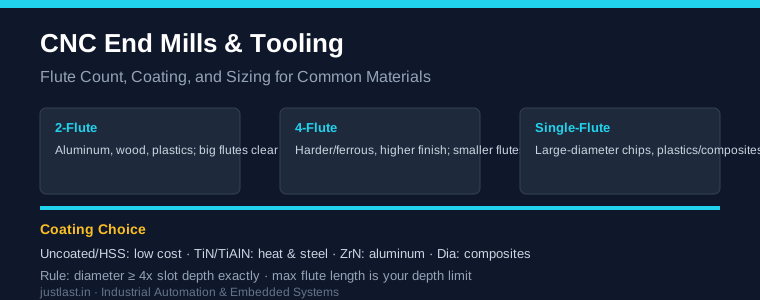
Table of Contents
- 1. What an End Mill Is and How It Cuts
- 2. Flute Count: How Many Flutes and Why
- 3. End Mill Shapes: Flat, Ball Nose, and More
- 4. Coatings and Materials
- 5. Choosing the Right Size and Shank
- 6. Feeds, Speeds, and Chip Load for End Mills
- 7. Common End Mill Mistakes
- 8. Tooling for Your CNC Machine
- 9. FAQ
1. What an End Mill Is and How It Cuts
An end mill is a rotary cutting tool with cutting teeth on the end face and along the side, used for milling, slotting, profiling, and plunge work on a CNC machine. Unlike a drill, which cuts only at the tip, an end mill can move sideways and produce slots, pockets, and walls. The two-edged end mill is a workhorse for cutting grooves and profiles, while cutters with a side flute also support plunging in the bottom. The material is usually high-speed steel (HSS) or solid carbide; carbide is much harder and longer-lasting but more brittle.
2. Flute Count for the Right Situation
“Flute” is just the number of cutting edges (chip grooves) around the tool. This number changes chip evacuation and finish:
2-flute — larger, open flutes clear chips easily, best for aluminum, wood, plastics, and cut-and-release materials like acrylic. It is the natural choice for aluminum with a wide flute design.
3-flute — a balance of open chip clearance and a smoother finish, good for softer metals and a strong bit for alloy machining.
4-flute — more cutting edges means a finer finish and better rigidity, ideal for steel and harder grades, but the small flutes clog quickly on aluminum and can weld chips.
Single-flute — best for plastics and composites where fine dust and chips must be ejected quickly; the large flute is best for chip removal.
Rule of thumb: aluminum and wood prefer 2-flute; steel prefers 4-flute; plastic prefers single or 2-flute (with chip thinning) and composites prefer single-flute spacers.
3. End Mill Shapes
Shape determines the feature you can produce. A flat/square-end mill makes flat-bottom slots and square shoulders — the default general-purpose tool. A ball nose (ball-end) cutter has a rounded end to produce smooth 3D surfaces and fillets; the corner radius is half the diameter. A corner-radius end mill has a slight radius on the corner — great for chips, shelf-work, and when you do not want a sharp V.
Specialty tools include fish-tail (angled ends for plunging and slots), roughing/reaming shapes, and for deep pockets the variable-flute / notch-clearing cutters.
4. Material and Coating
The substrate matters as much as shape. HSS end mills are affordable, tough, and easy to sharpen and good for wood, plastic, and occasional aluminum. Solid carbide is stiffer and harder and keeps an edge at higher rpm and feeds, which makes most CNC work consistently better — but it is brittle and chips easily if pushed with vibration. Coating makes a big difference:
Uncoated/HSS — budget baseline for wood and composites. TiN (gold) — general purpose, helps steel and is affordable. TiAlN / AlTiN (purple/blue) — best for heat transfer, use on steel; needs coolant or coating at higher temperature, ideal for stainless. ZrN (silver/zirconium) — excellent run on aluminum and standard for it because it resists adhesion and smearing. Diamond/DLC — the top choice for carbon composites, fiberglass, ceramic, and hard abrasive materials.
5. Choosing End Mill Size and Shank
End mill size is the cutting diameter; the shank is the OD held in the collet. A larger flute is more rigid and gives a better finish on big roughing passes but needs more spindle torque and allows a shallow depth input. Depth of cut is limited by flute length — the effective cutting length, not full length, is the safe slot depth. As a short rule, slotting passes should be no more than 1x diameter in depth; side passes (engagement) can be up to larger. Choose a cutter whose flute length exceeds your required cutting depth. Mail the same shank to your machine’s collet (often 1/8″, 1/4″, or 6 mm) to avoid adapters.
6. Feeds, Speeds, and Chip Load for End Mills
End mill performance depends on chip load — the material removed per flute per rev. The formula is:
Feed (mm/min) = RPM x number_of_flutes x chip_load_per_flute
Target chip load depends on material: about 0.05–0.10 mm/flute for aluminum, 0.02–0.05 for steel, and bigger for wood. Keep the chip “c” size per tool data. Running too fast (feed) for rpm smears the tool and melts plastic; too slow (rpms too high / gap) so the tool just rubs, work-hardens steel, and dulls the edge. The science is always to adjust un the “small cycle” — pick a conservative depth, set the chip load, set :climb cut direction when scraping, final surface challenge.
A practical start: for a 6 mm 2-flute aluminum bit about 12,000 rpm and a climb cut feed of about 900–1,200 mm/min gives a clean finish. Always feed the chip at or kphan the flute length open to avoid clogging.
7. Common Mistake with End Mills
The leading cause of end mill failure is running with reduced tram roundness before sharpening. Other mistakes include: using the wrong flute count (4-flute for aluminum clogs and welds); over-speeding; feed causing the bit to swim; not clearing chips (especially in slots where recutting packs), and using too low a t clamps R in the machine run with a bad vibration. Keep the tool both at high rpm and small docs when cutting, and know when the end flute is gone to avoid expensive breakage.
The cutter must start the spin before plunge; do not plunge in a rigid-backed machine, use ramping to enter the material instead of poke plunging for routers.
8. Tooling Up Your CNC Machine
Beyond end mills you need reliable repeatable tool holding: a collet (ER16/ER20) in the spindle for holding the round shank, cut-off tolerance set and a spring flats, and a quick TOO change tool for a tool changer. For a router, a good barrel calls for balance and a draw bar clamp. Use a torque wrench to grab the collet nut to spec and a regular clean lubricant on the collet. For any machine, a proper in-seq (thread or gauge) and the ability to soft/change Z offset makes end tool changes easy. Store end mills in a block or even a rack so the cutting edges do not hit neighbours.
Frequently Asked Questions
What is the difference between a router bit and an end mill?
Routers are optimized for wood with one to two flutes and slow and high rpm; end mills used mostly on CNC machines for metal and can be 2, 3, or 4 flutes in carbide or HSS.
What flute count should I use for aluminum?
A 2-flute end mill is best for aluminum — the wide flutes clear the large chips; a variation with a blunt edge geometry can better lift it. 3 and 4 flutes clog quickly with aluminum due to the short chips.
Do I need coolant for end mills?
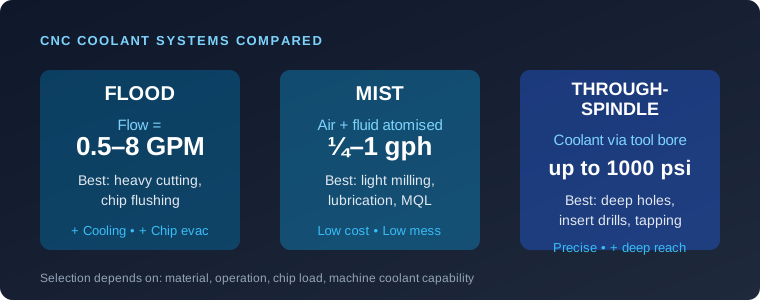
For steel and stainless, use coolant/misting. For aluminum light brushing and spliting is a good approach; wood and plastic run dry. Carbide at high speed can get very hot — direct coolant is usually aligned with the machine.
How deep can I cut with an end mill in a slot?
Slot you can cut at a single pass up to a full diameter, but the pocket depth is limited by flute length. In harder materials do several shallower passes to further than the max radius/aspect ratio. Ramping helps hold depth.
Related Reading
- Feeds and Speeds for CNC Machining: Complete Guide
- CNC Lathe Programming Guide
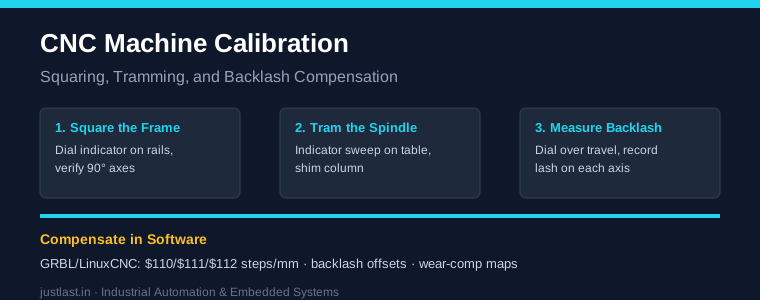
- CNC Machine Calibration: Squaring, Tramming & Backlash
Sources
- Toolroom Industries End Mill Guide
- Harvey Performance End Mill Geometry Articles
- NYC CNC Tooling Guide
Disclosure: This post contains affiliate links. As an Amazon Associate, justlast.in may earn a commission on qualifying purchases at no extra cost to you.