Key Takeaway: Edge computing in manufacturing processes data at the source — on the factory floor — reducing latency from 100–500ms (cloud) to 1–10ms (edge), cutting bandwidth costs by 60–90%, and enabling real-time predictive maintenance, AI-powered quality inspection, and autonomous mobile robot coordination without relying on internet connectivity.
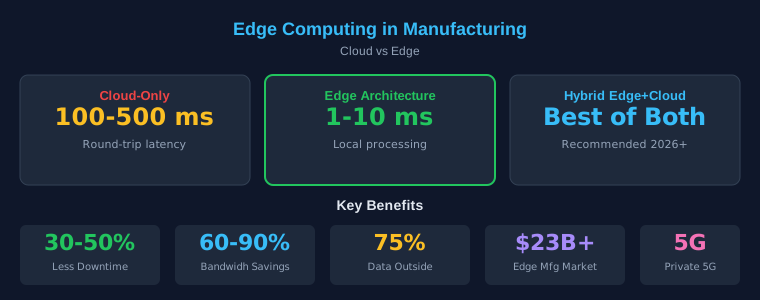
Table of Contents
- 1. Why Edge Computing Matters for Factory Floors
- 2. Core Benefits of Edge Computing
- 3. Edge Computing Architecture: Physical, Edge, and Cloud Layers
- 4. Real-World Use Cases in Manufacturing
- 5. 2026 Trends: AI at the Edge, 5G Convergence, and Orchestration
- 6. Implementation Guide: Hardware and Software Platforms
- 7. Frequently Asked Questions
- 8. Related Reading
- 9. Sources
1. Why Edge Computing Matters for Factory Floors
Traditional cloud-centric architectures send every sensor reading, camera frame, and machine vibration sample to a remote data center for processing. On a modern factory floor generating terabytes of data per day from CNC machines, robotic arms, conveyor sensors, and vision systems, this approach breaks down. Cloud round-trip latency of 100–500ms is unacceptable when a robotic welder needs to adjust its path in 5ms, or a quality inspection camera must reject a defective part before it moves to the next station.
Edge computing in manufacturing flips this model. Instead of sending raw data to the cloud, processing happens on devices physically located on or near the factory floor — industrial PCs, gateway devices, or embedded controllers. Only filtered results, aggregated metrics, and exception alerts travel to the cloud. The factory gets sub-10ms response times for critical control loops, while the cloud handles long-term analytics, model training, and enterprise-level dashboards.
The latency difference is not theoretical. A vibration sensor sampling at 10 kHz generates 40,000 bytes per second per axis. For a 3-axis accelerometer on each of 50 CNC spindles, that is 6 MB/s of raw data. Sending all of it to the cloud is wasteful and slow. An edge device running FFT analysis locally can detect bearing degradation in real time and only transmit the anomaly signature — a few hundred bytes — to the cloud for trend analysis.
2. Core Benefits of Edge Computing in Manufacturing
Predictive Maintenance: 30–50% Less Downtime
Edge-based predictive maintenance monitors vibration, temperature, current draw, and acoustic emissions in real time, detecting anomalies before they become failures. Unlike cloud-based systems that analyze data in batches, edge processing provides continuous, real-time condition monitoring. Studies from McKinsey and Deloitte consistently show that predictive maintenance programs reduce unplanned downtime by 30–50% and extend machine life by 20–40%. When the analysis runs at the edge, detection happens in milliseconds rather than minutes, enabling immediate machine slowdown or shutdown to prevent catastrophic failure.
Bandwidth Savings: 60–90%
By processing raw sensor data locally and transmitting only summaries, alerts, and statistical summaries, edge computing reduces the data that must traverse the factory network and WAN link to the cloud. A typical smart factory with 1,000 sensors generates 5–10 GB/day of raw data. Edge pre-processing reduces this to 0.5–1 GB/day — a 60–90% bandwidth reduction. For factories in regions with expensive or unreliable internet connectivity, this is not a luxury; it is a necessity.
Reliability and Offline Operation
Factory networks are not always reliable. Internet outages, cloud service disruptions, and network congestion are real-world events. Edge computing ensures that critical monitoring and control functions continue operating even when cloud connectivity is lost. An edge device running predictive maintenance algorithms will continue detecting anomalies and triggering alerts locally, storing data for later sync when connectivity is restored.
Data Security and Sovereignty
Sensitive manufacturing data — production rates, quality metrics, machine performance — stays on-premises. Edge computing aligns with data sovereignty requirements and reduces the attack surface. Only anonymized or aggregated data leaves the factory, reducing exposure to man-in-the-middle attacks and cloud-side breaches. For defense contractors, pharmaceutical manufacturers, and companies subject to GDPR or local data regulations, this is a compliance requirement.
Scalability
Edge architecture scales horizontally. Adding a new production line means adding edge devices alongside the new equipment — no need to increase cloud bandwidth or processing capacity proportionally. Each edge node handles its own data processing independently, making the system inherently modular and fault-tolerant.
3. Edge Computing Architecture: Physical, Edge, and Cloud Layers
A practical edge computing deployment in manufacturing follows a three-layer architecture:
Layer 1: Physical (Sensor and Actuator Layer)
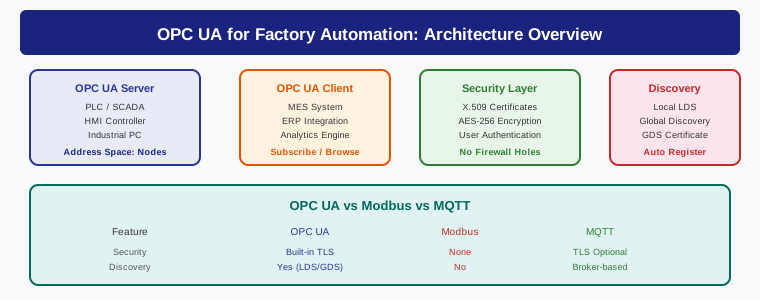
This layer includes all factory-floor devices: vibration sensors, temperature probes, current transformers, machine vision cameras, PLCs, servo drives, and robotic controllers. These devices generate raw data and execute physical commands. Communication protocols at this layer include OPC UA, Modbus TCP, EtherNet/IP, PROFINET, and industrial IO-Link. The key requirement is deterministic, low-latency communication — typically under 1ms for motion control and under 10ms for monitoring.
Layer 2: Edge (Processing and Analytics Layer)
Edge devices sit between the physical layer and the cloud. They receive raw data from sensors, run real-time analytics (FFT, statistical process control, machine learning inference), and make local decisions. Edge hardware ranges from powerful industrial PCs and NVIDIA Jetson modules for AI workloads to compact gateways like Raspberry Pi-class devices for simpler monitoring tasks. The edge layer also handles protocol translation — converting Modbus TCP or EtherNet/IP data to MQTT or OPC UA for cloud transmission.
Layer 3: Cloud (Enterprise and Analytics Layer)
The cloud handles what the edge cannot: long-term trend analysis across multiple factories, training machine learning models on historical data, enterprise dashboards, and integration with ERP and MES systems. The cloud receives pre-processed, filtered data from edge nodes — not raw sensor streams. This separation of concerns keeps each layer focused on what it does best: the edge handles real-time, the cloud handles strategic.
4. Real-World Use Cases in Manufacturing
Predictive Maintenance at the Edge
A CNC machining center with spindle vibration monitoring generates continuous accelerometer data. An edge device running an FFT-based bearing defect detection algorithm analyzes the vibration spectrum in real time. When the characteristic defect frequencies (BPFO, BPFI, BSF) exceed thresholds, the edge device triggers a maintenance alert and logs the event. Only the defect signature and trend data are sent to the cloud — not the raw vibration waveform. This reduces cloud storage requirements by 95% while providing faster fault detection than cloud-only analysis.
AI-Powered Visual Quality Inspection
Machine vision cameras on production lines capture images at rates of 30–120 frames per second. Sending these images to the cloud for AI inference introduces unacceptable latency — a defective part could pass multiple inspection points before the cloud returns a classification. Edge devices equipped with NVIDIA Jetson Orin modules run pre-trained convolutional neural networks (CNNs) locally, achieving inference times of 5–20ms per frame. Defective parts are rejected in real time by triggering pneumatic actuators or diverting conveyor gates. The edge device only uploads the classification result and a thumbnail of defective images for later review.
Autonomous Mobile Robot (AMR) Coordination
AMRs in warehouses and factory floors require sub-10ms coordination for collision avoidance, path planning, and fleet management. Cloud-based coordination is too slow and introduces a single point of failure. Edge computing servers running fleet management software coordinate all AMRs in a zone, processing LiDAR and camera data locally to maintain real-time situational awareness. If the edge server fails, AMRs default to conservative local obstacle avoidance — they slow down and stop rather than colliding.
Process Optimization and Digital Twins
Edge devices feed real-time data into digital twin models running on factory-floor servers. A digital twin of an injection molding machine, for example, uses real-time temperature, pressure, and cycle time data to predict part quality and optimize cycle parameters. The edge processes the physics model in real time; the cloud trains and updates the model parameters periodically using historical production data from multiple machines.
5. 2026 Trends: AI at the Edge, 5G Convergence, and Orchestration
TinyML and AI at the Edge
TinyML — running machine learning models on microcontrollers and edge devices with less than 1 mW of power — is transforming factory sensor nodes. Instead of sending raw data to a central edge server, individual sensor nodes can run anomaly detection models locally using TensorFlow Lite Micro or ONNX Runtime. A vibration sensor with a TinyML model can detect bearing defects on the sensor itself, reducing data transmission to a simple “normal” or “anomaly” flag. In 2026, TinyML-capable MCUs like the STM32N6 and ESP32-S3 are making this practical for cost-sensitive deployments.
5G and Edge Convergence
Private 5G networks in factories combine the low latency of 5G URLLC (Ultra-Reliable Low-Latency Communication, targeting sub-1ms) with edge computing. Multi-access Edge Computing (MEC) platforms from providers like AWS Wavelength and Azure Edge Zones deploy compute resources at the 5G network edge, enabling applications that need both wireless connectivity and local processing. For mobile robots, AR-guided maintenance, and wireless sensor networks, 5G + edge eliminates the cable while maintaining real-time performance.
Edge-Cloud Orchestration
Managing hundreds or thousands of edge devices across multiple factories requires orchestration platforms. Kubernetes-based solutions like K3s (lightweight Kubernetes) and KubeEdge enable cloud-native deployment and management of edge workloads. An AI model trained in the cloud can be automatically deployed to all factory edge devices via the orchestration layer, with A/B testing and rollback capabilities. This bridges the gap between cloud innovation speed and edge deployment requirements.
6. Implementation Guide: Hardware and Software Platforms
Choosing Edge Hardware
| Platform | Use Case | AI Performance | Price Range |
|---|---|---|---|
| NVIDIA Jetson Orin Nano | AI vision, ML inference | 40 TOPS | $250–$500 |
| NVIDIA Jetson Orin NX | Multi-camera AI, complex ML | 100 TOPS | $600–$1,000 |
| Siemens IPC227E | General industrial edge, SCADA | CPU only | $1,500–$3,000 |
| Advantech UNO-2484G | Protocol gateway, data aggregation | CPU only | $800–$1,500 |
| Raspberry Pi 5 + Hailo-8 | Lightweight ML, proof of concept | 13 TOPS (Hailo) | $100–$200 |
Choosing Edge Software Platforms
AWS IoT Greengrass: Extends AWS cloud capabilities to edge devices. Supports local MQTT messaging, Lambda functions at the edge, ML inference using SageMaker models, and over-the-air updates. Best for organizations already invested in AWS. Free tier covers basic usage; pricing scales with connected devices and data processing.
Azure IoT Edge: Deploys cloud workloads — including Azure ML models, Azure Functions, and custom containers — to edge devices. Strong integration with Azure Digital Twins and Azure Sentinel for security monitoring. Particularly strong in manufacturing due to deep OPC UA support and partnerships with Siemens, Rockwell, and ABB. Pricing based on per-device messages.
EdgeX Foundry: An open-source, vendor-neutral edge computing framework under the Linux Foundation. Designed specifically for IoT edge solutions, it provides a microservices-based architecture for device services, application services, and management. Best for organizations that want to avoid vendor lock-in and need maximum flexibility.
K3s + Kubernetes: For teams comfortable with cloud-native tooling, K3s provides a lightweight Kubernetes distribution that runs on edge hardware. Combined with tools like KubeEdge or Akri for device discovery, this approach enables cloud-native deployment patterns (GitOps, canary deployments) at the edge. Steeper learning curve but unmatched flexibility for complex deployments.
Frequently Asked Questions
What is edge computing in manufacturing?
Edge computing in manufacturing means processing sensor data, running analytics, and making control decisions on devices located on or near the factory floor, rather than sending all data to a remote cloud. This provides sub-10ms latency for critical operations, reduces bandwidth requirements by 60–90%, and ensures continuous operation even during internet outages.
How does edge computing reduce manufacturing downtime?
Edge-based predictive maintenance monitors vibration, temperature, current, and acoustic data in real time, detecting anomalies within milliseconds. When an edge device detects a developing fault — such as bearing wear, motor overheating, or tool breakage — it can immediately trigger alerts, slow down the machine, or initiate a controlled shutdown. This prevents catastrophic failures that would cause extended unplanned downtime, reducing downtime by 30–50%.
What hardware is needed for edge computing in a factory?
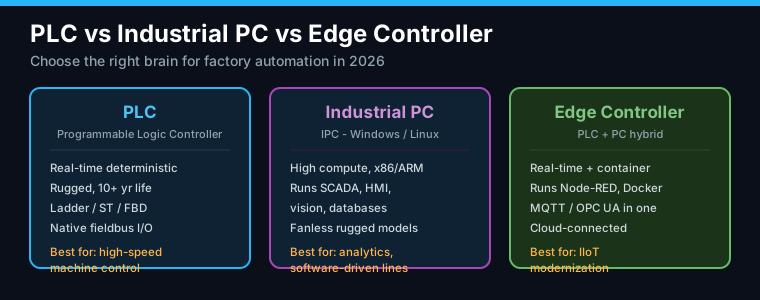
Edge hardware depends on the workload. For AI-powered visual inspection, NVIDIA Jetson Orin modules provide 40–100 TOPS of AI performance. For general data aggregation and protocol translation, industrial PCs from Siemens, Advantech, or Beckhoff are standard choices. For proof-of-concept deployments, a Raspberry Pi 5 with a Hailo-8 AI accelerator offers a low-cost starting point. All edge hardware should be rated for industrial environments (IP20 minimum, extended temperature range).
Can edge computing work with existing PLCs and SCADA systems?
Yes. Edge devices connect to existing PLCs and SCADA systems through standard industrial protocols like OPC UA, Modbus TCP, and EtherNet/IP. Edge gateways can read PLC registers, aggregate data from multiple machines, and bridge the information to MQTT or cloud platforms. This allows factories to add edge computing capabilities incrementally without replacing existing automation infrastructure.
Related Reading
- OPC UA Complete Guide: Industrial Communication Protocol for Smart Factories — The foundational protocol for edge-to-cloud data exchange in manufacturing
- MQTT for Industrial IoT: Complete Guide with ESP32 Examples — The lightweight messaging protocol that pairs with edge computing for factory telemetry
- Industrial ADC Techniques: Precision Analog-to-Digital Conversion with STM32 — Understanding sensor data quality at the source layer
Sources
- McKinsey — Extracting More Value from the Factory Edge
- Deloitte — Industry 4.0 and Predictive Maintenance
- NVIDIA Jetson Edge AI Platform
- Microsoft — Azure IoT Edge Documentation
- AWS — IoT Greengrass Documentation
- Linux Foundation — EdgeX Foundry
Disclosure: This post contains affiliate links. If you purchase hardware or cloud services through these links, we may earn a commission at no additional cost to you. This helps support our content creation.