
Key Takeaway: A PLC delivers deterministic real-time control for high-speed machine logic, an industrial PC (IPC) brings Windows/Linux computing power for analytics and SCADA, and edge controllers combine both – the right choice for factory automation depends on scan time, environment, software and connectivity needs.
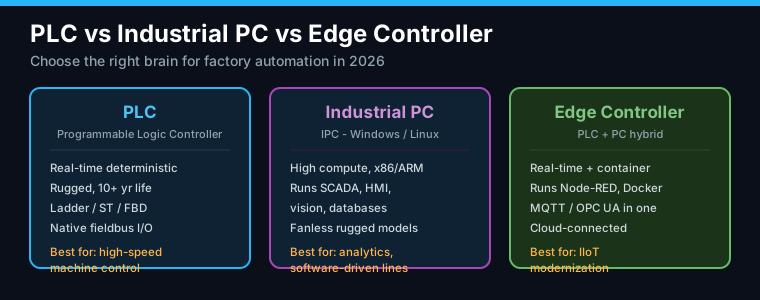
Table of Contents
- 1. Why the Controller Choice Matters
- 2. What Is a PLC and What Is It Best At
- 3. What Is an Industrial PC (IPC) and What Is It Best At
- 4. Edge Controllers: The Hybrid Middle Ground
- 5. PLC vs Industrial PC vs Edge Controller: Head-to-Head
- 6. Selection Framework for Factory Automation
- 7. Real-World Configuration Examples
- 8. FAQ
- 9. Related Reading
- 10. Sources
1. Why the Controller Choice Matters
The controller is the brain of every automated machine and production line. It reads sensor inputs, runs the control logic, and drives actuators, motors and valves. Get the architecture right and the machine is reliable, maintainable and easy to extend. Get it wrong and you end up with a controller that cannot meet scan-time targets, an operating system that crashes on the factory floor, or a platform your team cannot program.
The plc vs industrial pc question is one of the first architecture decisions in any automation project, and in 2026 the answer is no longer either/or. A third option – the edge controller – has matured into a genuine middle ground. This guide compares all three on the criteria that actually matter: determinism, ruggedness, software ecosystem, I/O connectivity, lifecycle and total cost.
2. What Is a PLC and What Is It Best At
A programmable logic controller (PLC) is a rugged industrial computer designed for one job: executing control logic in a deterministic, repeatable scan cycle. Programs are written in IEC 61131-3 languages – ladder logic, structured text, function block and sequential function chart – and the hardware is built to survive heat, vibration, electrical noise and years of continuous operation.
PLCs shine wherever timing is critical. A packaging line, a servo axis, a stamping press or a burner management system needs guaranteed response within a fixed scan time – typically 1-20 milliseconds – and a PLC delivers that deterministically. Modern PLCs also include native fieldbus support for PROFINET, EtherCAT, Modbus TCP or EtherNet/IP, so wiring hundreds of I/O points is straightforward.
Their weakness is compute. A typical PLC has limited memory, a proprietary OS and no general-purpose software ecosystem. Running a database, a vision algorithm or a Python script directly on a PLC is impractical or impossible. That is where an industrial PC comes in.
3. What Is an Industrial PC (IPC) and What Is It Best At
An industrial PC is a computer built into a rugged, fanless, panel-mount or rack-mount enclosure, running a mainstream OS – Windows 10/11 IoT, Linux or sometimes an embedded real-time variant. Because it uses the same CPUs, GPUs and storage as a desktop computer, it can run almost any software: SCADA packages, HMIs, databases, vision systems, edge analytics and even machine learning inference.
IPCs are the natural home for software-driven automation. If your line needs to run a historian database, host a Node-RED data flow, process camera images or communicate with an MES/ERP system, an IPC does it without the constraints of a PLC. They also excel at IIoT duty – an IPC is often the gateway that aggregates PLC data and publishes it to MQTT, as shown in our Modbus to MQTT gateway build.
What IPCs are not, by default, is deterministic. A general-purpose OS can be delayed by driver hiccups, antivirus scans or Windows updates. You can add real-time extensions, but this raises cost and complexity. IPCs also typically have less native industrial I/O – you usually pair them with remote I/O racks or a PLC rather than wire field devices directly.
4. Edge Controllers: The Hybrid Middle Ground
Edge controllers are the fastest-growing category in factory automation. They package a PLC-style real-time core with an open computing environment – usually Linux with Docker containers – in a single DIN-rail unit. One device runs your ladder logic at millisecond scan times and simultaneously hosts Node-RED, Python scripts, MQTT brokers and OPC UA servers.
This convergence matters for modernisation. Instead of buying a PLC for control and a separate IPC for connectivity, an edge controller does both. It connects natively to cloud platforms, supports over-the-air updates, and lets you add analytics capability without changing the control hardware. Products in this space span from industrial Raspberry Pi gateways to established vendors’ unified controllers.
The trade-offs are ecosystem maturity and engineering familiarity. Edge controllers are newer, so fewer technicians are trained on them, and the real-time core often has a smaller I/O capacity than a dedicated mid-range PLC. For very large or very fast machines, a full PLC remains the safer choice.
5. PLC vs Industrial PC vs Edge Controller: Head-to-Head
Here is the comparison on the criteria that drive purchasing decisions:
Determinism / scan time: PLC wins – guaranteed 1-20 ms cycles. Edge controller: good for most machines but real-time core is more limited. IPC: not deterministic without real-time extensions.
Programming languages: PLC uses IEC 61131-3 (ladder, ST, FBD). IPC uses Python, C#, C++, Node-RED. Edge controller supports both.
Software flexibility: IPC wins – full Windows/Linux ecosystem. Edge controller: strong container ecosystem. PLC: proprietary and limited.
Industrial I/O: PLC wins with native fieldbus and modular I/O. Edge controller: moderate. IPC: requires remote I/O.
Environment and lifecycle: PLC and IPC both rugged with 10-15 year availability. Edge controller depends on vendor.
Connectivity to cloud: Edge controller and IPC lead; PLC needs a gateway.
Total cost: PLCs are affordable for control-only; IPCs and edge controllers add cost but remove the need for separate gateway hardware.
6. Selection Framework for Factory Automation
Use this decision path to pick the right controller for a project:
If the machine is a high-speed, hard-real-time application – servo synchronization, safety interlocks, cam profiling – choose a PLC. The deterministic scan is non-negotiable. For servo sizing and tuning on such machines, our stepper vs servo selection guide and the PID motor control guide are useful companions.
If the task is mostly software – SCADA, data collection, vision, analytics, MES integration – choose an industrial PC. Pair it with remote I/O or a small PLC for the field devices.
If you need both control and connectivity on one device, or you are retrofitting an older machine with IIoT capability, choose an edge controller. It is the lowest-complexity path to a smart factory.
If your plant already standardises on one platform, favour that vendor’s offering. Standardisation across machines cuts spares, training and maintenance more than any single feature advantage.
Whichever you choose, keep the data architecture in mind. The OPC UA vs MQTT protocol guide and the remote monitoring architecture guide will help you connect the controller to the rest of the plant.
7. Real-World Configuration Examples
Small machine cell (3-5 stations): A mid-range PLC with Modbus TCP to a compact IPC running the HMI/SCADA and an MQTT bridge to the cloud. Reliable, cheap, easy to maintain.
IIoT retrofit of legacy machines: An edge controller (or industrial Raspberry Pi gateway) taps the existing PLC registers over Modbus RTU and publishes to MQTT. No change to the control logic. Our edge gateway deployment guide covers this pattern.
Data-heavy process line: An IPC runs a historian, an OPC UA server and analytics; a safety-rated PLC handles the interlocking. This split gives determinism where needed and computing where needed.
Frequently Asked Questions
Is an industrial PC a replacement for a PLC?
Not in hard real-time applications. The plc vs industrial pc trade-off is determinism versus computing power. For high-speed machine logic, keep a PLC; use an IPC for SCADA, analytics and connectivity.
Can a PLC run Windows or Linux?
Traditional PLCs run proprietary real-time operating systems, not general-purpose OSes. Some vendors now offer controllers with Linux-based environments, which is essentially the edge controller category.
What is the difference between a PLC and an edge controller?
An edge controller combines a PLC-style real-time core with an open Linux/container environment in one unit, so it can run control logic and IIoT software (Node-RED, MQTT, Docker) without a separate gateway computer.
Which is cheaper, a PLC or an industrial PC?
For control-only duty a PLC is usually cheaper. Once you add a separate IPC for HMI/SCADA and a gateway for connectivity, an edge controller or PLC-plus-IPC combination costs more upfront but consolidates hardware.
Do I need a PLC for a small automation project?
For a handful of I/O points, microcontrollers or compact PLCs are viable. As soon as you need reliability, standardised programming and industrial I/O, a compact PLC is the pragmatic choice.
Related Reading
- OPC UA vs MQTT: Choosing the Right Industrial IoT Protocol
- Edge Computing in Industrial Automation
- ESP32 Industrial IoT Gateway: Modbus to MQTT Bridge
- Industrial Edge Computing with Raspberry Pi
- Stepper vs Servo Motors for CNC
Sources
- PLCopen: IEC 61131-3 Standard
- OnLogic: Industrial PC vs PLC
- Control Engineering: Controllers and Industrial PCs
- ISA: International Society of Automation
- AutomationDirect: PLC Selection Resources
Disclosure: This post may contain affiliate links. If you purchase through these links, we may earn a commission at no extra cost to you. Recommendations are based on engineering merit, not affiliate revenue.