Key Takeaway: Ball screws and lead screws move the axes of CNC machines, but they are not interchangeable — a ball screw converts rotary motion to linear motion through recirculating steel balls at roughly 90 percent efficiency with minimal backlash, while a lead screw relies on a sliding nut contact at just 20 to 40 percent efficiency with measurable backlash. The right choice for a build comes down to how much precision, speed and durability your machine actually needs.
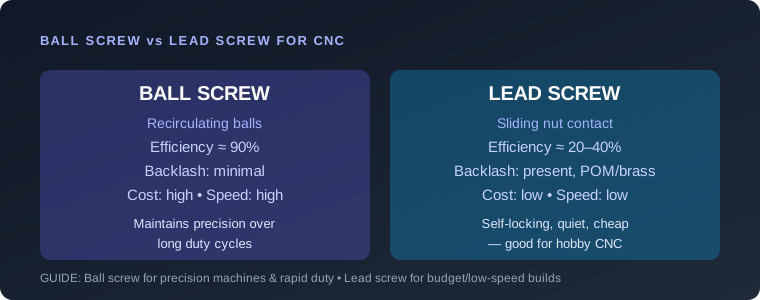
Table of Contents
- 1. The Basics: What Each Screw Does
- 2. How They Differ Mechanically
- 3. Accuracy, Backlash and Repeatability
- 4. Efficiency, Speed and Load Handling
- 5. Cost, Lifetime and Maintenance
- 6. When to Choose Ball Screws vs Lead Screws
- 7. FAQ
1. The Basics: What Each Screw Does
Every CNC machine translates rotary motion from a motor or stepper into linear motion along an axis, and the component that does this translation is usually either a ball screw or a lead screw. On a desktop 3D printer or a hobby router you will almost always find a lead screw, while commercial machining centers moved by servos rely on ball screws. Understanding the mechanical difference between the two explains why.
2. How They Differ Mechanically
A lead screw is the original, simplest design: a threaded shaft, typically Acme or trapezoidal thread, and a directly threaded nut that rides on the thread flanks. The contact is sliding, metal-on-metal (or metal-on-plastic for POM nuts), which creates friction but also makes the assembly cheap and inherently self-locking — meaning it holds position when unpowered.
A ball screw replaces that sliding contact with recirculating steel balls carried between the screw shaft and the nut. Instead of sliding, the nut rolls over the balls, so the motion is low-friction rolling contact. Ball screws can be assembled with a preload that squeezes the balls against both sides of the thread, eliminating almost all looseness or backlash between the nut and shaft.
3. Accuracy, Backlash and Repeatability
Backlash is the slop between the nut and the screw — the small amount of travel lost when you reverse direction. On a lead screw it comes from the clearance needed between the thread and nut, and it accumulates over the lifetime of the part as the threads wear. This shows up as positional error when the axis changes direction, which is exactly what hurts machined features and part finish.
Ball screws, especially preloaded ones, effectively eliminate backlash because the balls are forced into constant contact from both sides. That is why ball screws are the default for machines that reverse direction constantly and need repeatable, accurate positioning. There are anti-backlash lead screw nuts (split nuts with a spring) that reduce — but rarely eliminate — lead screw backlash, and they help a lot on budget builds that cannot justify the price of a ball screw.
4. Efficiency, Speed and Load Handling
The single biggest practical difference is efficiency. A rolling ball screw converts about 90 percent of the motor input into linear thrust, so it wastes little energy and can run at high speeds and rapid moves without overheating. A lead screw converts only about 20 to 40 percent of input into thrust, because most of it is lost to sliding friction. That makes lead screws less efficient and slower, and it generates heat that limits duty cycle.
That efficiency gap directly affects load and speed capability. Stepper-driven machines move slowly and at lower torque anyway, so a lead screw is often sufficient — especially where its self-locking property is an advantage. Servo-driven industrial axes run fast, reverse often and push heavy loads, which is precisely where ball screws shine. A lead screw that works great on a light printer axis would simply not survive frequent high-speed production moves on a mill.
5. Cost, Lifetime and Maintenance
Cost is the deciding factor for most hobby builders. A good lead screw with an anti-backlash nut costs a fraction of a comparable ball screw and its nut. Ball screws also need more careful installation — the ends usually need machining, the screw must be aligned, and a preloaded nut is more sensitive to misalignment and contamination.
Lifetime and contamination matter more than new builders expect. Ball screws are precision components: chips and grit shorten their life dramatically, so they usually run under protective covers or with wipers. Lead screws with plastic nuts can sometimes be run dry or wear cheaply, which makes them forgiving and low-cost to maintain. A well-maintained ball screw holds its accuracy for years; a worn lead screw needs its nut or the screw replaced but costs little to refresh.
6. When to Choose Ball Screws vs Lead Screws
As a rule of thumb, choose a ball screw when you need accuracy under load, frequent reversal and higher speed — that is, essentially any machine expected to cut metal or run production, or any axis moved by a servomotor. Choose a lead screw when the build is budget-limited, slow, light, or benefits from self-locking — common on 3D printers, hobby routers and engraving machines, and Z axes that need to hold position when powered down.
For a hobby CNC that will cut wood, plastic or light aluminum at modest speeds, a quality lead screw with an anti-backlash nut is often the smart spend. If you are planning a machine for consistent metal cutting, production accuracy or high rapids, budget for ball screws instead — the extra cost pays back in finish, repeatability and durability. Either way, brace and align the screw properly and protect it from chips, because even the best ballscrew fails early when it is dirty or misaligned.
Frequently Asked Questions
Are ball screws always better than lead screws?
No. Ball screws have higher efficiency, less backlash and longer high-speed life, but they cost more and are less forgiving of misalignment. For light, slow hobby builds a lead screw is often the better value.
What is the efficiency difference between a ball screw and a lead screw?
A ball screw converts roughly 90 percent of input to thrust, while a lead screw converts only about 20 to 40 percent, with the rest lost to sliding friction.
Can I use a lead screw instead of a ball screw on a CNC mill?
You can, on a light hobby mill run slowly. For cutting metal at production speeds and rapids, a ball screw’s higher efficiency and lower backlash are strongly recommended.
Why are ball screws self-locking on some builds?
Lead screws can be self-locking, holding position when unpowered. Ball screws generally are not self-locking, which is why driven axes may need brakes or servos with holding torque.
How do I eliminate backlash in a lead screw?
Use an anti-backlash (split) nut with a spring that takes up the slack, and keep the screw clean and lightly lubricated to slow wear.
Related Reading
- Multi-Axis Stepper and Servo Motor Controller Design
- CNC Toolpath Strategies: Conventional vs Climb Milling
- VFD for CNC Spindle Motors
Sources
- Thomson Linear — Ball Screw Fundamentals
- NSK — Precision Ball Screw Catalog and Selection
- Servo2Go — Ball Screw vs Lead Screw Guide
Disclosure: This post contains affiliate links. If you buy through a link, we may earn a small commission at no extra cost to you. This helps keep justLast.in free for readers.